
Physics: Why White Light Splits into Colours
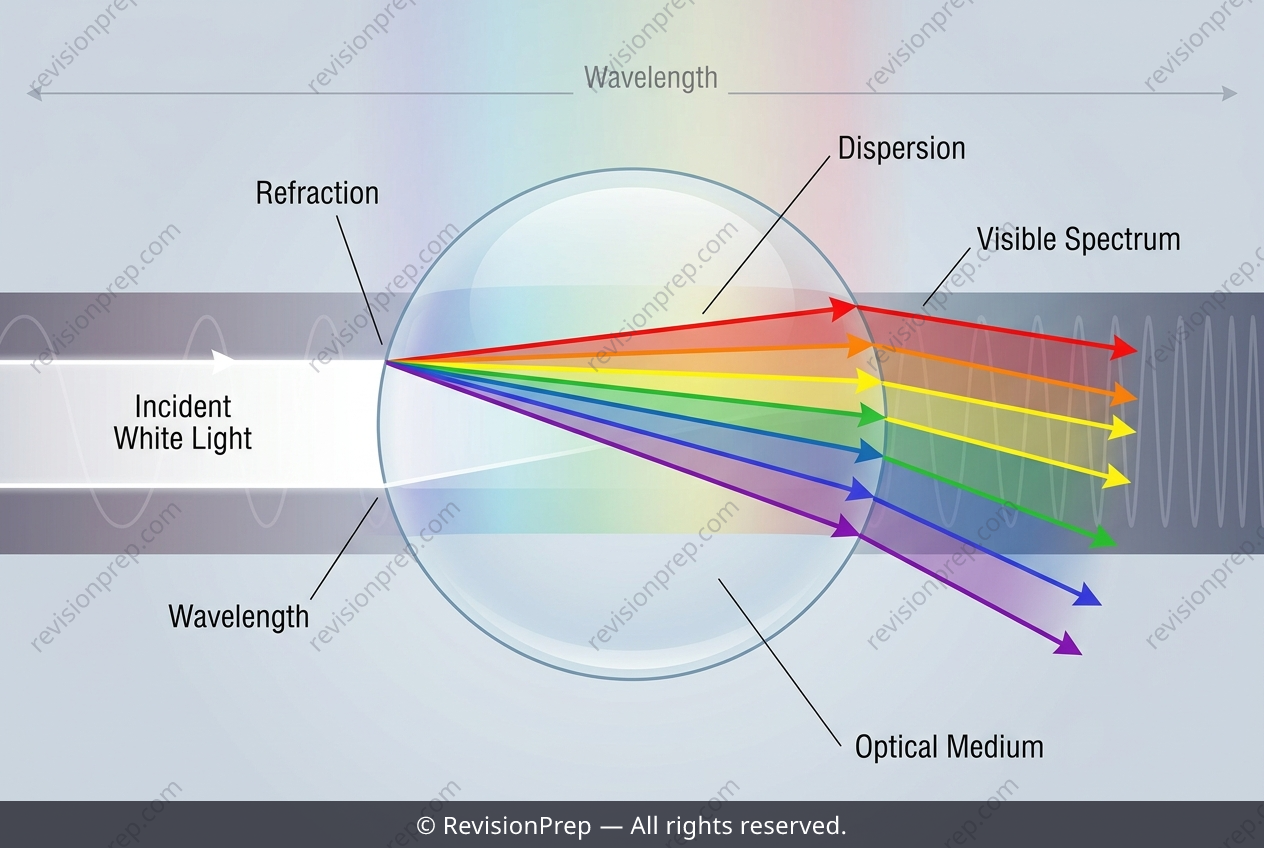
When sunlight hits a puddle, the shimmering colours you see are not magic—they are physics in action. This phenomenon is known as dispersion, the process by which white light is separated into its component colours. Water acts like a tiny prism, bending each wavelength of light by a slightly different amount, so the mixture of colours that makes up “white” light fans out into a visible spectrum—from red to violet. This splitting of light is far more than a pretty sight; it is a fundamental tool for understanding the world. Rainbows, for instance, are nature’s own dispersion event, revealing that sunshine and rain coexist—a clue used in weather prediction. Beyond that, dispersion powers everyday and scientific instruments: prisms in cameras and telescopes separate light to sharpen images, and astronomers analyse starlight by observing how it splits to learn what distant stars are made of. The key relationship here is that each colour corresponds to a specific wavelength and frequency, linked by the wave equation v = fλ. When light enters a denser medium like water, its speed changes, but its frequency stays constant—so the wavelength shifts, and the colours separate. Understanding dispersion means seeing how a single beam of light can unlock hidden information about the world around us.
Start practising IB questions today
150,000+ IB-styled questions, criteria-mapped and instantly accessible.