
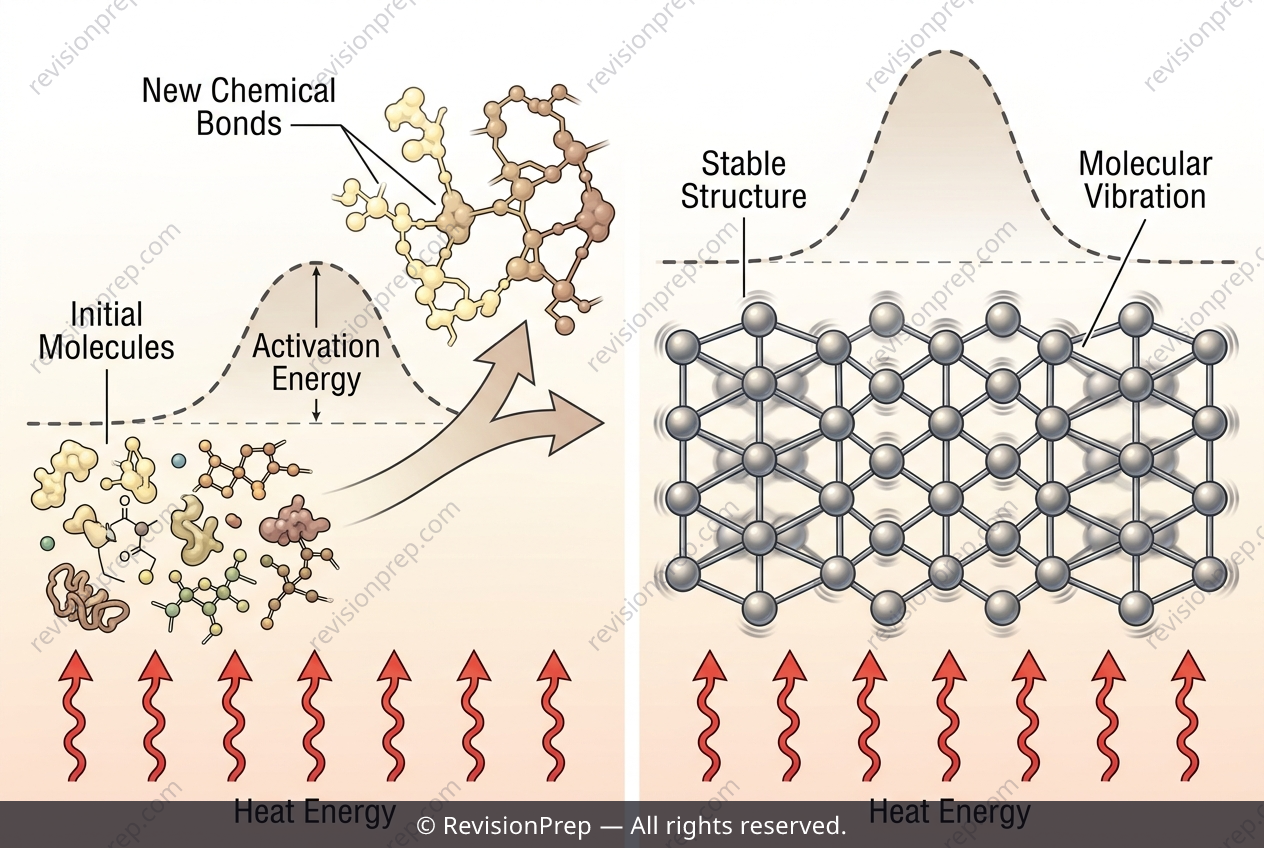
Chemistry: Batter vs Spoon — Activation Energy
Chemical reactivity is the driving force behind the transformations we observe in everyday materials, from baking a cake to leaving a spoon in a hot oven. At its heart, a chemical change involves the breaking and forming of bonds, which requires a minimum energy input known as the activation energy (Ea). When heat is supplied, molecules gain kinetic energy, and if that energy exceeds Ea, collisions can lead to new substances with different properties—like a batter turning brown and solid. The key distinction lies in the intrinsic stability of the reactants. Cake batter contains carbohydrates, proteins, and sugars that are energetically poised to rearrange into new compounds (e.g., Maillard reactions and caramelisation), releasing or absorbing energy as bonds reform. A metal spoon, however, is composed of metallic bonds that are highly stable at typical oven temperatures; its atoms simply vibrate faster (a physical temperature rise) without reaching the activation threshold for any chemical transformation. Thus, reactivity is not just about heat—it is about whether the material’s molecular structure can overcome its own activation barrier to form new, stable products.
Start practising IB questions today
150,000+ IB-styled questions, criteria-mapped and instantly accessible.