
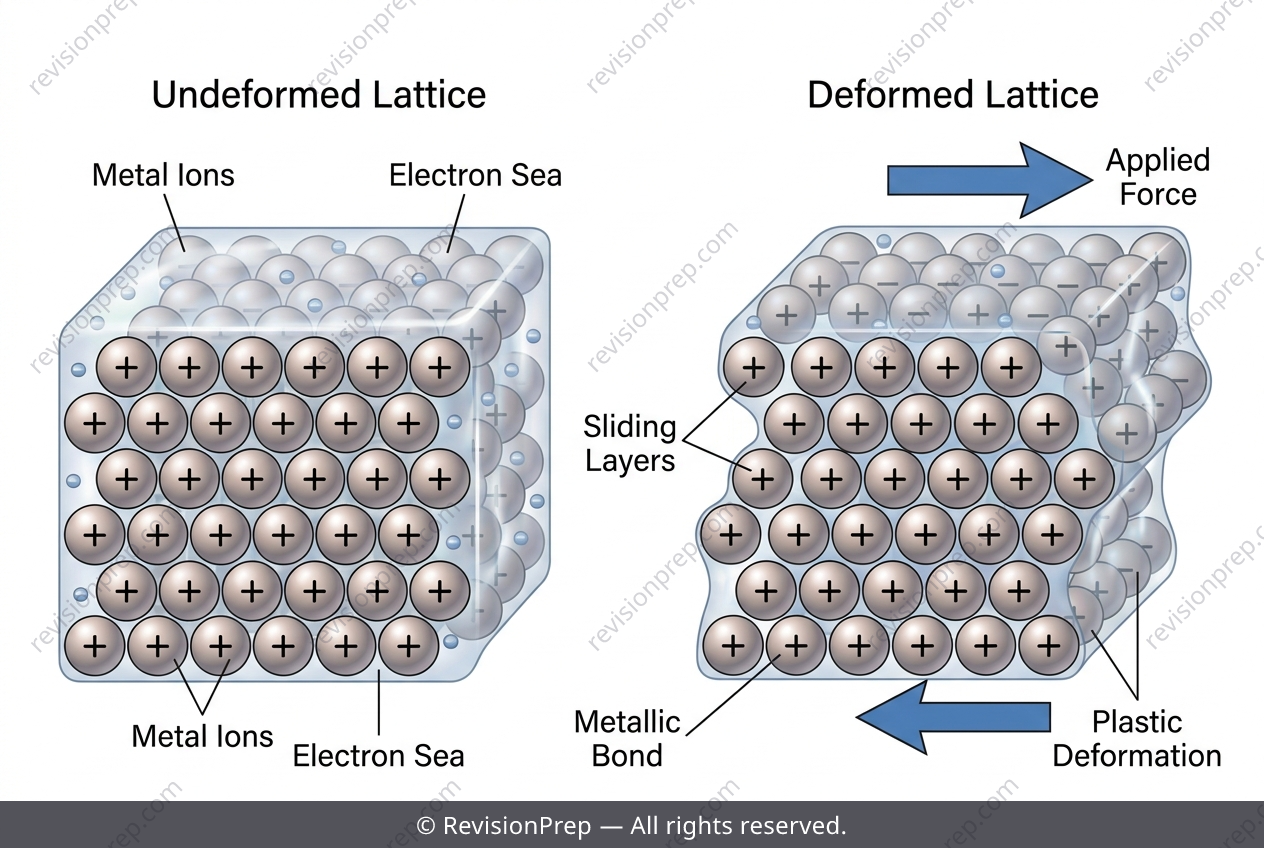
Chemistry: Metallic Bonding Explains Why Metals Bend
Metals are defined by their ability to change shape under force without shattering—a behaviour rooted in the metallic bond. In this bond, positively charged ions are arranged in a lattice, surrounded by a “sea” of delocalised electrons that move freely. This electron cloud acts as a glue, holding ions together while allowing them to slide past one another when stress is applied. The result is plasticity: the capacity for permanent deformation without fracture. This concept matters because it explains why we can bend copper wires into circuits, hammer iron into tools, or roll aluminium into foil. In the classic test, a copper wire bends into a curve—demonstrating ductility, the ability to be drawn or shaped under tension—while an iron nail flattens under a hammer, showing malleability, the ability to deform under compression. Both observations share a common mechanism: the layers of ions shift, and the electron sea re-forms around the new positions, preserving metallic bonding. Neither metal cracks because the bond is non-directional and resilient. Understanding this link between structure and response to force is central to predicting how metals behave in engineering and manufacturing.
Start practising IB questions today
150,000+ IB-styled questions, criteria-mapped and instantly accessible.