
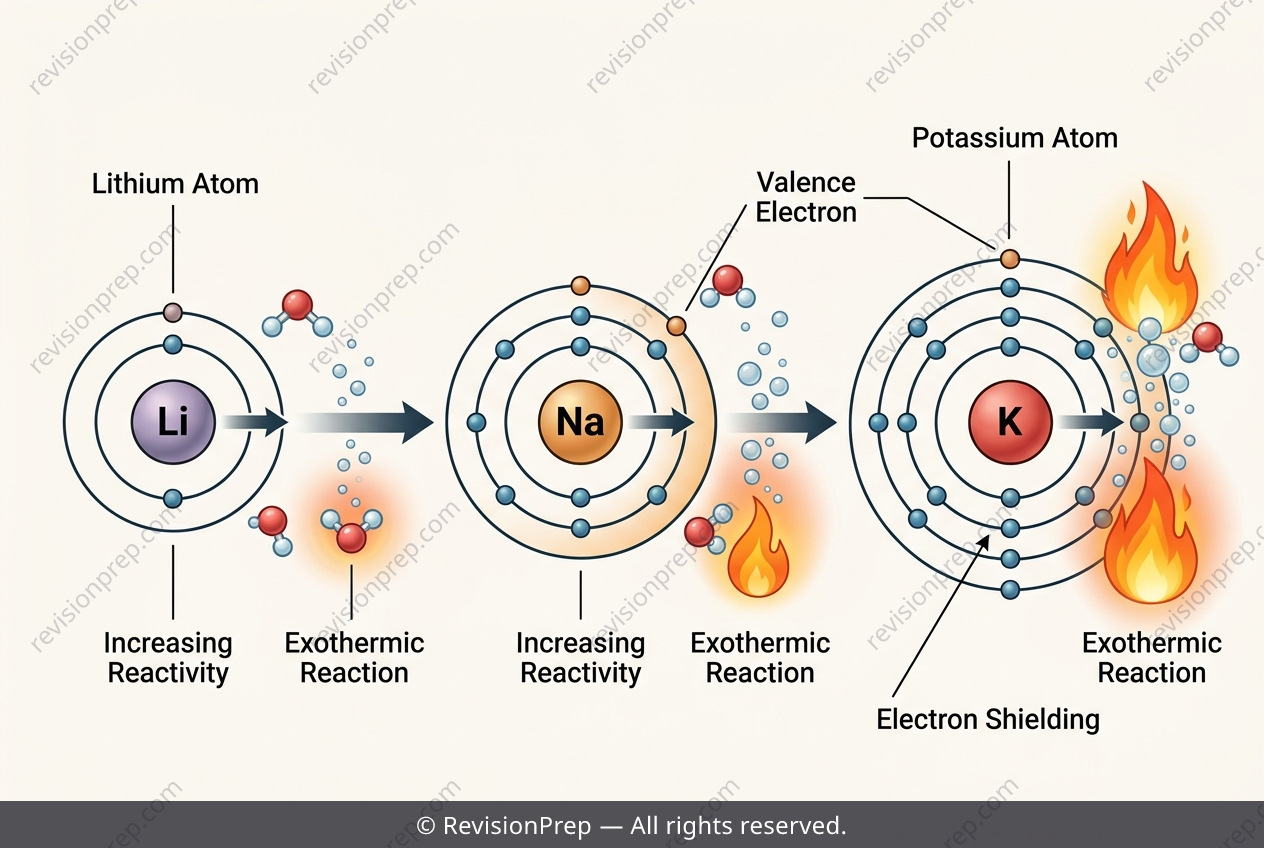
Chemistry: Reactivity Rises Down Group 1
The periodic table is more than a list of elements—it is a map of behaviour. At its heart lies the concept of periodic trends: the predictable patterns in properties that emerge as you move across a period or down a group. For Group 1, the alkali metals, the defining feature is a single outer (valence) electron. This electron is held loosely, so it is lost easily, which is why every alkali metal reacts with water in the same fundamental way: releasing heat and hydrogen gas. This shared mechanism explains both the power and the peril of these reactions. The rapid release of heat makes the reaction a potential source of emergency warmth, but the hydrogen gas produced is flammable, creating an explosion risk. The trend down the group—from lithium at the top to potassium further down—shows how reactivity increases with atomic size, as the outer electron becomes even easier to lose. Lithium reacts gently and controllably, while potassium reacts violently. Understanding these connections between electron configuration, position, and reactivity allows you to predict not just what happens, but how safely it can be harnessed.
Start practising IB questions today
150,000+ IB-styled questions, criteria-mapped and instantly accessible.