
Chemistry: The Hidden Risk in a Golden Crust
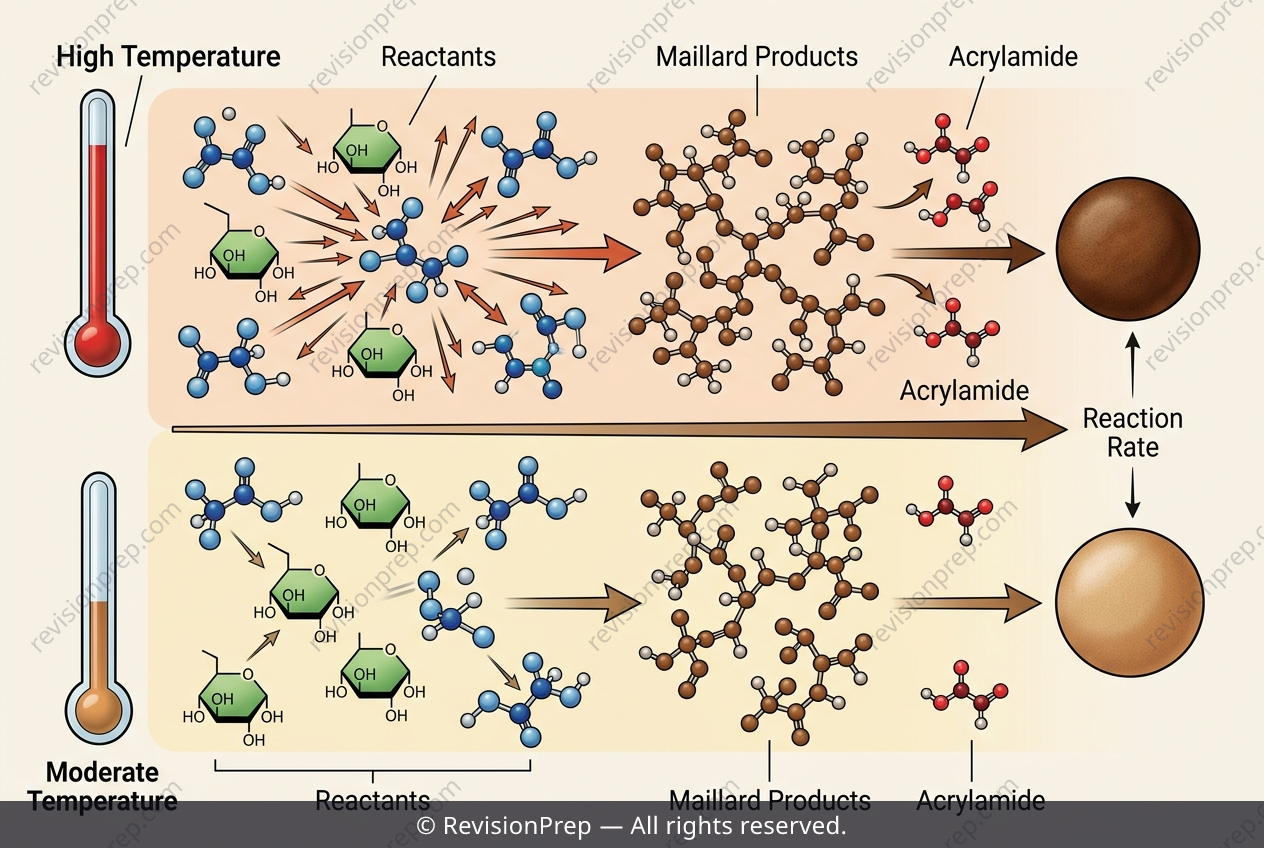
The Maillard reaction is a cornerstone of food chemistry, transforming raw dough into golden, flavourful bread. At its heart, this is a study of chemical reaction kinetics—specifically, how temperature dictates the speed at which amino acids and sugars interact. When you slide bread into a hot oven, the surface heats rapidly, providing the activation energy needed for these molecules to collide and react, producing the characteristic brown crust and complex aromas we associate with freshly baked bread. This everyday process beautifully illustrates a fundamental principle: reaction rate depends on molecular energy and collision frequency. As the oven temperature rises, the reactant molecules gain kinetic energy, moving faster and colliding more often, which accelerates the Maillard reaction. However, this relationship has a trade-off. Pushing the temperature above 180°C speeds up browning but also triggers an unwanted side reaction that forms acrylamide, a potentially harmful compound. Understanding this balance—between the energy needed for a desirable reaction and the risk of generating undesirable by-products—is essential for mastering both baking and broader chemical processes.
Start practising IB questions today
150,000+ IB-styled questions, criteria-mapped and instantly accessible.