
Chemistry: What Every Reaction Leaves Behind
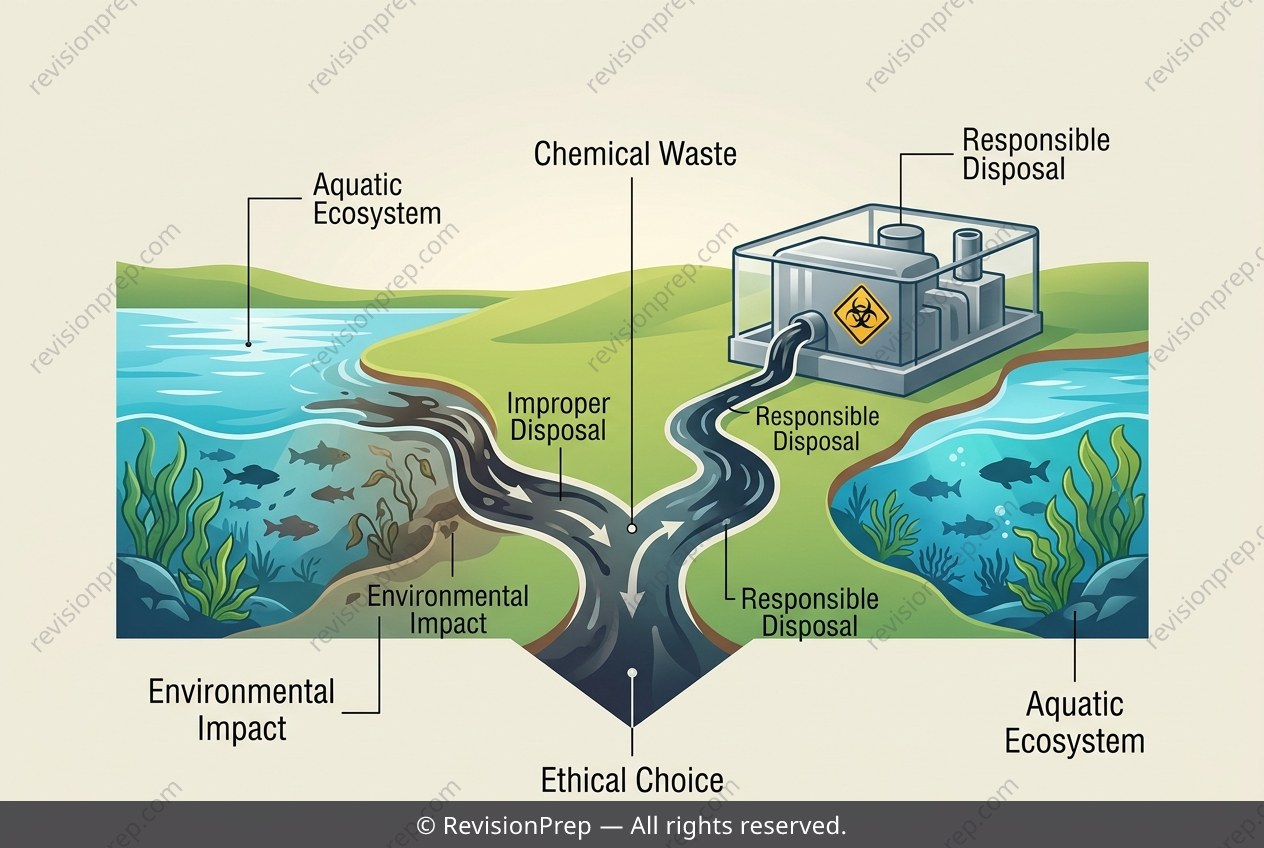
Chemical reactions are often taught as tidy equations—reactants in, products out—but in the real world, every reaction leaves behind something. When iron nails are placed in a blue copper sulfate solution, a single displacement reaction occurs: iron displaces copper, forming solid copper metal and a new solution of iron sulfate. The equation Fe + CuSO₄ → FeSO₄ + Cu captures the visible change, but it hides a less visible problem: the leftover copper sulfate, if poured down a sink, becomes a pollutant. This is where environmental and ethical stewardship enters chemistry—not as an afterthought, but as a core part of designing any experiment. The issue is not just that copper sulfate is toxic to aquatic life; it’s that the reaction’s byproducts and leftovers carry their own hazards. Switching to zinc granules, for example, makes the reaction more vigorous and leaves less unreacted copper sulfate, but it produces zinc sulfate—also toxic to aquatic organisms. The disposal problem doesn’t disappear; it merely changes chemical identity. This highlights a key relationship: every reaction has a waste stream, and that waste stream must be managed with the same care as the reaction itself. Collecting waste for hazardous disposal, rather than releasing it into waterways, reflects the ethical responsibility of scientists to protect ecosystems—a principle that applies far beyond the lab bench.
Start practising IB questions today
150,000+ IB-styled questions, criteria-mapped and instantly accessible.