
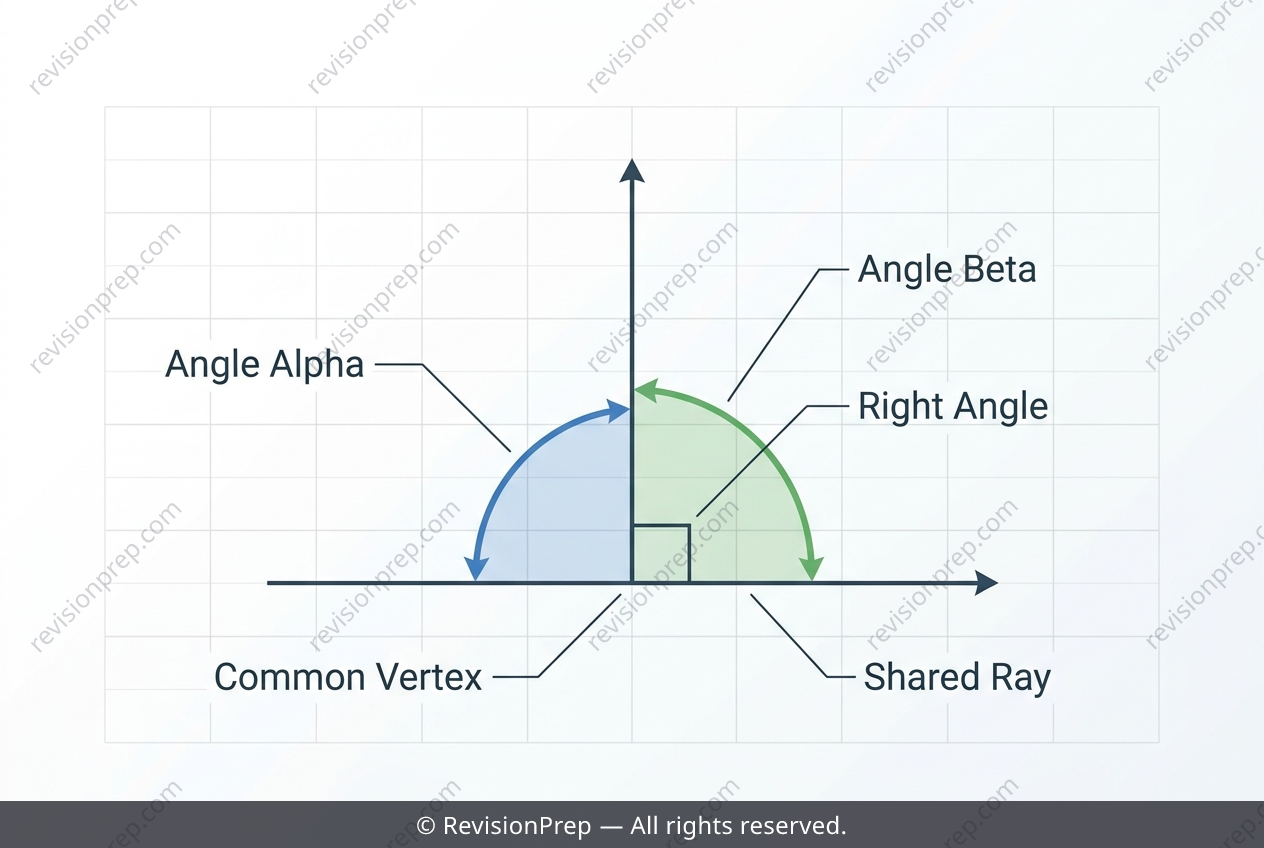
Maths: Complementary Angles and the 90° Rule
When two angles meet at a shared vertex, their relationship often hinges on a single, elegant condition: whether their measures sum to a right angle. This is the heart of complementary angles, a foundational concept in geometry that bridges simple arithmetic with spatial reasoning. In this topic, we explore how the Angle Addition Postulate allows us to combine adjacent angles, and how recognising complementary pairs unlocks a deeper understanding of shapes, proofs, and real-world applications like construction or navigation. The key mechanism is straightforward: if the sum of two angle measures equals 90°, they are complementary. Mathematically, this is written as ∠A + ∠B = 90°. The notation matters—using ∠A and ∠B precisely links the visual diagram to the algebraic relationship. This connection is not just about memorising a term; it’s about justifying why two angles belong together. For instance, when given individual measures, you calculate their sum, and if that sum hits 90°, you’ve identified a complementary pair. This simple rule forms a building block for more complex angle problems, where splitting a right angle into parts or verifying perpendicularity becomes second nature. Understanding this property early prepares you for the logical rigour expected in IB Mathematics.
Start practising IB questions today
150,000+ IB-styled questions, criteria-mapped and instantly accessible.