
Maths: From Equal Sides to Equal Angles
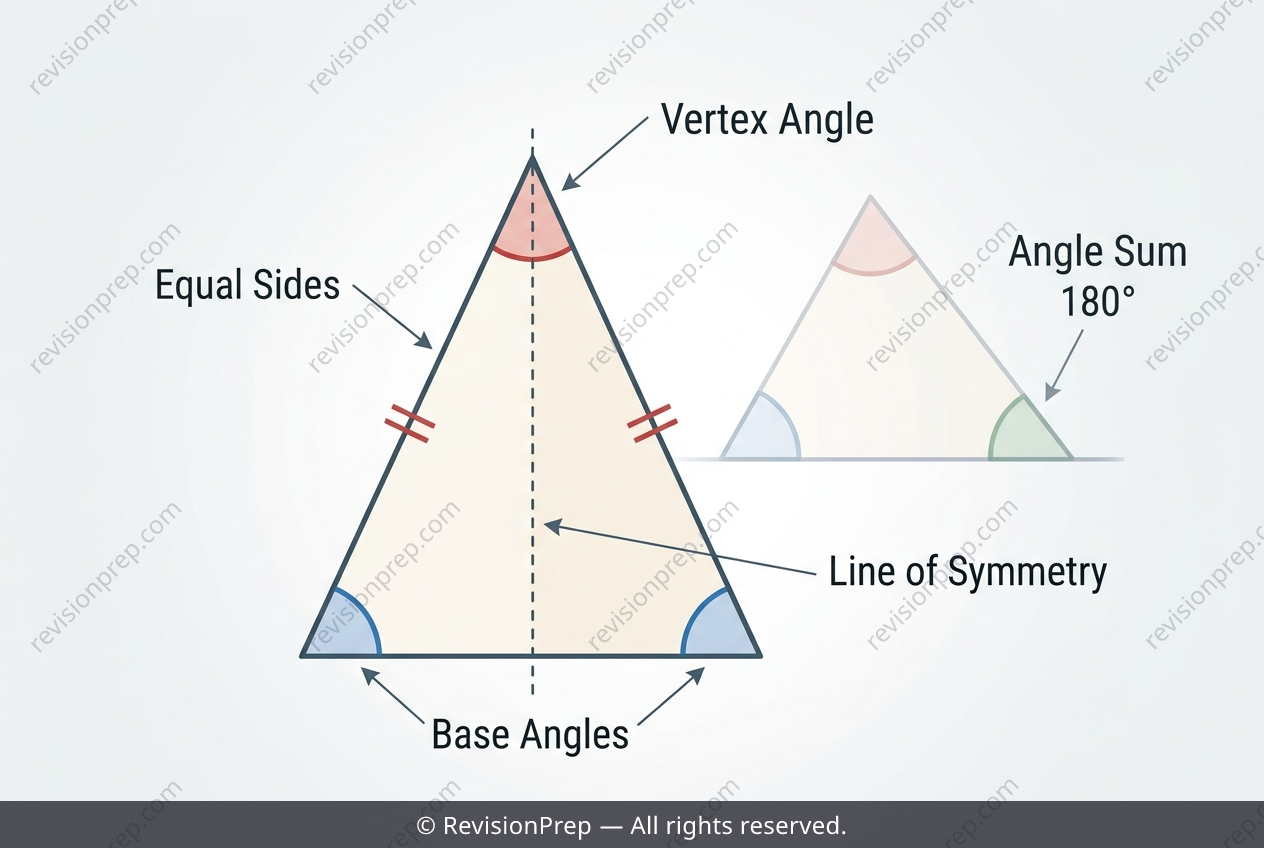
Isosceles triangles are the quiet workhorses of geometry, hiding a simple but powerful secret: the base angles—the two angles opposite the equal sides—are always equal. This relationship, known as the Isosceles Triangle Theorem (or Base Angles Theorem), turns a single known angle into a gateway for unlocking the entire triangle’s shape. When you see a triangle with two equal sides, you instantly know that its two base angles share the same measure, creating a symmetry that simplifies everything from proofs to real-world design. This equality is not an isolated fact; it plugs directly into the Angle Sum Property of Triangles, which states that the three interior angles always add up to 180°. Together, these two ideas form a tight logical chain: if you know the vertex angle (the angle where the equal sides meet), you can subtract it from 180°, then split the remainder equally between the two base angles. The notation matters too—writing ∠B = ∠C is the precise, compact way to express that equality, and it is this notation that bridges the visual diagram to the algebraic calculation. Understanding how these parts connect—equal sides, equal base angles, and the fixed sum of 180°—gives you a reliable toolkit for solving any isosceles triangle problem, no matter how the diagram is drawn.
Start practising IB questions today
150,000+ IB-styled questions, criteria-mapped and instantly accessible.