
Ratio, Proportion & Percentages
The MYP 2 rules for spotting direct vs inverse proportion and mastering every type of percentage question
Quick facts
Every ratio, proportion and percentage question in IB MYP 2 asks the same underlying thing: does one quantity change in a fixed, predictable multiple of the other? Get that right and direct proportion, inverse proportion, percentage increase, percentage decrease and reverse percentages all become the same handful of moves applied in different directions. Get it wrong — usually by forgetting that a flat fee or fixed charge breaks the clean relationship — and marks slip away even when the arithmetic is correct. This teaser walks through the five ideas that show up in almost every unit test and eAssessment: spotting direct and inverse proportion from a table or graph, working with simple percentages, applying the multiplier method for increase and decrease, and undoing percentage change to find an original value. The full revision notes go deeper with worked traps and mark-scheme language for Criterion C explanations.
What you’ll be able to do
Direct Proportion: Constant Ratio, Line Through the Origin
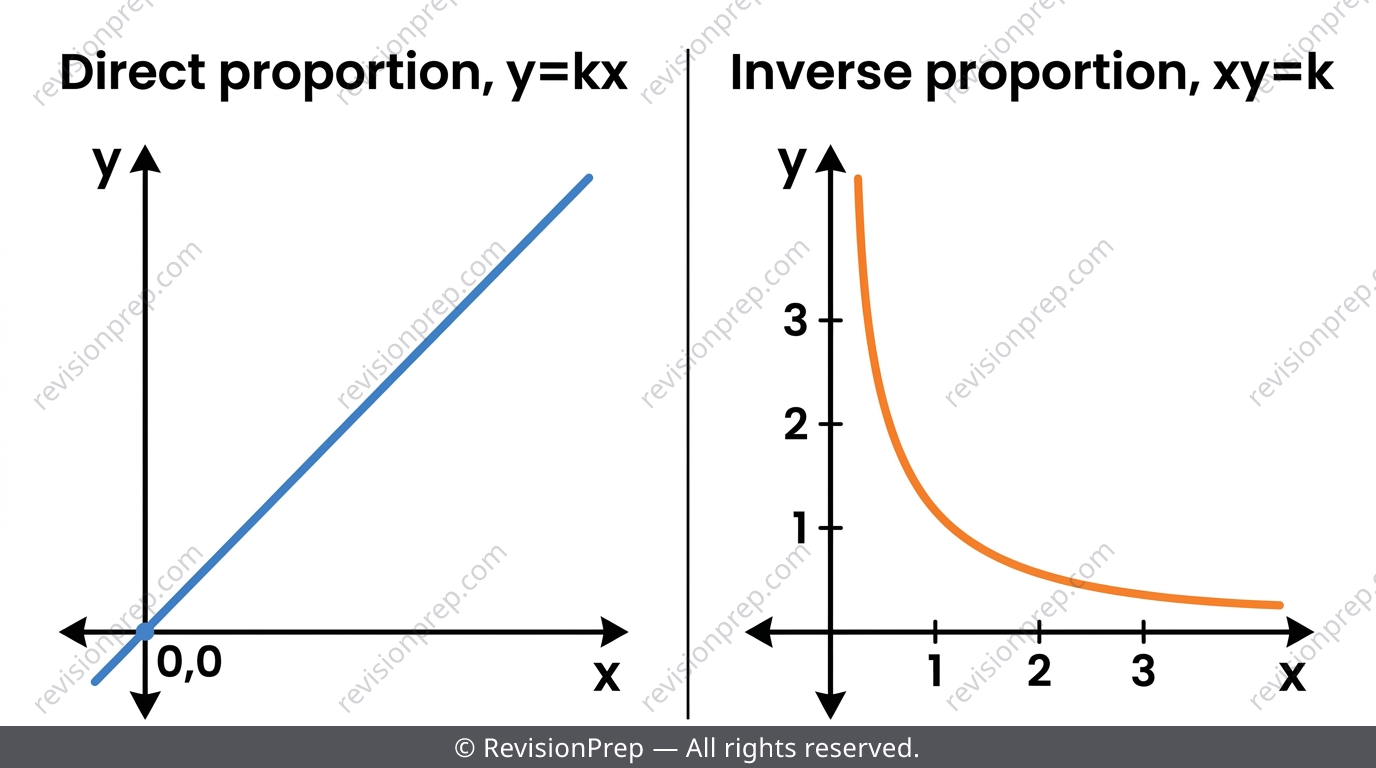
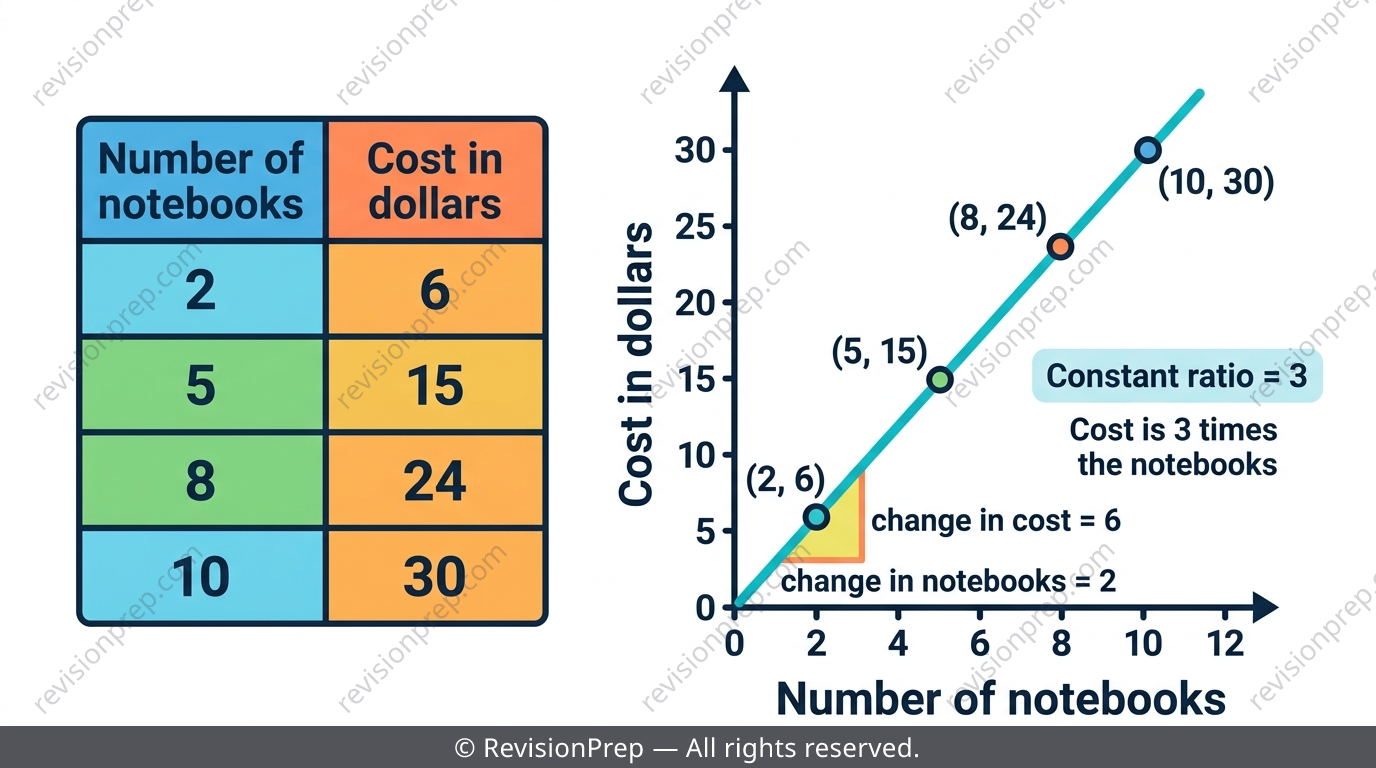
Two quantities are directly proportional when doubling one doubles the other — the ratio stays the same for every pair, and that fixed value is the constant in . On a graph this always looks like a straight line passing through the origin. If the numbers increase together but the line has a -intercept, it's just a linear relationship, not direct proportion.
Exam tip
Always calculate from a labelled data point rather than eyeballing the gradient off the axis gridlines — misreading the scale is a classic error.
Common mistake
Swapping the variables, e.g. writing instead of — match the letter that changes BECAUSE of the other quantity.
Inverse Proportion: Constant Product, Decreasing Curve
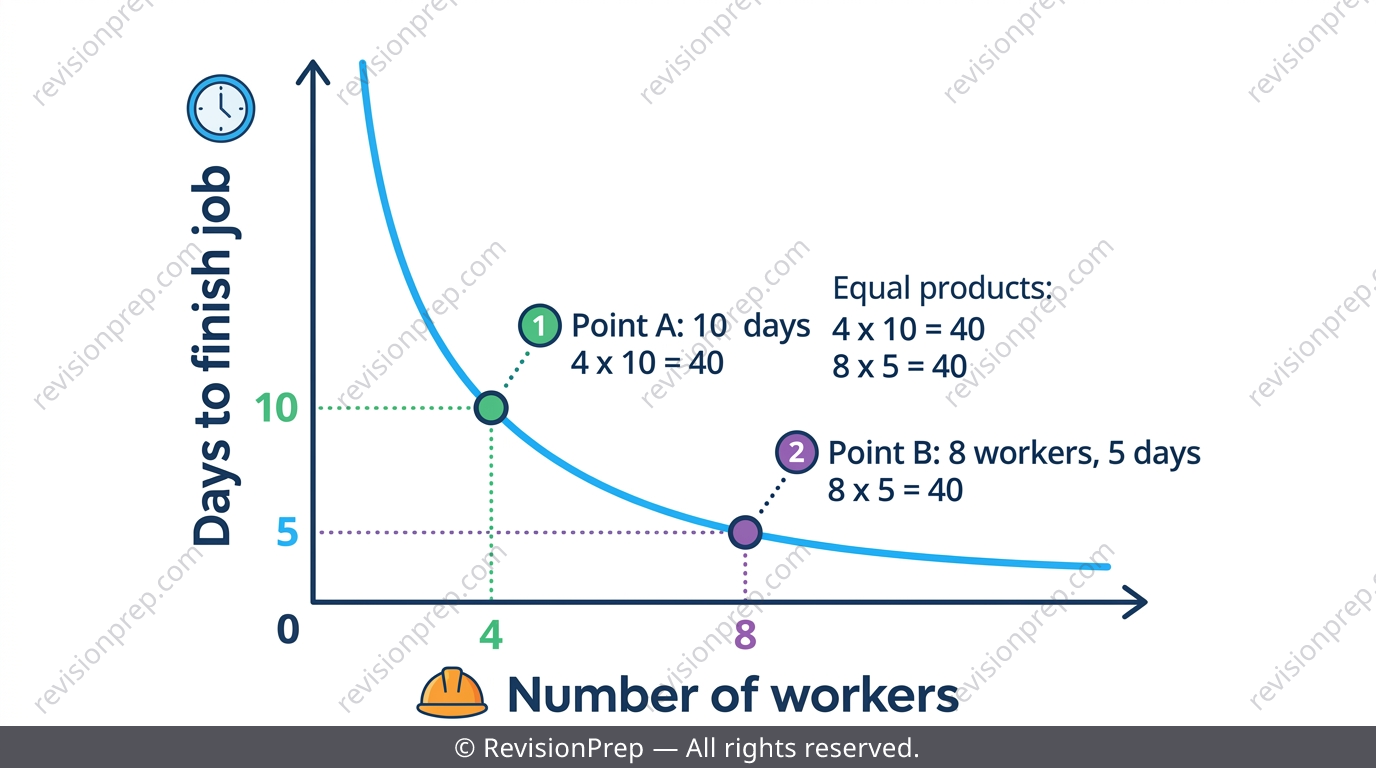
Inverse proportion is the opposite pattern: as one quantity doubles, the other halves, so the PRODUCT stays constant at , giving . The graph is a curve that gets closer and closer to both axes but never touches them. Classic real examples are speed and time for a fixed distance, or number of workers and time to finish a fixed job.
Exam tip
To confirm inverse proportion, multiply each matching pair — if gives the same value every time, that's your constant .
Simple Percentages: Two Core Moves
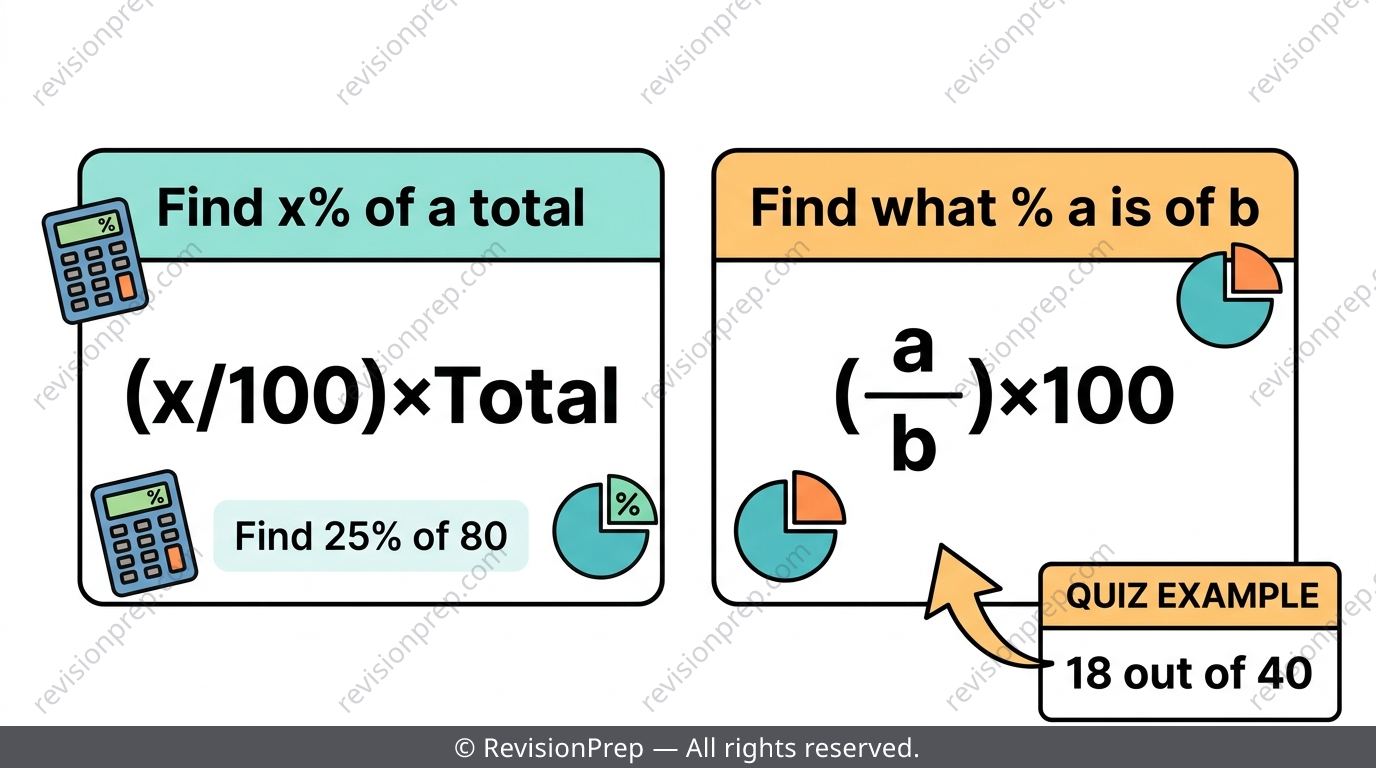
A percentage is a fraction out of 100, so 23% simply means . Nearly every basic question is one of two moves: finding of an amount using , or finding what percentage one amount is of another using . Remember that percentages above 100% are completely normal — 150% just means 1.5 times the whole.
Common mistake
Dividing the wrong way round when finding 'what % is X of Y' — the WHOLE always goes on the bottom. A quiz score coming out above 200% is an instant red flag.
Percentage Increase and Decrease: The Multiplier Method
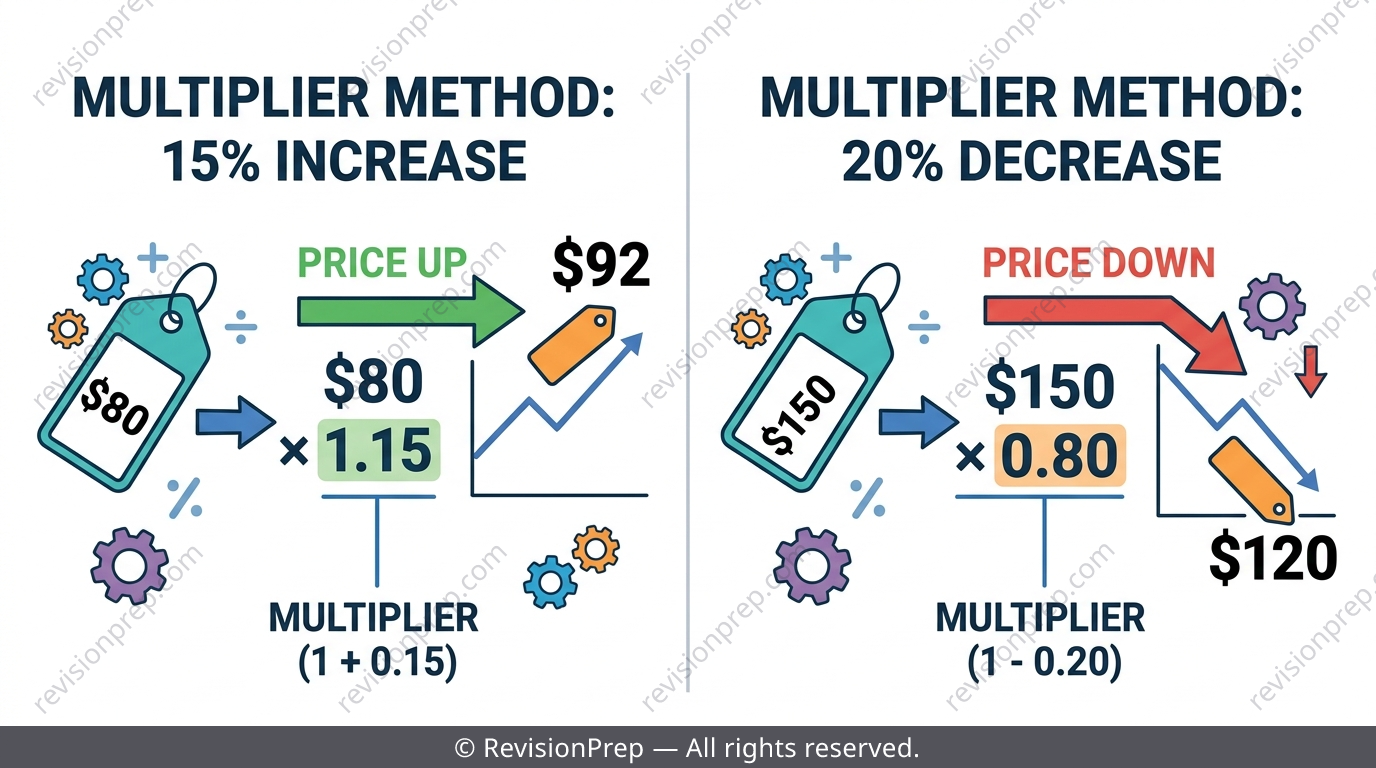
To increase by , multiply the original by ; to decrease by , multiply by — one clean calculation instead of two separate steps. Successive changes don't add together: a 20% increase followed by a 20% decrease does NOT return you to the original value, because the second change acts on a different, already-changed amount.
Common mistake
Assuming two 10% increases equal a 20% increase — actually , a 21% overall rise. Always multiply the multipliers, never add the percentages.
Reverse Percentages: Working Backwards to the Original
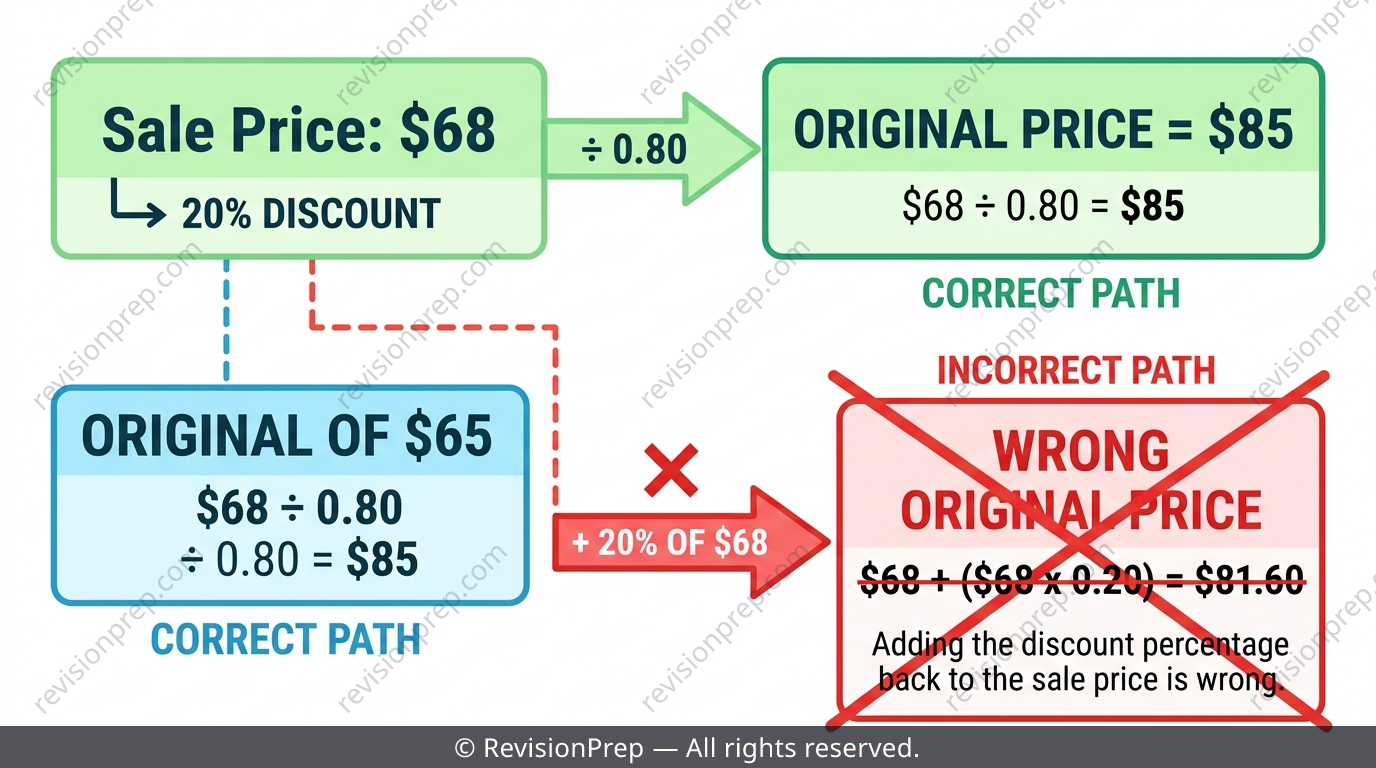
Reverse percentage questions give you the AFTER value and ask for the BEFORE value — the opposite direction from a normal increase or decrease question. The rule is to divide the final value by the multiplier , never to take of the final value and add or subtract it, since the final value is already the changed amount.
Exam tip
Spot the keyword pattern: 'after a discount of r%, the price is $X... find the original price' always signals a reverse percentage question — divide, don't add.
Common mistake
Taking 20% of the discounted $68 (=$13.60) and adding it back to get $81.60 — this is wrong because 20% of the ORIGINAL price is a different amount than 20% of the sale price.
Quick formula sheet
Practice questions
- A table shows x: 1,2,3,4 and y: 2,4,6,8. Is this direct proportion? State the value of k.
- Find 20% of $150.
- Use the multiplier method to increase $60 by 10%.
- 4 workers can build a wall in 9 days. If the job is inversely proportional to the number of workers, how long would 6 workers take?
- A class scored 27 out of 30 on a test. Express this as a percentage.
- A shirt priced at $45 is reduced by 15%. Find the sale price using the multiplier method.
- A price increases by 25% and then decreases by 25%. Is the final price equal to the original price? Explain using multipliers.
- A laptop is on sale for $680 after a 15% discount. Find the original price.
- A delivery service charges $12 for 1 item, $22 for 2 items, and $32 for 3 items. Explain, with evidence, why this is NOT direct proportion.
Frequently asked questions
What's the difference between direct and inverse proportion?+
In direct proportion, the ratio y ÷ x stays constant and both quantities increase together (y = kx). In inverse proportion, the product x × y stays constant, so as one quantity increases the other decreases (xy = k).
How do I know if a graph shows direct proportion?+
It must be a straight line that passes through the origin. If it's a straight line but has a y-intercept, it's a linear relationship, not direct proportion.
Why doesn't a 20% increase followed by a 20% decrease return to the original price?+
Because the second percentage change acts on a different (already changed) amount. You must multiply the multipliers step by step, not add the percentages.
How do I solve a reverse percentage question?+
Divide the final value by the multiplier (1 ± r/100) — never take r% of the final value and add or subtract it, since the final value is already the changed amount.
What's the difference between a percentage point and a percentage change?+
A percentage point difference is a simple subtraction between two percentages (e.g. 45% to 50% is a 5 percentage point rise), while a percentage change is calculated relative to the original value using (change ÷ original) × 100.
Why isn't 'both quantities increase together' enough evidence for direct proportion?+
A fixed fee or flat charge can make two quantities increase together without the ratio staying constant. You must check that y ÷ x is the same for every pair AND that the graph passes through the origin.
Get the full Ratio, Proportion & Percentages revision notes
Related articles