
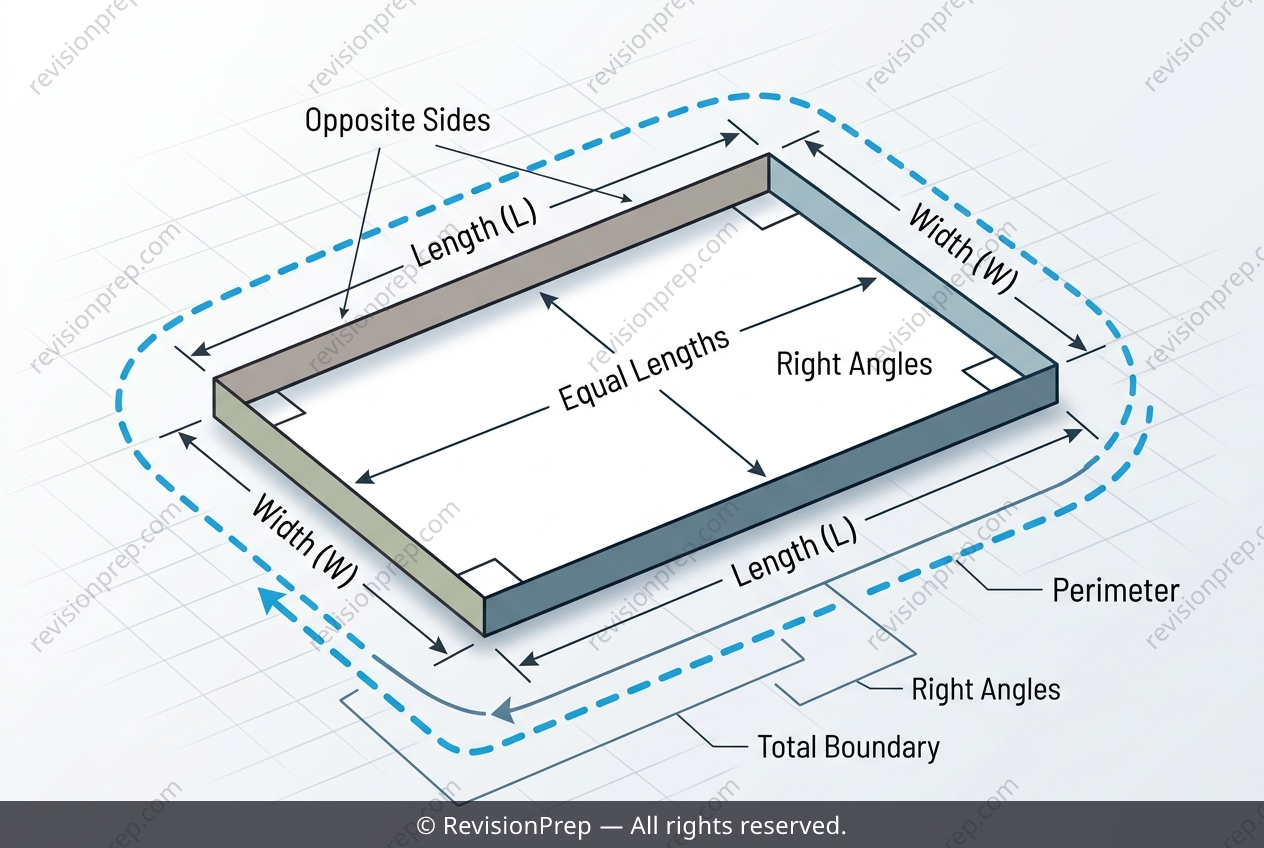
Maths: How Rectangle Properties Define Perimeter
Geometry is all about understanding the shapes that make up our world, and quadrilaterals—four-sided figures—are among the most fundamental. When we zoom in on a rectangle, we’re not just looking at a box; we’re studying a system of balanced relationships. The most basic property, and the one that anchors everything else, is that opposite sides are equal in length. This single rule isn’t just a fact to memorise—it’s the engine that drives how we measure the shape’s boundary. From that one relationship, we can unlock the concept of perimeter, which is the total distance around the outside. For any rectangle, the perimeter is found by doubling the sum of its two distinct side lengths, expressed as P = 2 × (length + width). This formula works precisely because opposite sides are equal, so you only need to measure two different sides to know all four. Understanding this connection—from a simple property to a practical measurement—shows how geometric definitions aren’t isolated facts, but the building blocks for solving real problems involving space, distance, and design.
Start practising IB questions today
150,000+ IB-styled questions, criteria-mapped and instantly accessible.