
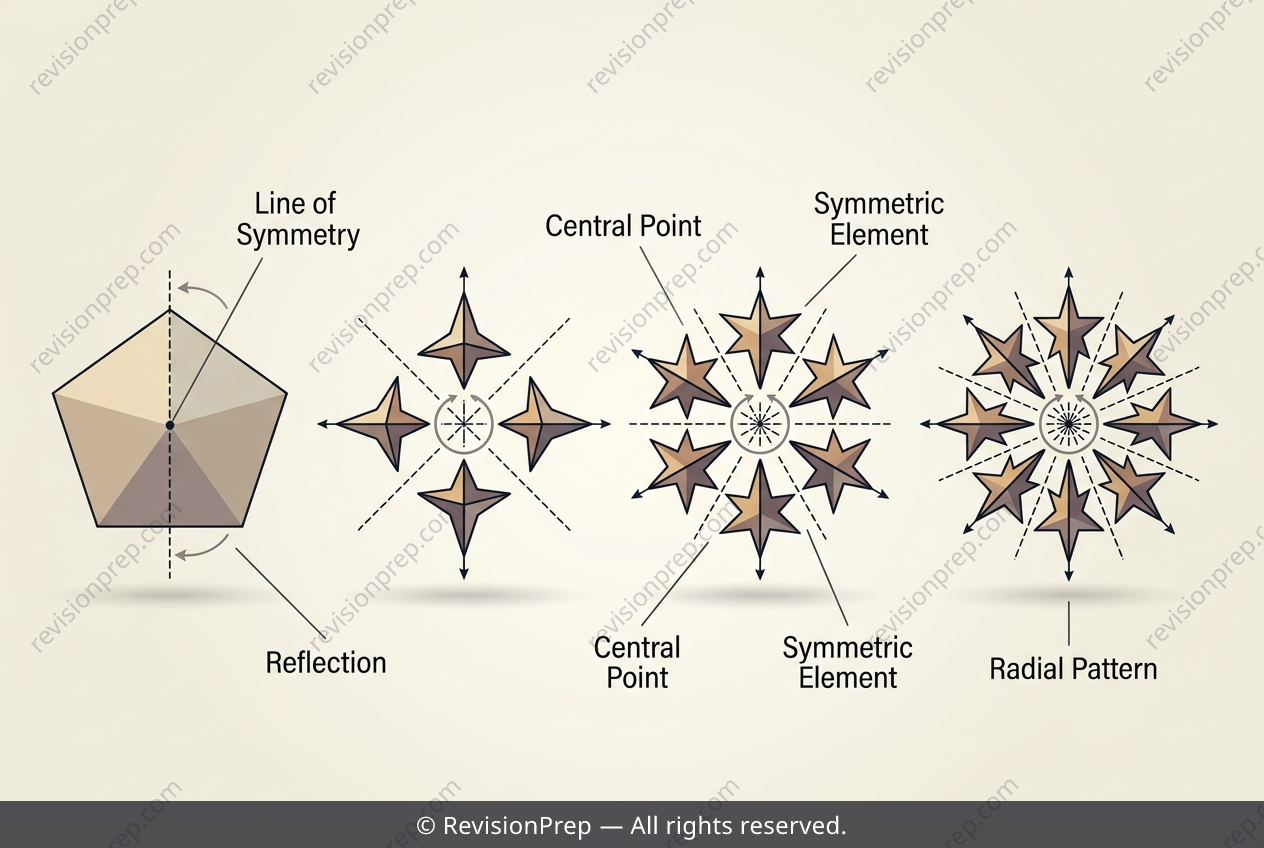
Maths: How Repetition Creates Lines of Symmetry
Symmetry is the hidden engine of visual harmony, and in geometry, it is defined by two precise, measurable ideas: reflectional symmetry, where a line acts as a mirror splitting a figure into two identical halves, and rotational symmetry, where a shape repeats itself as it spins around a central point. In the context of a mandala—a circular design built from repeated leaf shapes—these two concepts fuse beautifully. Every leaf placed evenly around the centre creates a line of symmetry that passes through that leaf, the centre, and the leaf directly opposite, meaning the number of lines of symmetry always equals the number of leaves when the arrangement is perfectly even. This relationship is not just a neat trick; it is the core mechanism that links the count of repeated parts to the count of mirror lines. For any such radially symmetric figure, each repeated element contributes exactly one line of symmetry, and that line always goes through the centre. So, when you compare a mandala with eight leaves to one with four, you are really comparing how many times the pattern can be folded onto itself—each leaf adds one fold line, and the total number of folds scales directly with the number of leaves. Understanding this connection lets you predict symmetry counts without drawing every line, turning a visual puzzle into a simple, logical pattern.
Start practising IB questions today
150,000+ IB-styled questions, criteria-mapped and instantly accessible.