
Maths: Polygon Angles — Regular vs Irregular
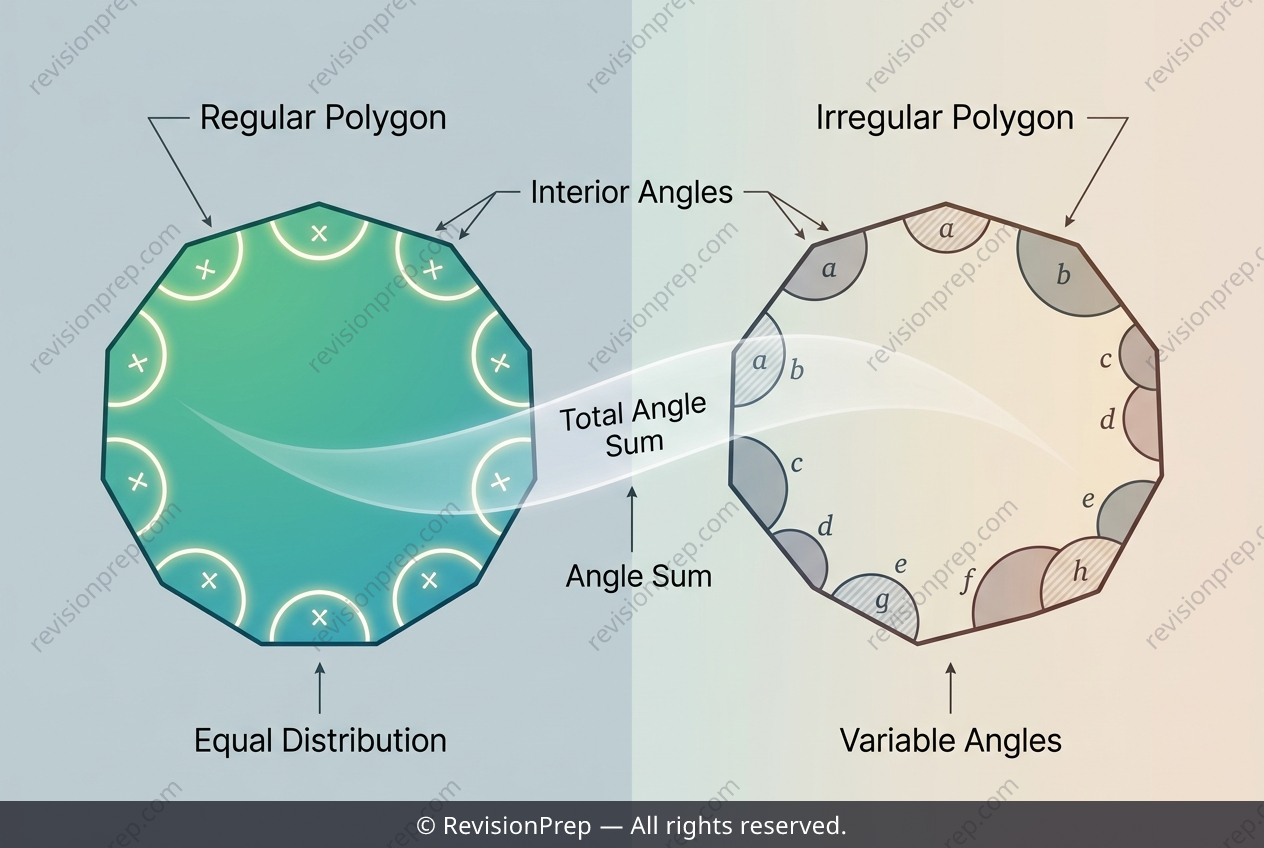
Polygon angle properties are the quiet backbone of geometry — they tell you how a shape’s sides and corners are locked together, and they let you predict the behaviour of everything from floor tiles to molecular structures. At the heart of this topic sits one formula: the sum of interior angles of any n-sided polygon is (n − 2) × 180°. This single expression works for every polygon, regular or irregular, because it comes from dividing the shape into triangles. What makes the formula powerful is how it splits into two very different uses. For a regular polygon — where every side and every angle is identical — you can simply divide the total angle sum by the number of angles to find each individual interior angle. But for an irregular polygon, the total sum tells you only the combined total, not how that total is distributed. Since infinitely many different sets of unequal angles can add up to the same sum, the individual angles remain unknowable from the sum alone. This contrast between regularity and irregularity is the core idea: the formula gives you the whole, but only regularity lets you break that whole into equal parts.
Start practising IB questions today
150,000+ IB-styled questions, criteria-mapped and instantly accessible.