
Maths: Scale Drawings — Measuring the Hidden Error
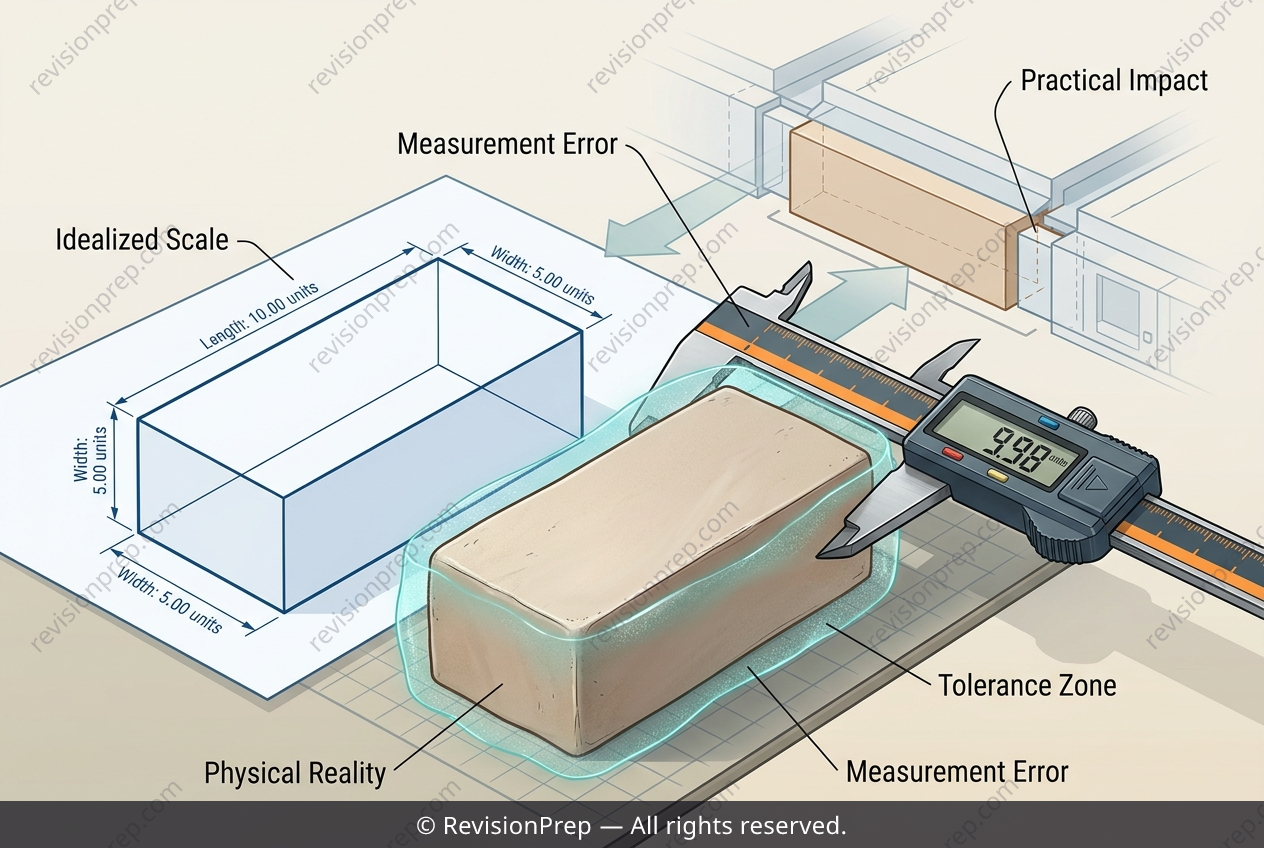
Scale drawings are powerful tools—they shrink the world down to a piece of paper, letting us plan rooms, buildings, and objects before they exist. But every model carries a hidden cost: the moment you scale a measurement up or down, you also scale up any error made along the way. In this topic, we explore congruence and similarity through the lens of measurement uncertainty, asking not just “what are the real dimensions?” but “how trustworthy is that answer?” The core idea is that a scale factor acts as a multiplier on both the true size and the error. If a plan uses 1 cm = 0.5 m, then a tiny 1 mm mistake on the drawing—perhaps from a wobbly ruler or stretched paper—becomes a 0.05 m (5 cm) mistake in the actual room. That might seem small, but for a table meant to fit a specific space, it can mean the difference between a clean fit and a collision with a wall. Scale drawings also flatten three-dimensional reality, hiding height or depth, and paper itself can shrink or swell with humidity. Understanding these limitations isn’t just about precision; it’s about knowing when a model is good enough for its purpose, and when its silent distortions will betray you in the real world.
Start practising IB questions today
150,000+ IB-styled questions, criteria-mapped and instantly accessible.