
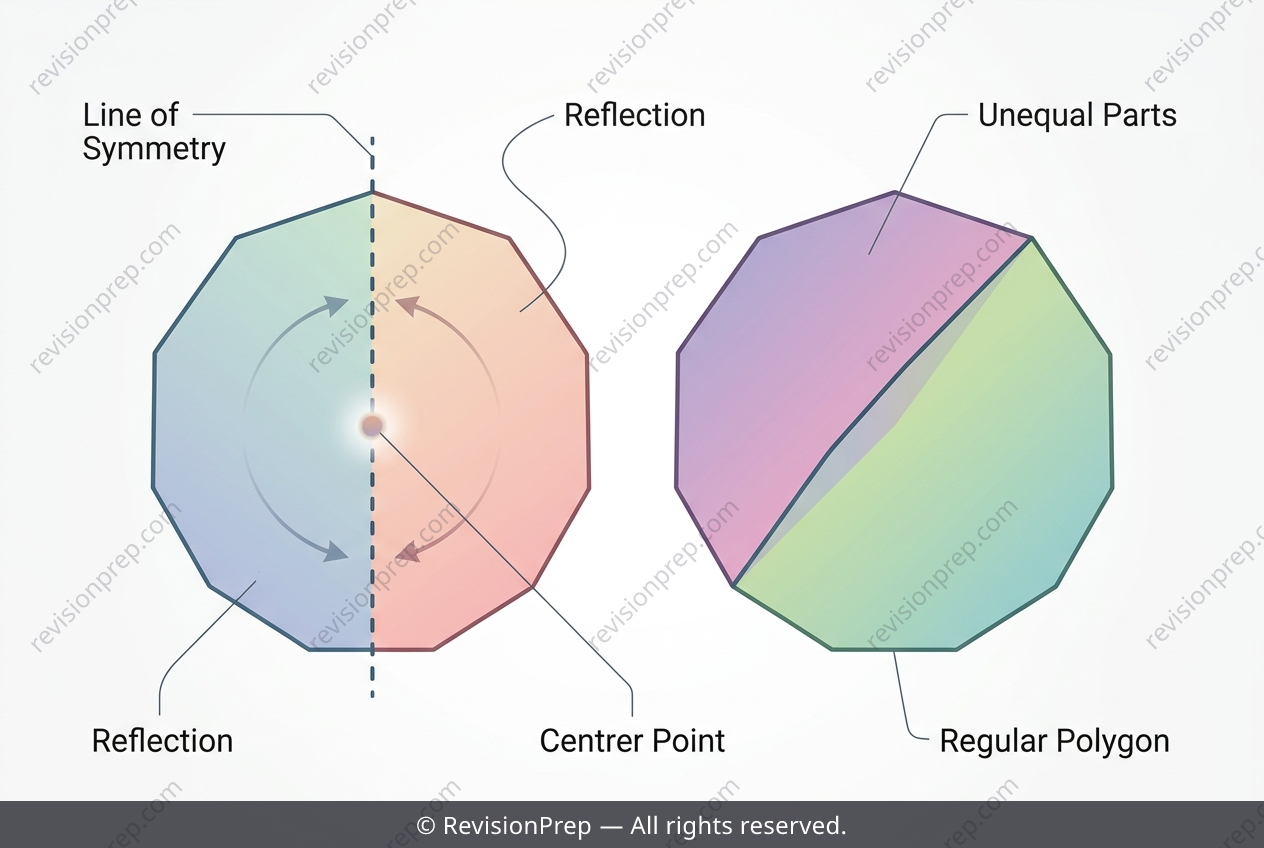
Maths: Testing True Lines of Symmetry
Symmetry is one of the most elegant ideas in geometry: a line of symmetry acts as a mirror, dividing a shape into two congruent halves that match exactly when folded. In a regular hexagon, this means every true line of symmetry must pass through the centre, connecting opposite vertices or the midpoints of opposite sides. The concept hinges on congruence — the two halves must be identical in size and shape, not merely similar or roughly equal. But not every diagonal in a hexagon is a line of symmetry. A diagonal joining two non-opposite vertices misses the centre entirely. Why does that matter? Because the centre is the pivot of the hexagon’s rotational and reflective balance. If a fold line doesn’t pass through the centre, the vertices and sides on either side land in mismatched positions, so the halves cannot be mirror images. This connection between a line’s path through the centre and the resulting congruence of halves is the core mechanism behind testing symmetry — and it’s a relationship that reappears across tessellations, where repeated congruent shapes fit together without gaps or overlaps. Understanding why a line fails the symmetry test is just as important as spotting one that passes it.
Start practising IB questions today
150,000+ IB-styled questions, criteria-mapped and instantly accessible.