
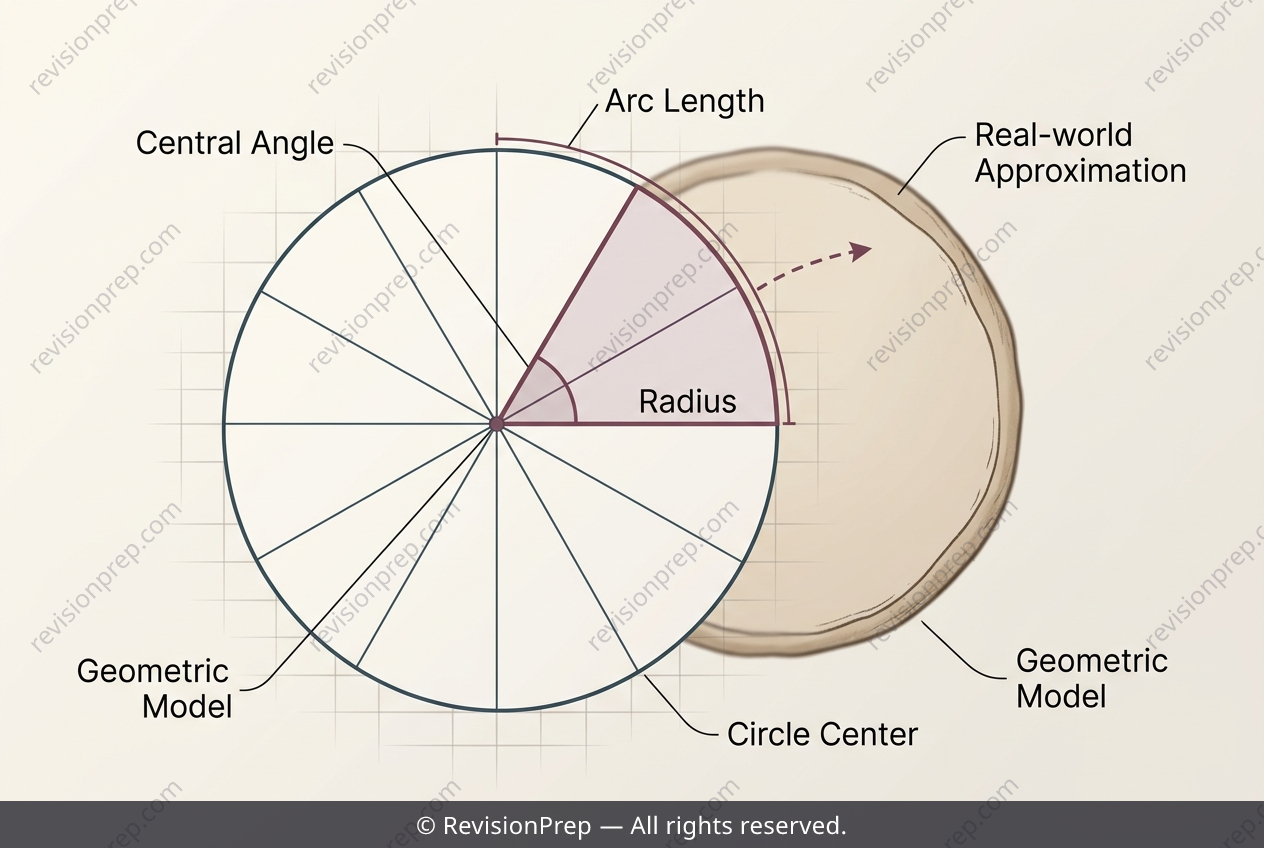
Maths: The Geometry of a Pizza Slice
A single slice of pizza is more than lunch—it is a sector, a wedge of a circle bounded by two radii and the arc between them. When a chef divides a circular pizza into equal slices, the geometry of the circle dictates that each slice’s central angle—the angle at the tip of the wedge—must be a fraction of the full 360° revolution. This relationship is the backbone of circle properties: the total angle around a point is fixed, so splitting it into equal parts is a direct division problem, where the number of slices determines the angle per slice. Why does this matter? Because sectors are everywhere, from pie charts to gear teeth to architectural arches. Understanding how a central angle relates to the whole circle lets you calculate arc lengths, areas, and proportions without measuring every curve. The model assumes a perfect circle and perfectly equal cuts, but reality intervenes—an uneven crust, a slightly misshapen base, or a hand that wobbles. These imperfections highlight the gap between ideal mathematics and physical practice, reminding you that the formula gives a theoretical baseline, while real-world applications require tolerance for deviation.
Start practising IB questions today
150,000+ IB-styled questions, criteria-mapped and instantly accessible.