
Maths: What Makes a Polygon Truly Regular?
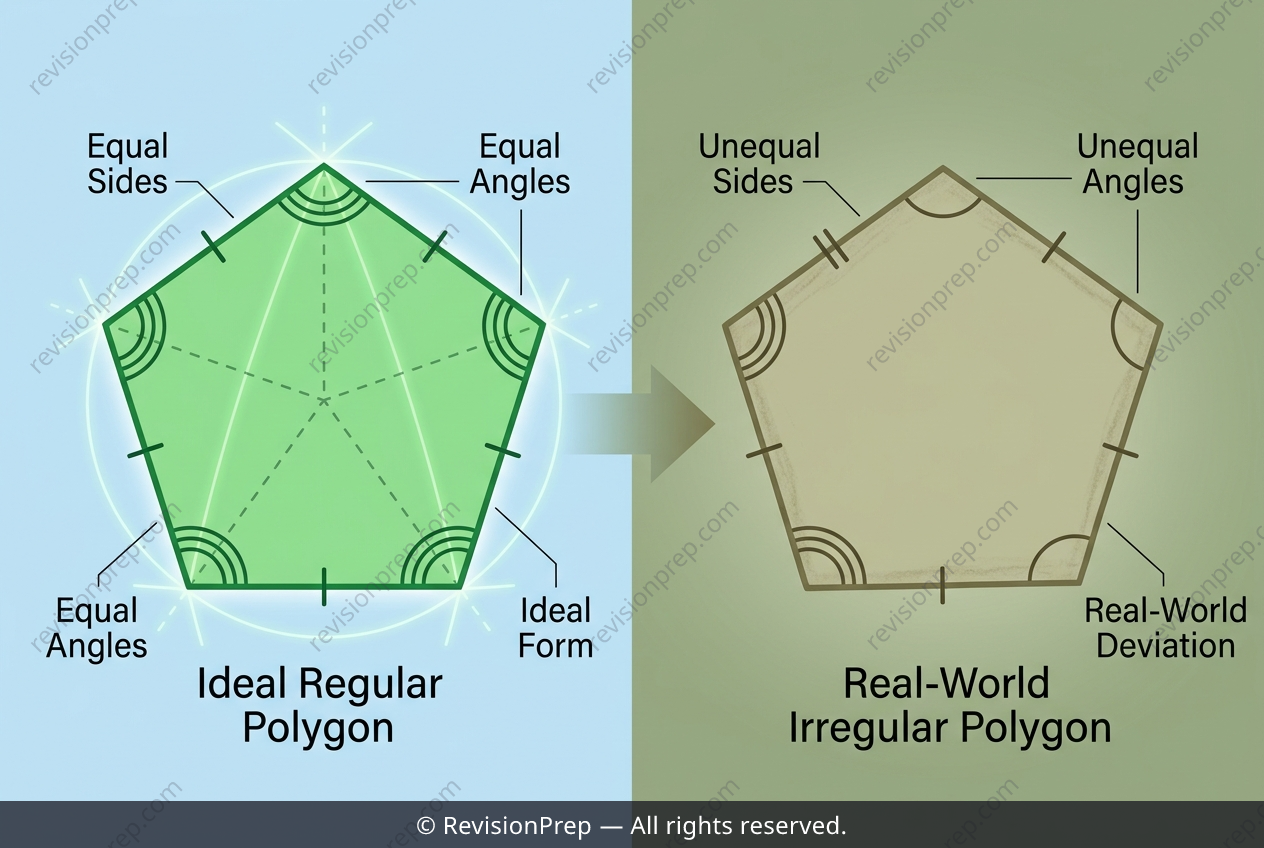
A regular polygon is one of the most precise ideas in geometry: every side must be exactly the same length, and every interior angle must be exactly the same size. For a pentagon, this means five equal sides and five equal angles, all derived from the simple relationship that the sum of interior angles equals (n − 2) × 180°. This formula is not just a calculation tool—it defines the very condition of regularity, because if even one angle deviates, the shape loses its geometric identity. Why does this matter beyond the classroom? In real-world design, from garden layouts to architectural facades, achieving perfect regularity is nearly impossible due to physical constraints. The marking scheme highlights this by testing not only the computation of the angle sum and each individual angle, but also the logical consequence of a measured deviation—here, every angle falling short of the ideal. This connects the abstract formula to practical judgment: regularity is a strict condition, not a loose approximation. Even a small shift in one corner, caused by uneven terrain or construction tolerance, breaks the equality of angles, and the shape can no longer be called regular. Understanding this link between formula, measurement, and definition is what turns a simple polygon problem into a lesson about precision and real-world limits.
Start practising IB questions today
150,000+ IB-styled questions, criteria-mapped and instantly accessible.