
Physics: How a Gymnast Stays Balanced on a Beam
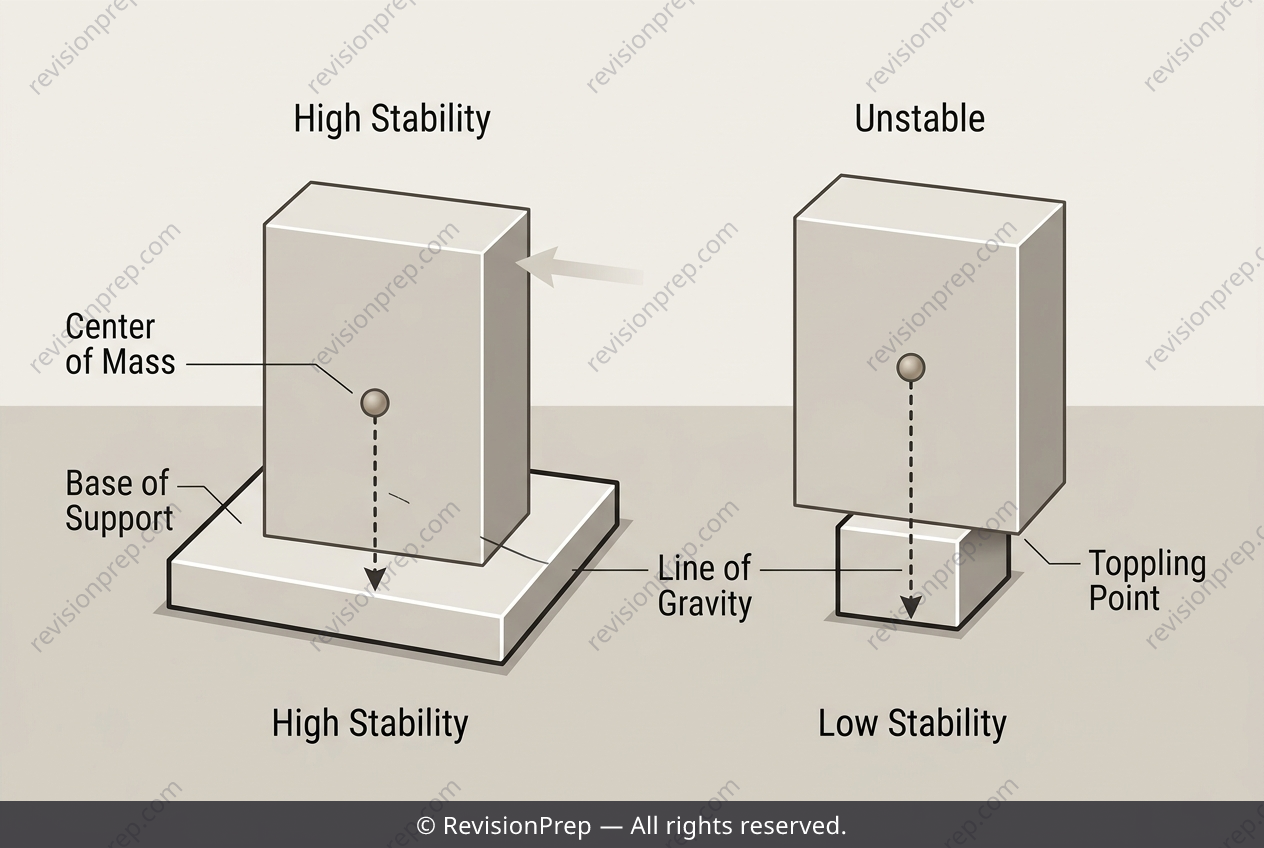
When a gymnast stands motionless on a balance beam, she is a perfect demonstration of static equilibrium—a state where all forces acting on an object are balanced, resulting in zero net force and zero acceleration. In this case, only two forces are at play: her weight, pulling downward through her centre of mass, and the upward normal reaction force from the beam’s surface on her feet. These forces are equal in magnitude and opposite in direction, keeping her perfectly still. Yet equilibrium is not just about forces; it is about stability—the ability to maintain that balance when disturbed. The beam’s narrow, 10 cm width creates a tiny base of support, the area beneath her that provides contact with the ground. A flat, wide beam enlarges this base, meaning her centre of mass (located 0.9 m above the beam) must shift much further sideways before it falls outside the support area and causes a tip. Furthermore, by raising her arms out to the sides, she spreads her mass horizontally, lowering her effective centre of mass relative to her body’s axis and increasing her rotational inertia. This gives her more time and leverage to make corrective adjustments, keeping her centre of mass safely within the base of support—the key mechanism behind rotational stability.
Start practising IB questions today
150,000+ IB-styled questions, criteria-mapped and instantly accessible.