
Physics: How Balanced Forces Explain Constant Speed
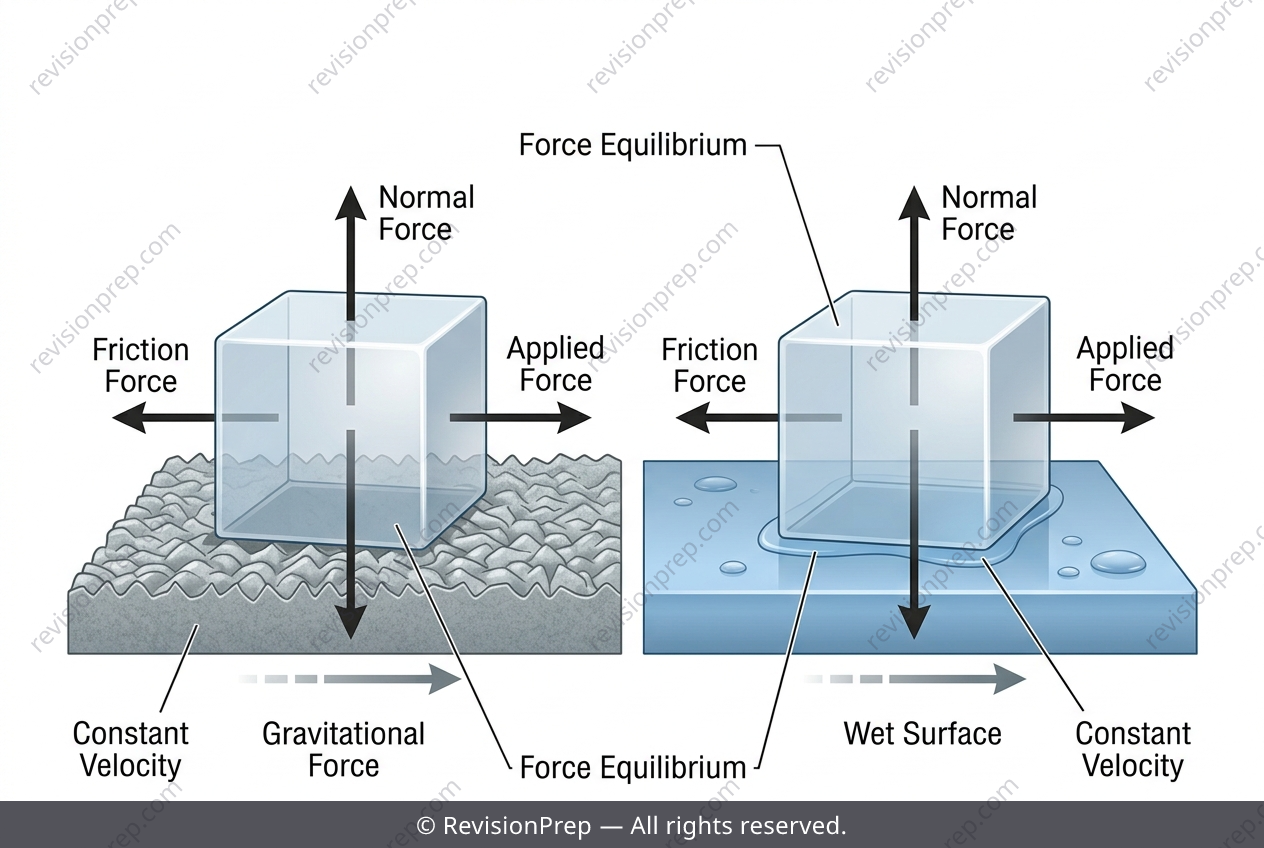
Force diagrams are the visual language of mechanics: they turn a messy real-world situation into a clean map of every push and pull acting on an object. At the heart of this topic sits Newton’s First Law, which tells us that an object moving at constant velocity—like a box sliding across a floor at steady speed—must have a net force of zero. That means all the forces acting on it are perfectly balanced, cancelling out in pairs. For the box, four forces matter: weight pulling downward, the normal force pushing upward (equal in length to weight), your pushing force to the right, and friction resisting to the left. The crucial insight is that when speed is constant, the horizontal arrows must be exactly equal in length—friction matches your push. If the floor turns wet, friction shrinks, the arrows no longer balance, and the box accelerates. This reveals a key limitation: a free-body diagram is a snapshot of one instant under one set of conditions. It shows force magnitudes and directions, but not how those forces change over time or with surface changes—so it’s a powerful tool, but always a simplified model of reality.
Start practising IB questions today
150,000+ IB-styled questions, criteria-mapped and instantly accessible.