
Physics: How Moments Keep a Seesaw Balanced
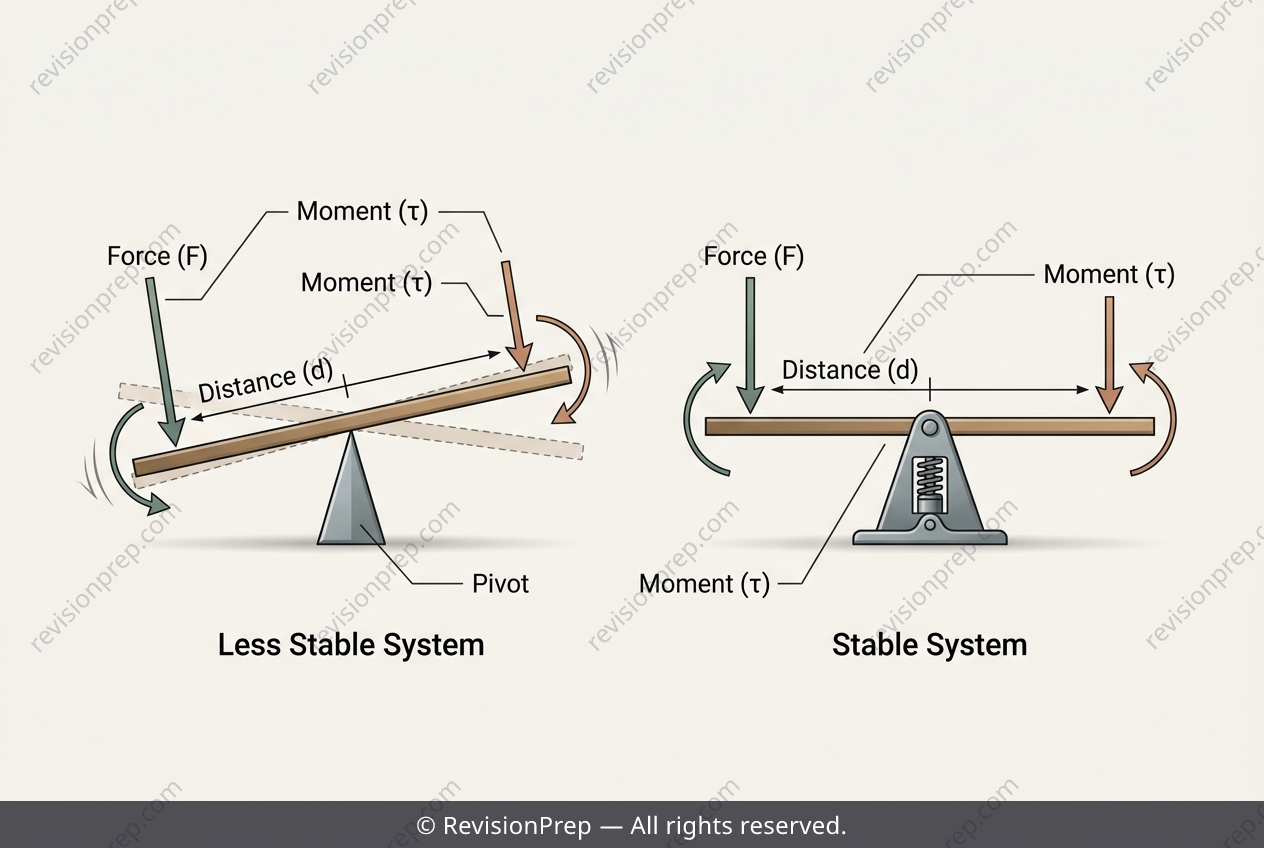
Imagine a playground seesaw perfectly still in the air, with two children of different weights suspended on either side. That stillness isn’t luck—it’s the result of rotational equilibrium, a state where all the turning forces acting on an object cancel out. In physics, this balance is governed by the principle of moments: the turning effect (moment) of a force equals the force’s magnitude multiplied by its perpendicular distance from the pivot (moment = weight × distance). When the clockwise moments equal the anticlockwise moments, the net moment is zero, and the system is balanced—no rotation occurs. This concept matters far beyond playgrounds. Engineers, architects, and designers use it to ensure structures from cranes to furniture remain stable under varying loads. But equilibrium isn’t the only consideration; mechanical stability also involves how a system responds to disturbances. A perfectly balanced seesaw can still tip violently if a child shifts suddenly. That’s where damping comes in—mechanisms like springs absorb and dissipate kinetic energy, reducing the severity of sudden movements. Understanding these relationships—between force, distance, moment, and damping—helps us evaluate real-world trade-offs, like choosing between a cheaper, rigid seesaw and a pricier, spring-loaded one that protects against dangerous tipping.
Start practising IB questions today
150,000+ IB-styled questions, criteria-mapped and instantly accessible.