
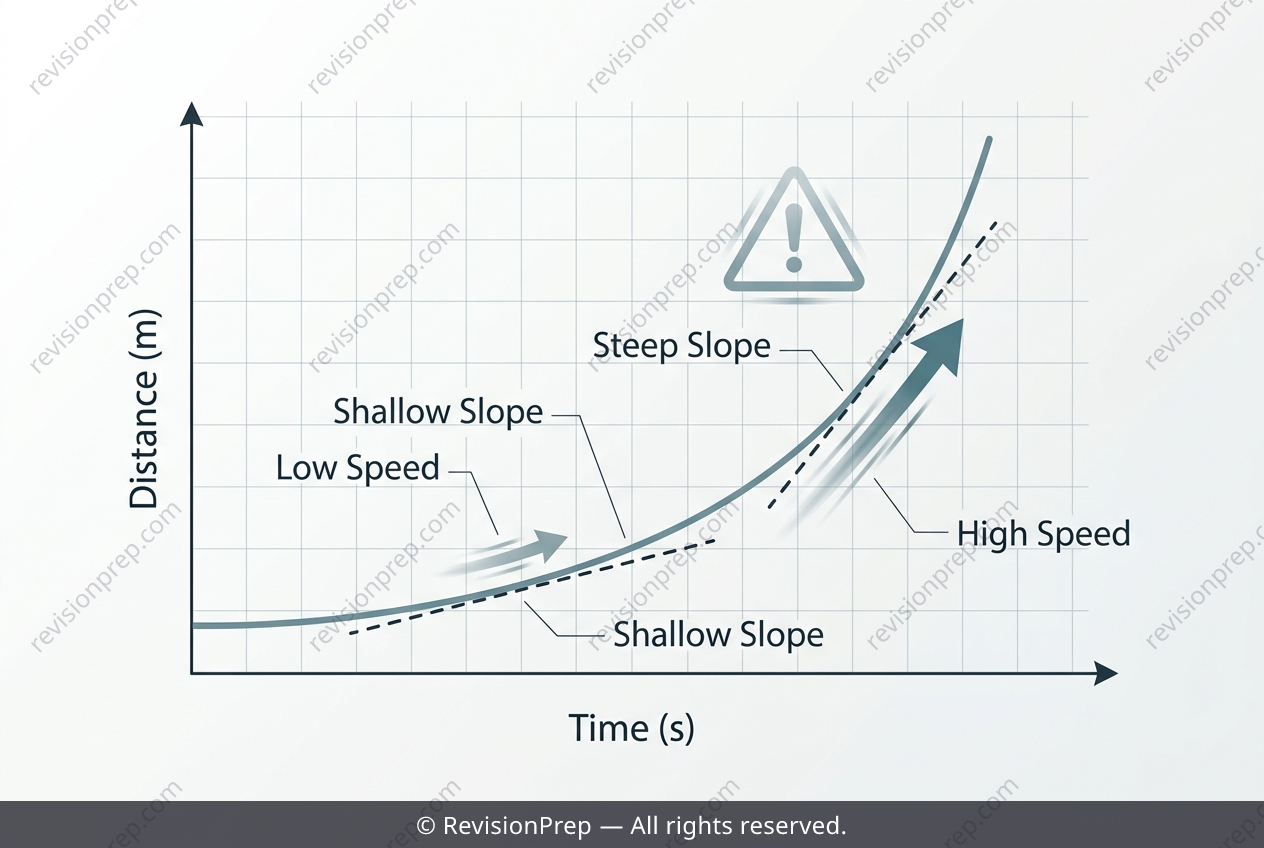
Physics: How Slope Reveals Speed and Stopping Distance
On a distance-time graph, the story of motion is written in its slope. The core concept here is simple yet powerful: the steepness of the line at any moment directly encodes the object’s instantaneous speed. A steeper slope means the car is covering more distance in the same unit of time—mathematically, speed = change in distance ÷ change in time (v = Δd/Δt). When that slope grows steeper, as when a car approaches a pedestrian crossing, it signals acceleration—a real-time warning that the vehicle is getting faster. Why does this matter? Because reading that slope correctly is a matter of life and safety. The graph is not just a picture; it is a predictive tool. If a driver or observer misreads the slope and underestimates how steep it truly is, they will assume the car is moving slower than it actually is. That misjudgment directly impacts stopping distance—the gap needed to brake safely. Underestimating speed means braking too late, leaving insufficient room to halt before the crossing, and dramatically increasing the risk of a collision. Thus, the connection between graph interpretation and physical consequence is direct: slope translates to speed, speed translates to stopping time, and stopping time translates to safety.
Start practising IB questions today
150,000+ IB-styled questions, criteria-mapped and instantly accessible.