
Physics: Why Measurement Error Obscures Force Balance
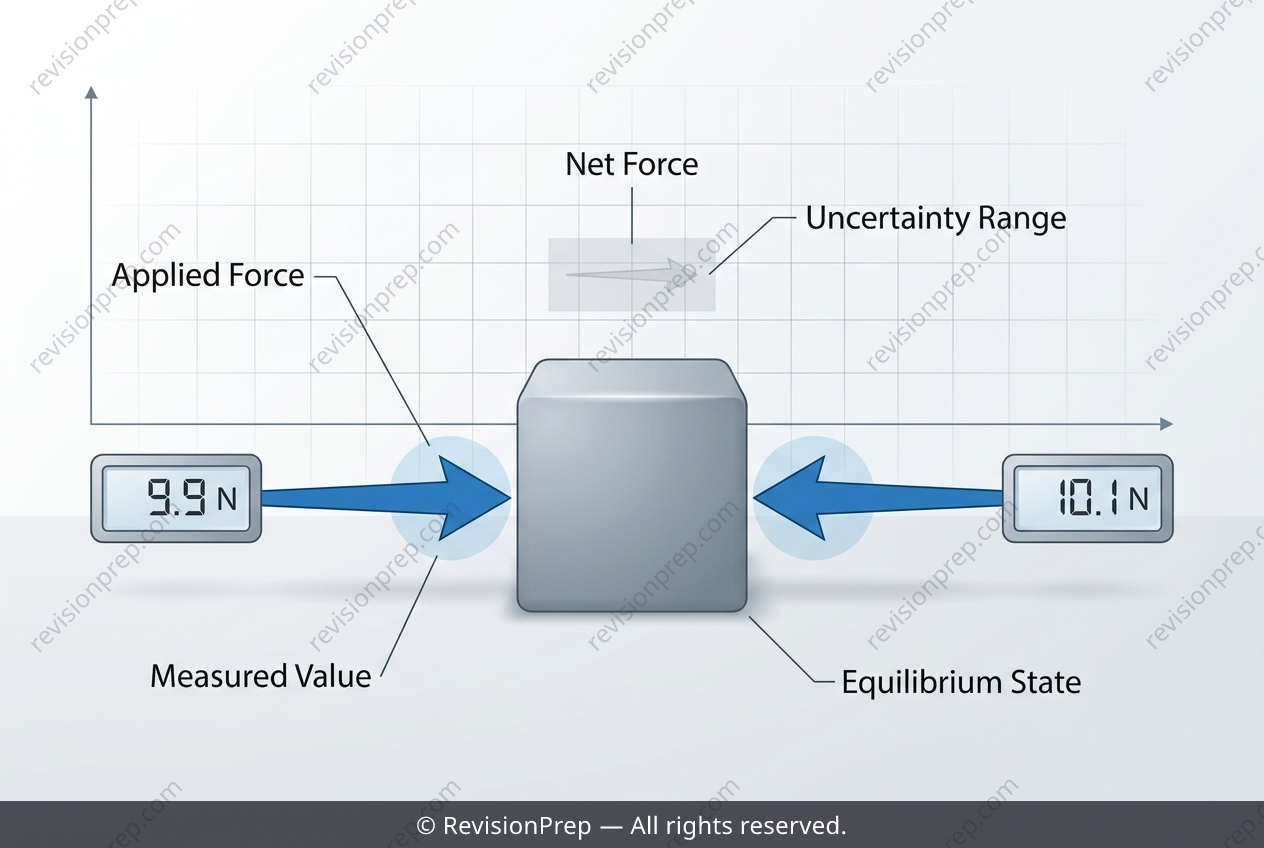
In physics, forces are said to be balanced when their vector sum equals zero, resulting in no change in an object’s motion. This principle is central to understanding equilibrium, yet in practice, perfect balance is rarely observed directly—instead, we rely on measurements that carry inherent uncertainty. When you push an object from both sides with sensors, the raw readings will rarely match exactly, even if the true forces are equal. The core challenge is distinguishing a genuine imbalance from the “noise” of imperfect equipment. The key relationship here is net force (Fnet = Fleft − Fright). If the box remains stationary, Newton’s first law implies Fnet is effectively zero. However, because each sensor has a stated uncertainty (e.g., ±0.1 N), any difference between average forces must be compared against that margin. If the observed difference is smaller than the uncertainty, the data cannot support a claim of imbalance—the forces are balanced within the limits of the equipment. This connection between calculated averages, their difference, and measurement error is what turns raw data into a defensible scientific conclusion about equilibrium.
Start practising IB questions today
150,000+ IB-styled questions, criteria-mapped and instantly accessible.