
Physics: Why a Stronger Push Breaks the Balance
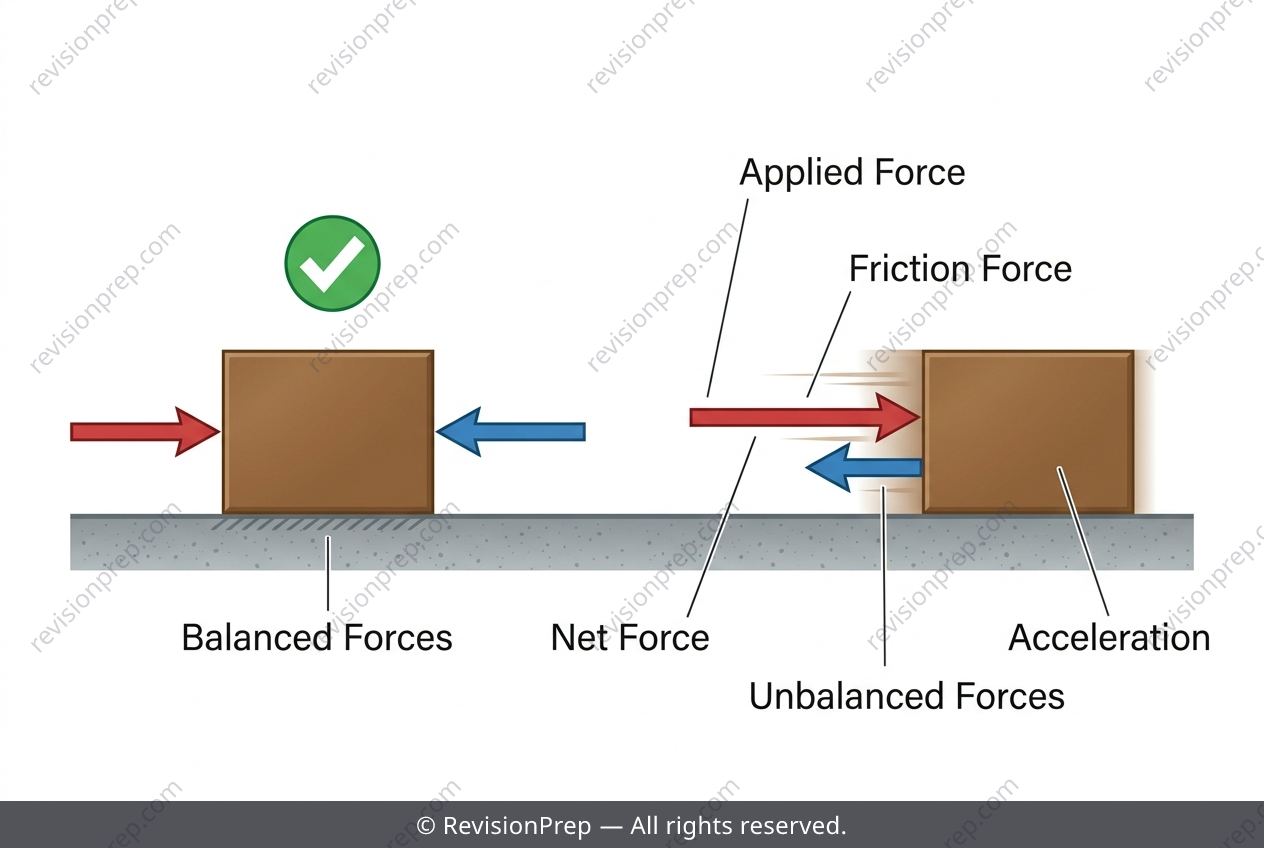
When you push against a heavy box and it refuses to budge, you are experiencing Newton’s First Law in action. This law states that an object at rest stays at rest unless acted upon by an unbalanced net force. In physics, forces are not just about strength—they also have direction. When multiple forces act on an object, they combine into a single overall effect called the net force. If that net force is zero, the object’s motion does not change. The key relationship here is balance versus imbalance. Balanced forces occur when two forces are equal in size and opposite in direction, causing them to cancel out completely—leaving a net force of 0 N. This is why a stationary box pushed with 10 N to the right, while friction pushes 10 N to the left, remains perfectly still. The forces are equal and opposite, so they effectively “cancel.” However, the moment one force exceeds the other—say, the push grows stronger while friction stays the same—the forces become unbalanced. A non-zero net force then appears, and according to Newton’s First Law, that unbalanced force causes the object to accelerate in the direction of the larger force. Understanding this balance is the foundation for predicting whether objects will start moving, stop, or continue at a constant velocity.
Start practising IB questions today
150,000+ IB-styled questions, criteria-mapped and instantly accessible.