
Physics: The Hidden Cost of Friction on Acceleration
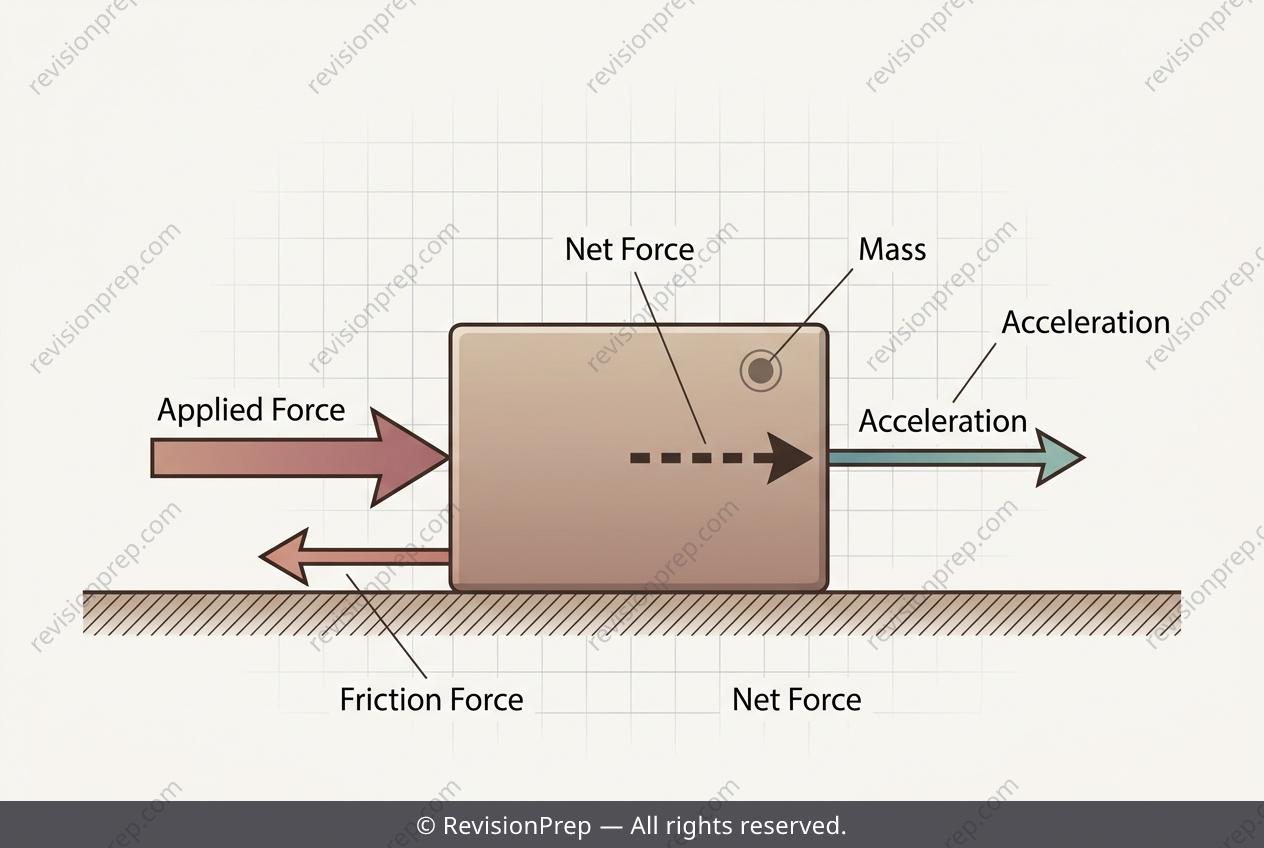
Force diagrams are the visual language of motion, and at their heart sits a single, powerful relationship: Newton’s Second Law, F = ma. This law tells us that the net force acting on an object—the vector sum of every push and pull—directly determines how quickly that object accelerates. If you double the net force, you double the acceleration, provided the mass stays constant. But the real world is rarely a clean, frictionless vacuum, which is why drawing a proper force diagram matters: it forces you to account for every force, not just the one you are applying. Consider a child pushing a toy car across a floor. Push harder, and the car’s acceleration increases—that is the direct, intuitive link between net force and acceleration. Yet the car does not speed up as much as you might expect, because friction between the wheels and the floor acts in the opposite direction. This opposing force subtracts from your push, shrinking the net force and therefore the actual acceleration. Understanding this interplay—applied force versus resisting force—is what turns a simple equation into a tool for predicting real motion, from bicycles to rockets.
Start practising IB questions today
150,000+ IB-styled questions, criteria-mapped and instantly accessible.