
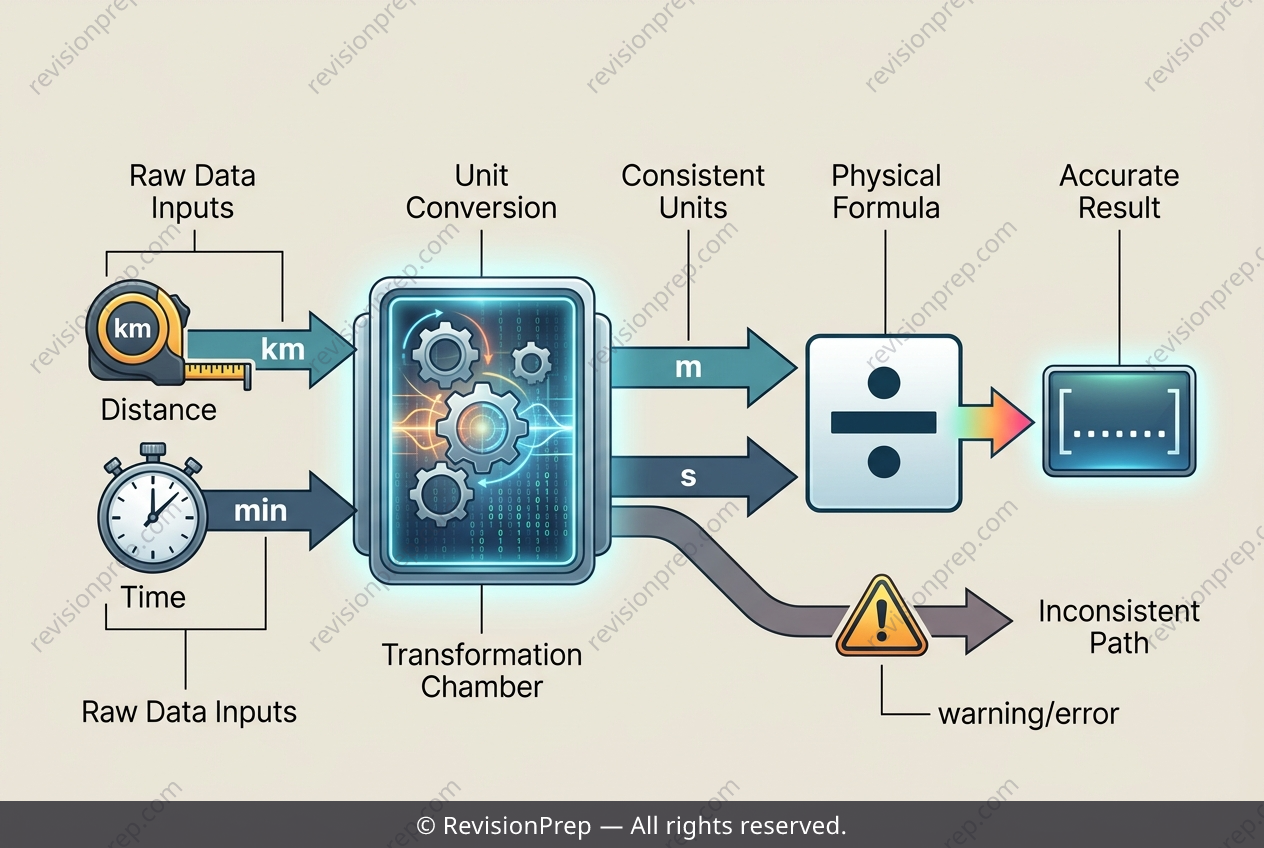
Physics: Unit Consistency Matters in Speed Calculations
Speed, velocity, and acceleration form the foundation of how we describe motion, but the numbers only mean something when their units tell a consistent story. At its heart, this topic asks you to connect a physical quantity—how fast something moves—to the ratio of distance travelled over time taken. Yet that simple relationship, speed = distance ÷ time, hides a trap: if distance is in kilometres and time is in minutes, the result is a hybrid unit that no speedometer, road sign, or physics formula recognises. The real skill lies in dimensional analysis—checking that every value you plug into an equation carries the correct unit before you divide, multiply, or compare. Converting 15 km to 15,000 metres and 20 minutes to 1,200 seconds transforms the calculation into a meaningful speed expressed in metres per second (m/s). This matters beyond the classroom: a speed limit given in m/s cannot be judged against a raw quotient of km/min, because the two numbers live in different unit worlds. Getting the conversion right is not arithmetic housekeeping—it is the difference between a safe driver and a false verdict. When you master unit consistency, you unlock the ability to compare, predict, and evaluate motion reliably across any scale.
Start practising IB questions today
150,000+ IB-styled questions, criteria-mapped and instantly accessible.