
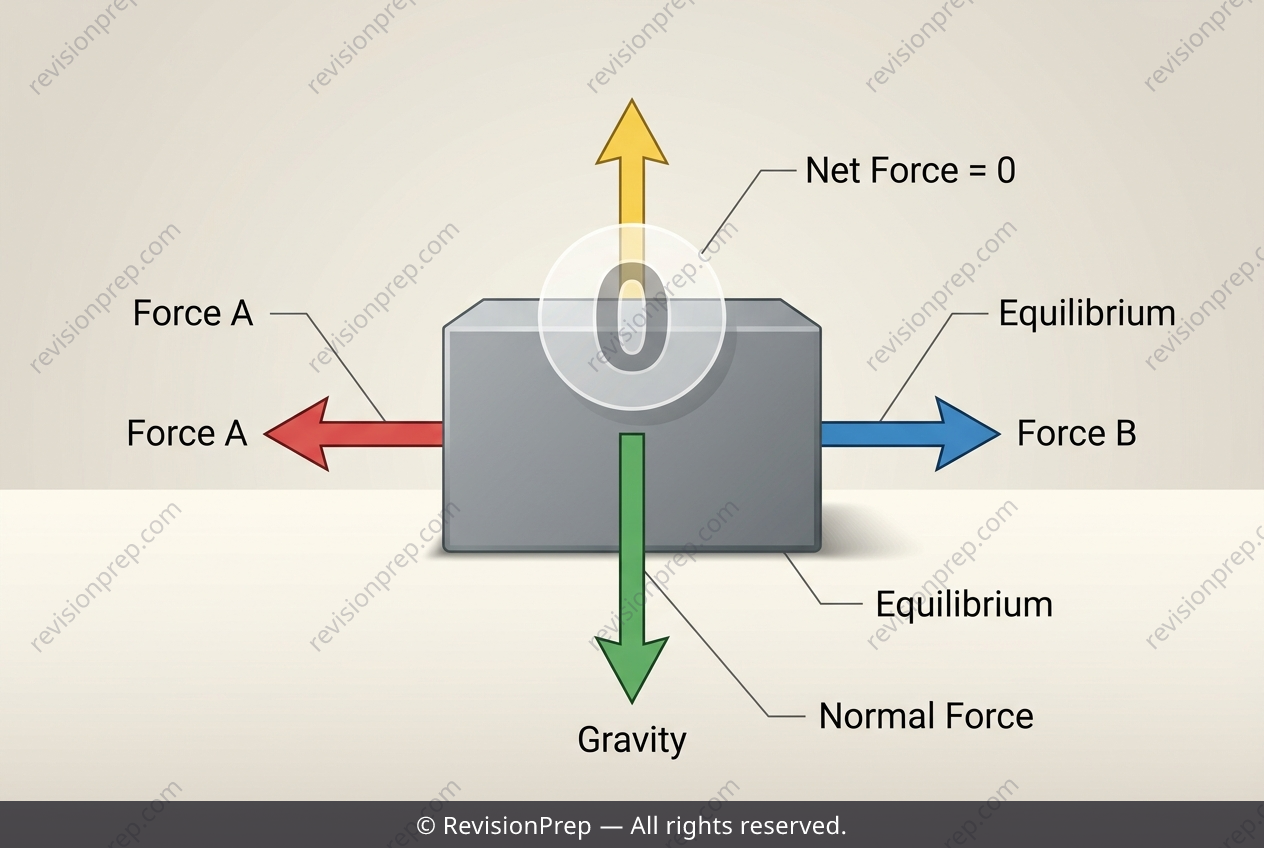
Physics: Why 10 N Left Cancels 10 N Right
When you push a book across a table at a steady speed, or hold a cup of water without it moving, you are experiencing balanced forces in action. Scientifically, balanced forces occur when two or more forces acting on a single object are equal in magnitude (the same size) and opposite in direction. Because these forces cancel each other out perfectly, the net force—also called the resultant force—on the object is zero. This idea is the foundation of equilibrium, a state where an object’s motion does not change. If the net force is zero, the object either remains at rest or continues moving at a constant velocity (Newton’s first law). The key relationship here is that balance is not about the absence of forces, but about their vector sum equalling zero. For example, if a 10 N force pulls right and a 10 N force pulls left, they are equal and opposite, so the resultant is 0 N. Understanding this distinction between balanced (net force = 0) and unbalanced (net force ≠ 0) forces helps explain why objects speed up, slow down, or change direction only when forces are not perfectly matched.
Start practising IB questions today
150,000+ IB-styled questions, criteria-mapped and instantly accessible.