
Physics: Why a Motionless Box Has Balanced Forces
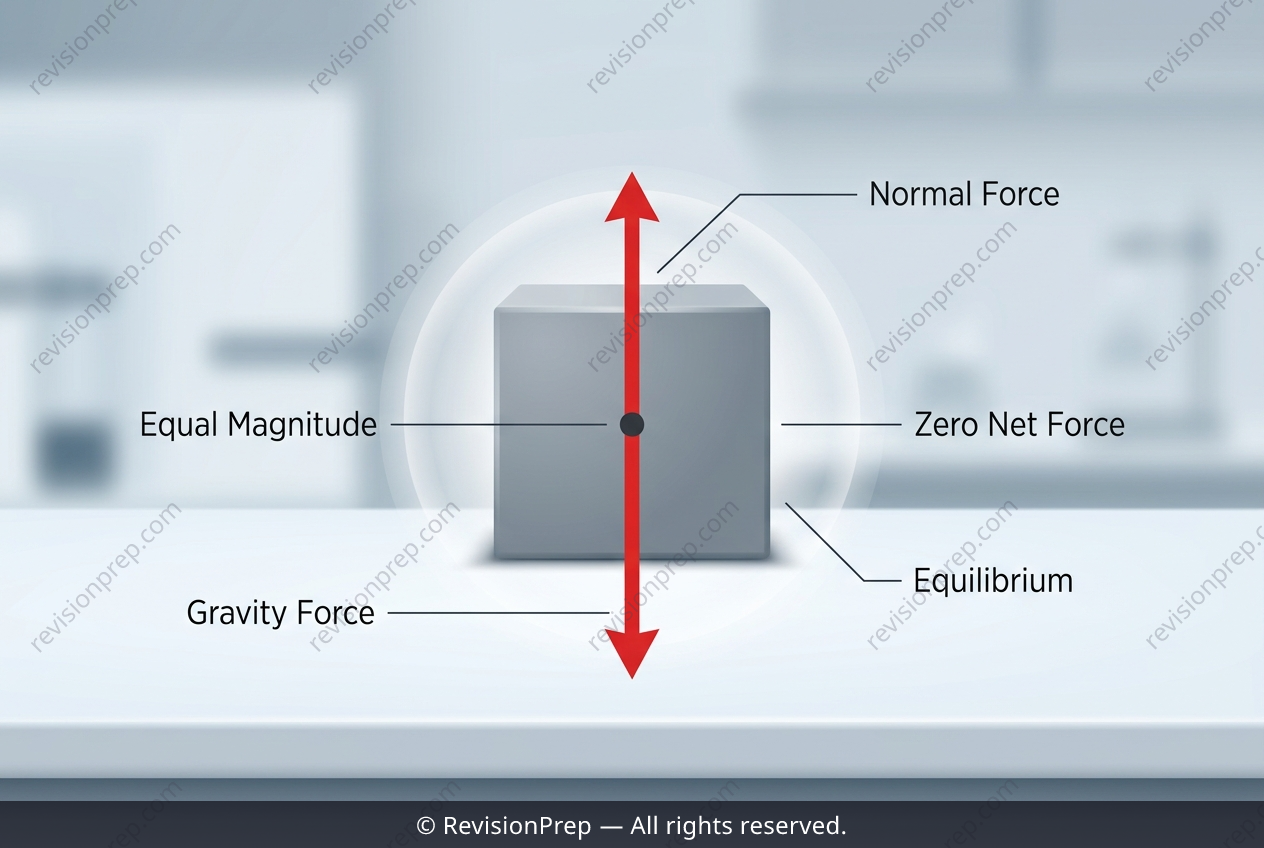
When a box sits motionless on a table, it might seem like nothing is happening—but in physics, that stillness is a rich story of balanced forces. The core idea here is net force and static equilibrium: the condition where all forces acting on an object cancel out, leaving a net force of zero. This is why the box remains “at rest”—not just because it isn’t moving, but because there is no unbalanced push or pull to change its state of motion. The force diagram for this box shows two arrows: gravity pulling downward and the normal force pushing upward. The length of each arrow represents the magnitude of the force. For the box to stay perfectly still, these two forces must be equal in size and opposite in direction—so the arrows must be drawn the same length. If one were longer, the net force would no longer be zero, and the box would accelerate in that direction. This relationship—balanced forces leading to zero acceleration—is the heart of Newton’s first law, and it connects directly to the idea of equilibrium: when ΣF = 0, an object at rest stays at rest. Understanding this simple scenario builds the foundation for analyzing more complex systems where multiple forces act at angles or along different axes.
Start practising IB questions today
150,000+ IB-styled questions, criteria-mapped and instantly accessible.