
Physics: Why Balanced Force Arrows Must Match
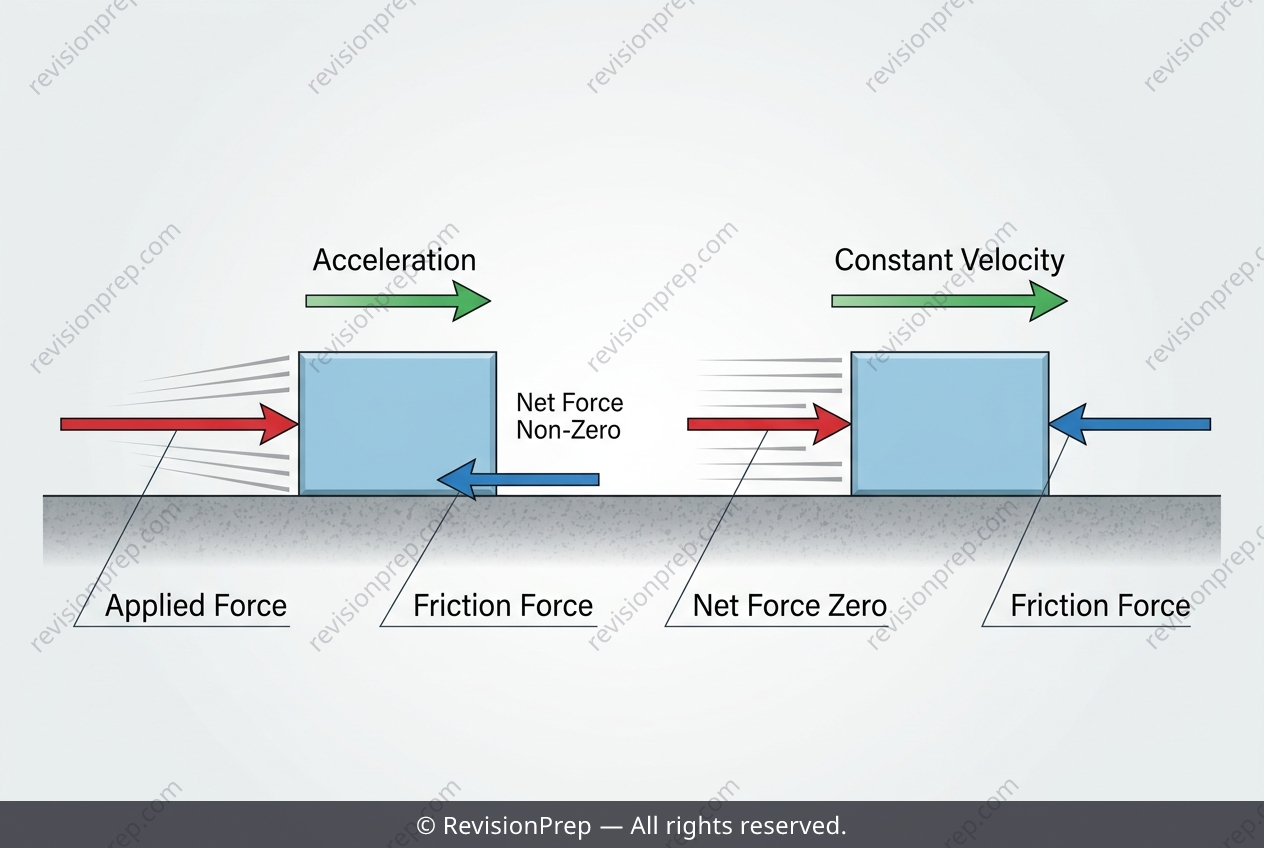
Newton’s First Law of Motion is the quiet engine behind every object that glides, rolls, or slides at a steady pace. At its heart lies a simple but profound idea: an object moving at constant speed does not need a continuous push—it needs a perfect balance of all forces acting upon it. When forces are balanced, the net force is zero, and motion remains unchanged. When they are unbalanced, a net force appears, and the object accelerates. This concept matters because it separates intuition from physics. A box sliding across a rough floor at constant speed is not experiencing a stronger push than resistance; it is experiencing equal and opposite forces. The applied force and friction force must cancel exactly, meaning their magnitudes are equal and their directions opposite. In a force diagram, this balance is visual: arrows of identical length pointing in opposite directions. If one arrow is drawn longer than the other, the diagram falsely implies a net force, which would cause acceleration—contradicting the condition of constant speed. Understanding this relationship between force arrows, net force, and motion is foundational for analysing any dynamic system, from a book on a table to a satellite in orbit.
Start practising IB questions today
150,000+ IB-styled questions, criteria-mapped and instantly accessible.