
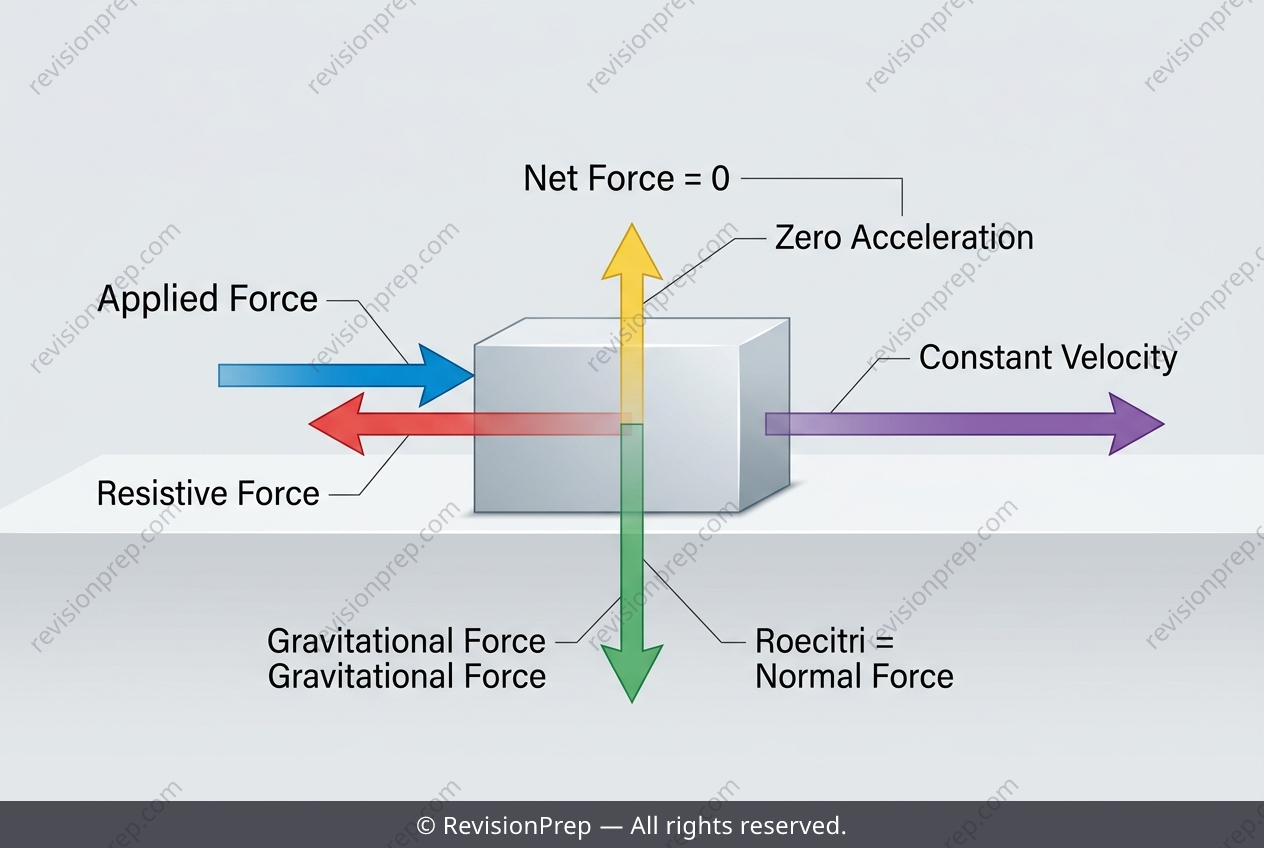
Physics: Why Constant Speed Hides Balanced Forces
Newton’s First Law of Motion is the quiet engine behind every smooth, steady journey—and every sudden stop. At its heart lies a simple but profound idea: an object will keep doing exactly what it’s doing unless a net force pushes or pulls it otherwise. In this blog post, we’re unpacking balanced and unbalanced forces through a classic scenario: a toy car gliding along a flat track at a constant speed. Why does this matter? Because constant speed is not the same as “no forces.” In fact, the car is likely experiencing friction, air resistance, and the push of its motor—yet if its speed never changes, those forces must be perfectly cancelling each other out. That’s the key relationship: when the net force (F_net) equals zero, acceleration (a) is also zero, and velocity stays constant. Here, the data shows speed holding steady at 3 m/s every second—no speeding up, no slowing down. That tells us acceleration is zero, which means the forces acting on the car are balanced, equal in size and opposite in direction. Understanding this link between motion, acceleration, and force isn’t just a mark-scoring skill—it’s the foundation for predicting how anything from a rocket to a bicycle will behave.
Start practising IB questions today
150,000+ IB-styled questions, criteria-mapped and instantly accessible.