
Physics: Why Doubling Speed Quadruples Air Resistance
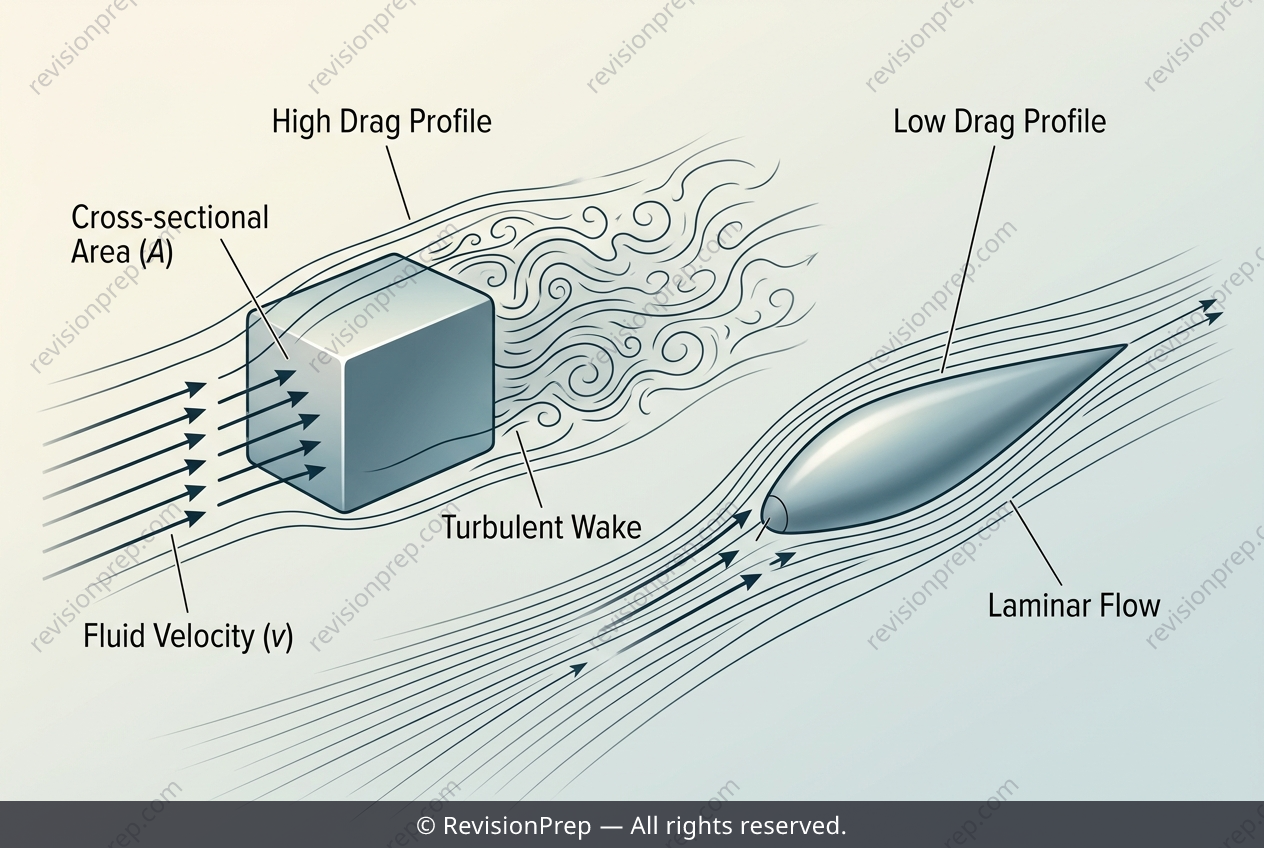
Fluid resistance is the force that opposes motion through a fluid—whether air or water—and it scales with the square of speed. For a cyclist, this means that doubling your velocity doesn’t just double the drag; it quadruples it. The drag force is given by Fd = ½ ρ Cd A v², where ρ is the fluid density, Cd is the drag coefficient (a shape-dependent factor), and A is the cross-sectional area facing the flow. Together, Cd and A determine how “slippery” an object is, and reducing either one directly cuts the resistive force at any given speed. This concept matters because aerodynamic efficiency separates competitive cyclists from casual riders—at racing speeds, drag can account for over 90% of the total resistance. A helmet with a flat front and a high C_d (like a boxy design) will always push more air aside than a streamlined teardrop shape, which guides air smoothly around the rider. However, the benefit of a low-drag shape is not constant: because drag depends on v², the absolute difference between two designs shrinks dramatically at low speeds. Additionally, a teardrop profile is optimised for straight-on airflow; in crosswinds, it can create side forces that compromise stability—a trade-off between pure aerodynamics and real-world handling.
Start practising IB questions today
150,000+ IB-styled questions, criteria-mapped and instantly accessible.