
Physics: Why Falling Objects Reach Terminal Velocity
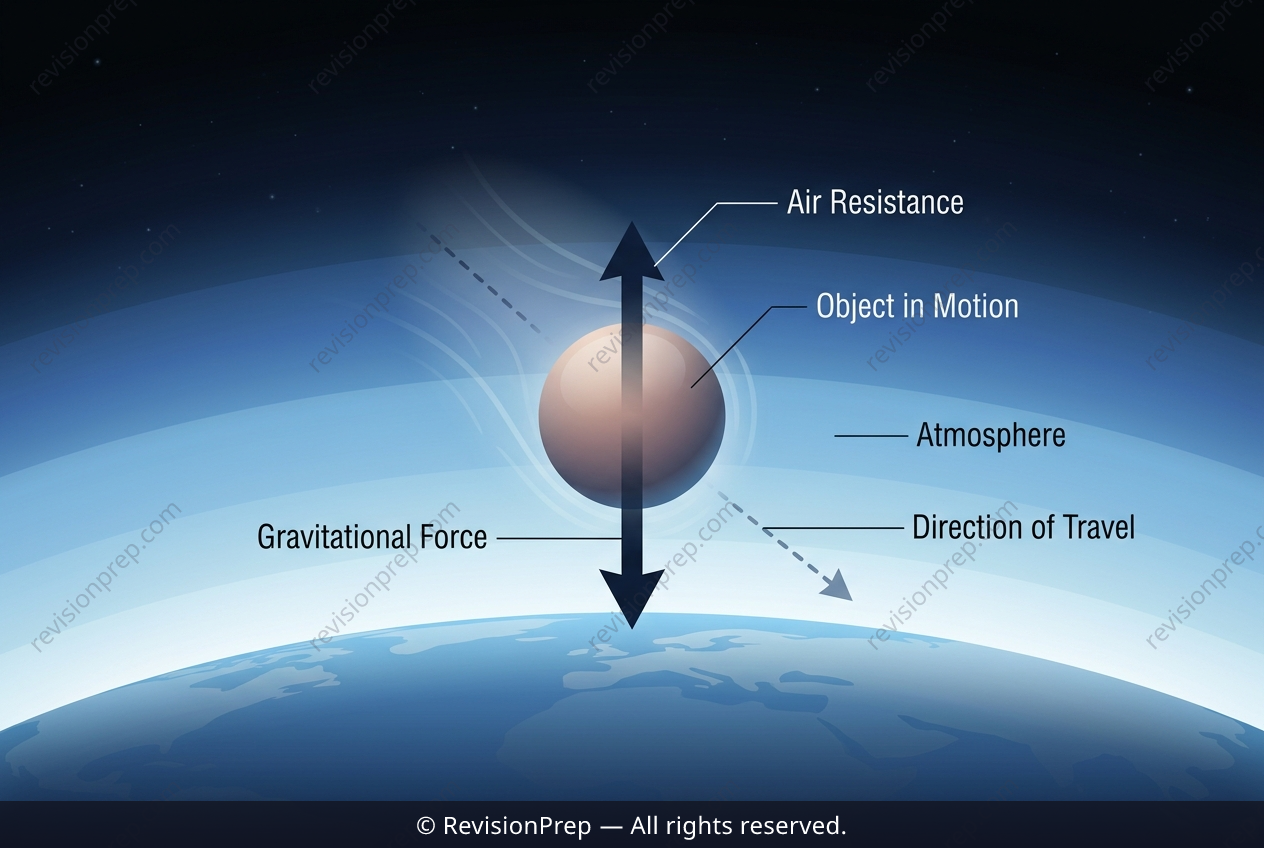
When a ball is released above Earth, it doesn’t simply hover—it accelerates downward. That invisible pull, the reason objects fall, is gravitational force (often called gravity). It is the attractive interaction between any two masses, and here, Earth’s large mass exerts a force on the ball’s mass, drawing it toward the planet’s centre. This force acts continuously, giving the ball its weight (W = mg), where m is mass and g is the gravitational field strength (≈ 9.8 N/kg on Earth). But gravity isn’t the only actor in this story. As the ball falls, it pushes air molecules aside, and they push back—this is air resistance, a contact force opposing motion. While gravity points straight down, air resistance points up, and their difference determines the net force (F_net = ma). Early in the fall, gravity dominates, so the ball speeds up. As speed increases, air resistance grows until it balances gravity, leading to terminal velocity. Understanding how these two forces interact—one constant and attractive, the other speed-dependent and resistive—explains why a feather drifts while a stone drops quickly, and why every falling object eventually reaches a steady speed if it falls long enough.
Start practising IB questions today
150,000+ IB-styled questions, criteria-mapped and instantly accessible.