
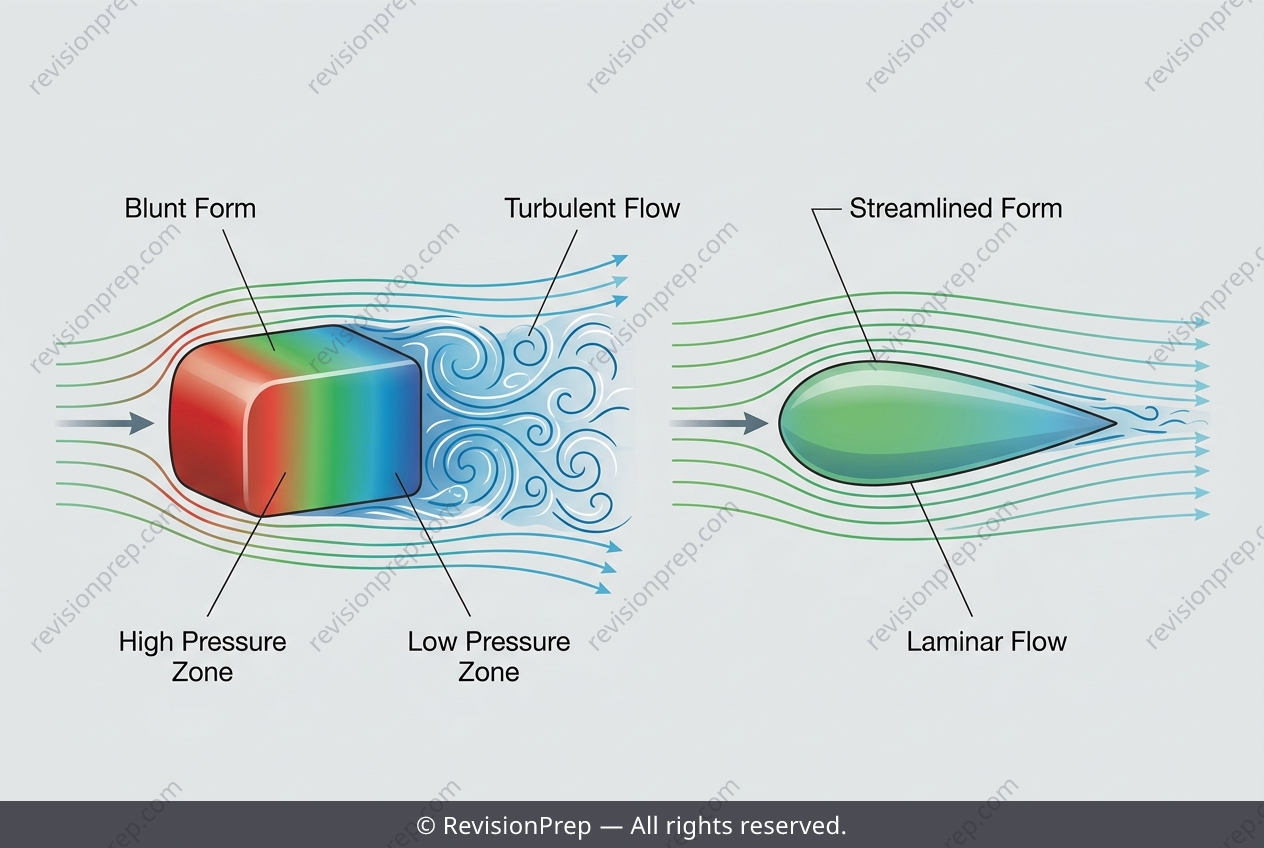
Physics: Why Streamlined Shapes Reduce Air Resistance
When a car moves through air, it must constantly push aside countless air particles, and the resistance it feels from this interaction is known as air resistance or drag. This force opposes motion, and its magnitude depends heavily on the object’s shape and the way air flows around it. At its core, drag is governed by the relationship Fdrag = ½ρv²CdA, where ρ is air density, v is speed, C_d is the drag coefficient, and A is the frontal surface area—but the real story lies in how shape influences these factors. The distinction between a flat, box-shaped front and a smooth, curved one illustrates the principle of streamlining. A flat front presents a large surface area directly to oncoming air, forcing particles to stop abruptly and pile up, creating high-pressure zones and chaotic, swirling turbulence behind the vehicle. In contrast, a streamlined, curved shape allows air to follow the contour smoothly, splitting it gently and letting it rejoin with minimal disturbance. This reduces the drag coefficient and the energy wasted on turbulence, which is why modern vehicles, aircraft, and even athletes adopt curved profiles—they minimise the air’s resistance by guiding flow rather than fighting it. Understanding this mechanism connects shape, airflow, and force in a single, practical principle.
Start practising IB questions today
150,000+ IB-styled questions, criteria-mapped and instantly accessible.