
Physics: Why Zero Net Force Keeps a Book Still
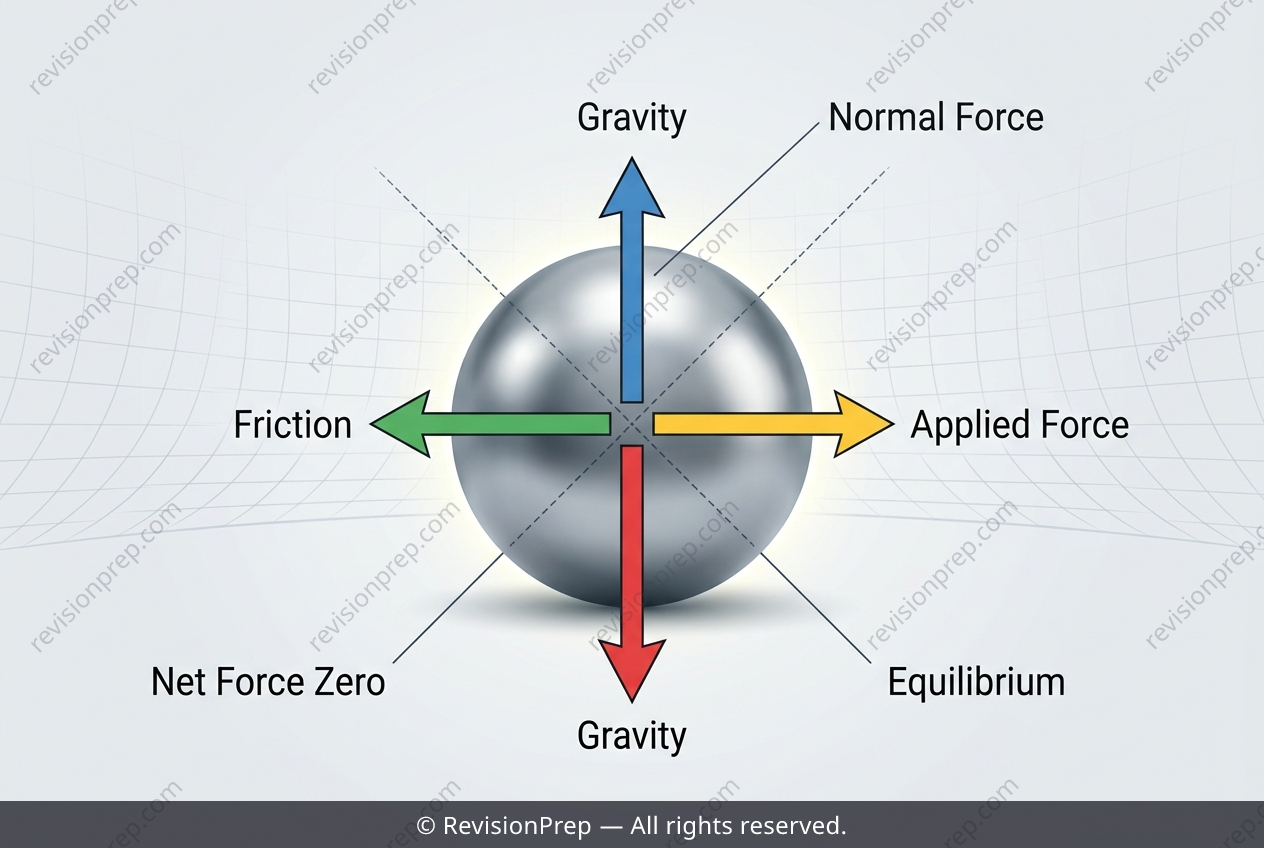
When a book sits motionless on a table, it is not simply “doing nothing”—it is a perfect demonstration of Newton’s First Law of Motion. This law states that an object at rest will remain at rest unless acted upon by a net (unbalanced) external force. In this scenario, two distinct forces are at play: the downward pull of gravity (the book’s weight) and the upward push of the table, known as the normal force. These forces act along the same line but in opposite directions. The key to understanding why the book remains stationary lies in the concept of net force. When two forces are equal in magnitude and opposite in direction, they cancel each other out, resulting in a net force of zero (F_net = 0). According to Newton’s First Law, with zero net force, there is no acceleration—so the book’s velocity stays constant at zero. This state of balanced forces is called equilibrium. The relationship between these forces is not just about them existing; it is about their precise balance, which dictates whether an object will stay put, speed up, slow down, or change direction. Recognising this balance is the foundation for predicting the motion of any object under the influence of multiple forces.
Start practising IB questions today
150,000+ IB-styled questions, criteria-mapped and instantly accessible.