
Matter and Its Properties
Classify substances, decode atomic structure and pick the right separation technique — fast.
Quick facts
Matter and Its Properties is one of the most conceptually dense units in IB MYP 3 Sciences, but it all comes down to one question: what are the particles doing? Once you can classify a substance as an element, compound, or mixture by its particle arrangement, everything else — chemical symbols, atomic structure, periodic trends, and separation techniques — becomes a logical extension of that idea. This teaser walks through the five concepts examiners test most often in Criterion A and C tasks: classifying matter, memorising the tricky Latin-derived chemical symbols, understanding atomic number and mass number, explaining periodic trends with cause-and-effect reasoning, and choosing the correct separation method based on physical properties. Get these five locked down and you'll handle almost any question this unit throws at you. For full worked examples, diagrams and practice sets, the complete revision note is linked below.
What you’ll be able to do
Classifying Elements, Compounds and Mixtures
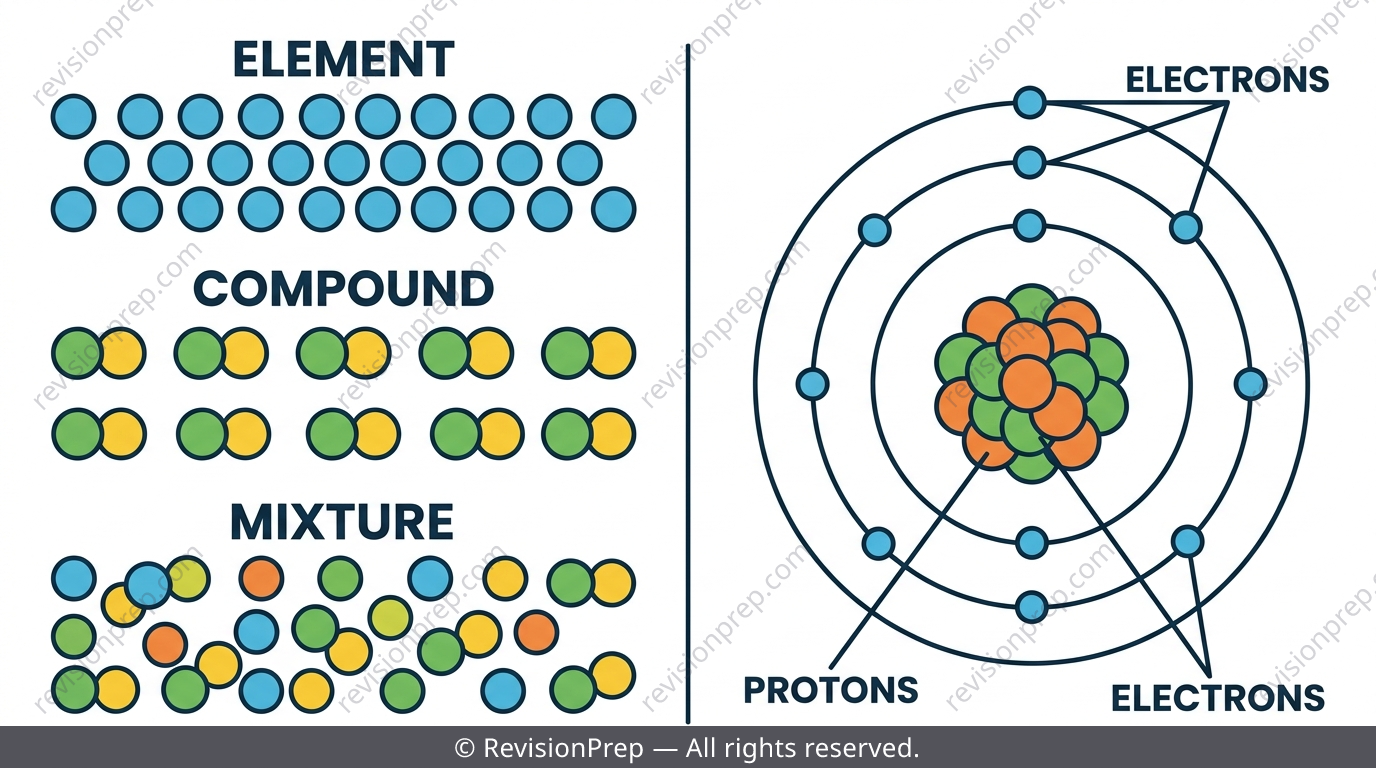
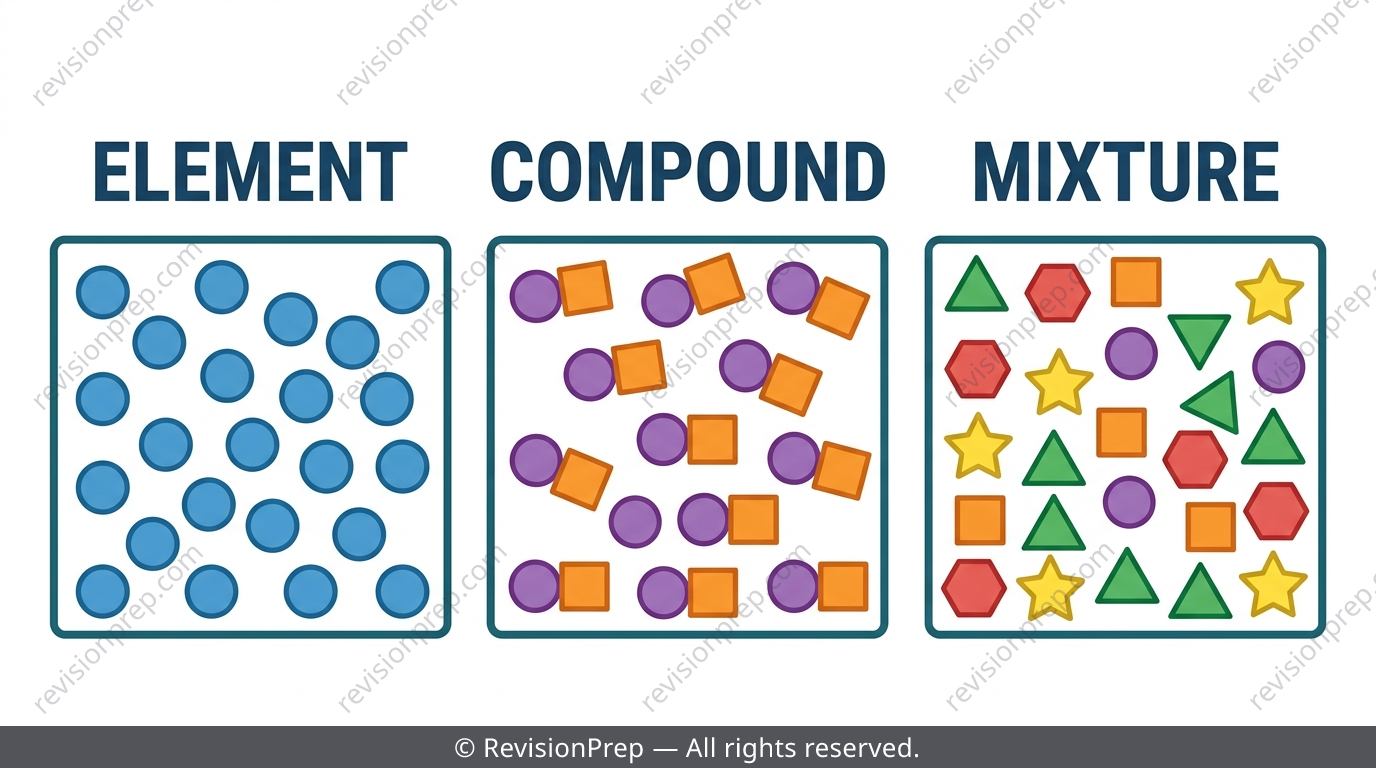
Everything comes down to what the particles are doing: identical atoms throughout means an element, different atoms chemically bonded in a fixed ratio means a compound, and anything physically jumbled together with no bonding means a mixture. Compounds usually behave completely differently from the elements that formed them — think explosive sodium and toxic chlorine gas becoming harmless table salt. Mixtures, by contrast, keep the individual properties of their parts because nothing has actually bonded, which is exactly why they can be separated by physical methods.
Exam tip
If a question asks you to justify a classification, describe the particle arrangement (bonded vs jumbled, same vs different atoms) rather than just naming the category.
Common mistake
Assuming a compound will share properties with its component elements, when in reality bonding usually creates entirely new properties.
Mini summary
Classify by particles: same atom = element, bonded different atoms in fixed ratio = compound, physically combined = mixture.
Chemical Symbols and the Latin Exceptions
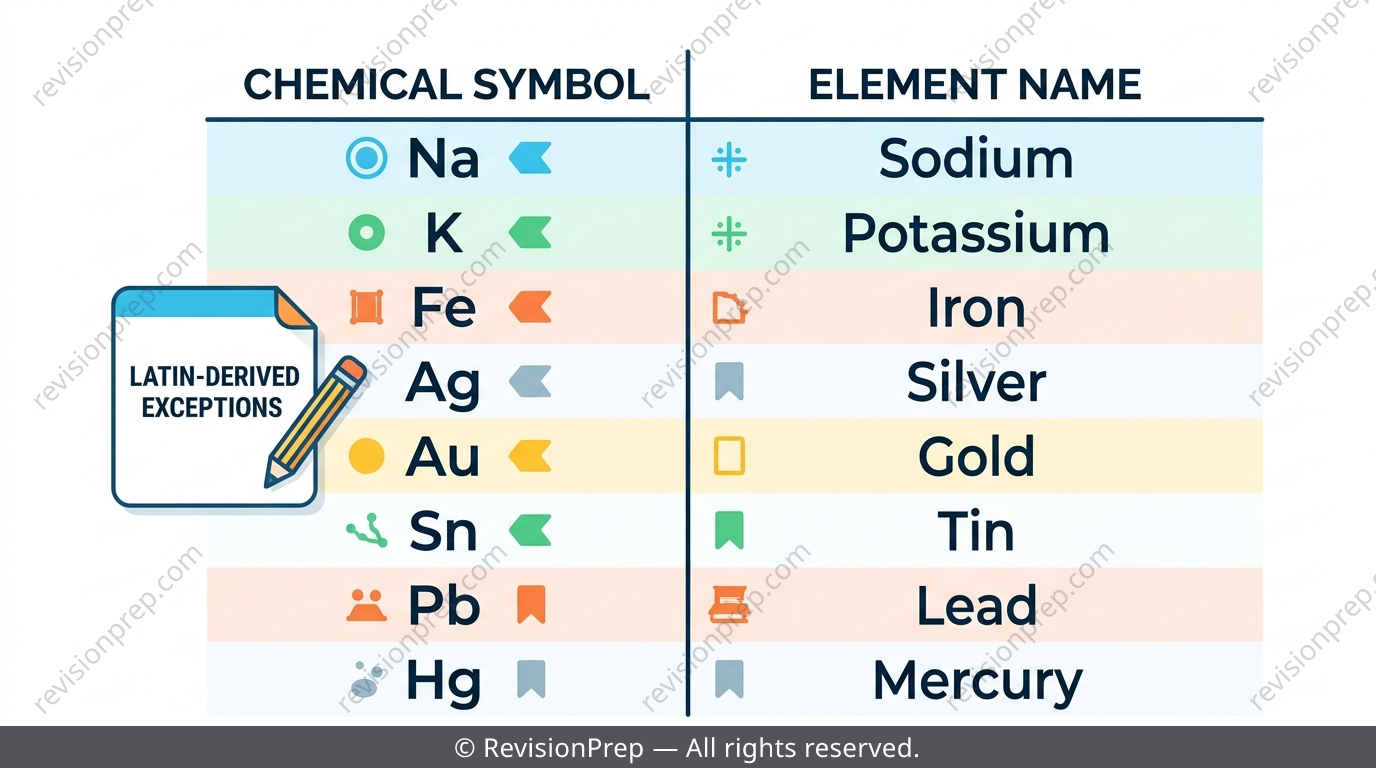
Every element has a one- or two-letter symbol, always capital first letter and lowercase second letter — Co (cobalt) is not the same as CO (carbon monoxide). Many symbols come from Latin or Greek roots rather than English, and this is the single most commonly tested trap in this section. Symbols like Na, K, Fe, Ag, Au, Sn, Pb and Hg simply cannot be guessed from the English element name and must be memorised as exceptions.
Exam tip
For 'explain' questions worth multiple marks, give the full chain: what the symbol comes from, why that naming system was used, and the specific word — not just 'it's Latin'.
Common mistake
Assuming a chemical symbol's first letter must match the English element name (e.g. expecting 'L' for Lead) instead of recognising the Latin-derived exceptions.
Mini summary
Memorise Na, K, Fe, Ag, Au, Sn, Pb, Hg as Latin-root exceptions; capitalisation changes meaning entirely (Co vs CO).
Atomic Structure: Protons, Neutrons and Electrons
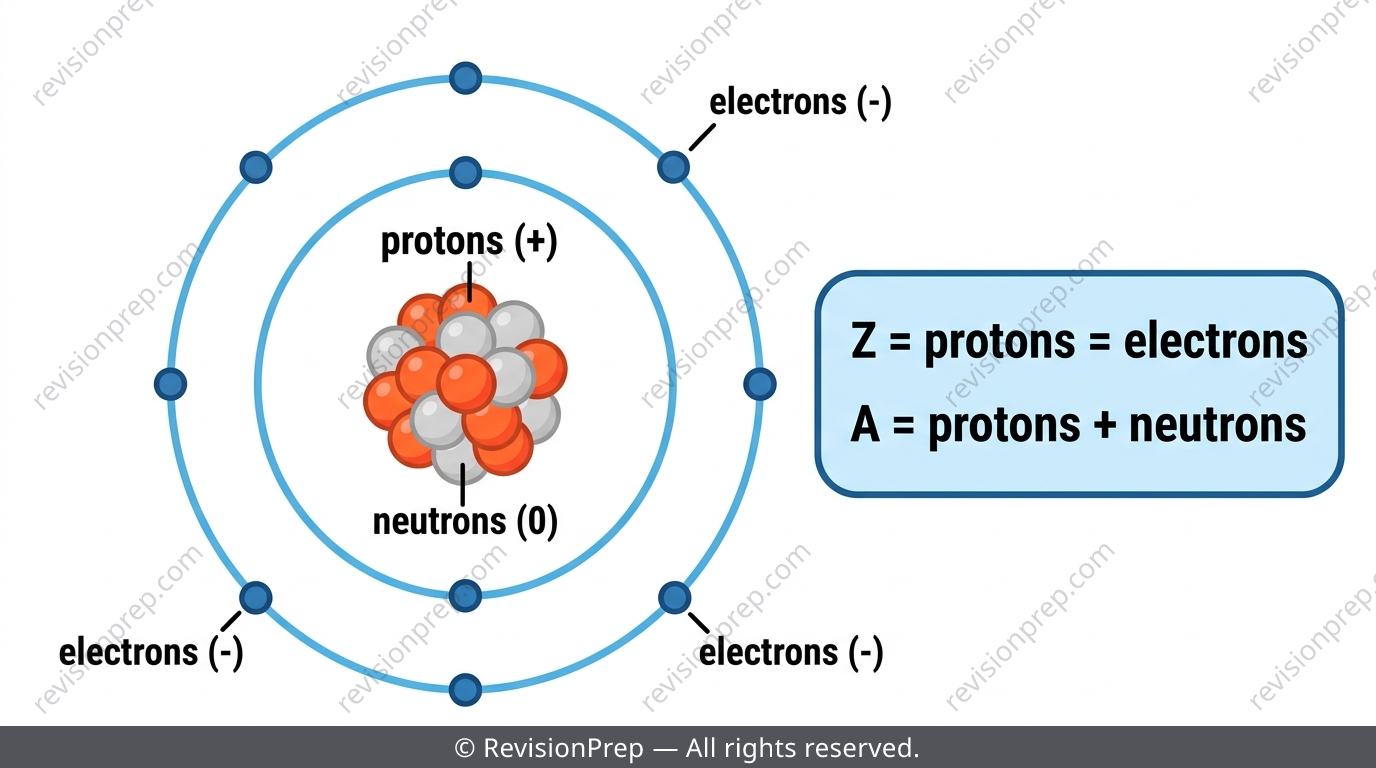
Every atom has a tiny, dense nucleus of protons and neutrons surrounded by electrons in shells at relatively huge distances away. Atomic number equals the number of protons, and since atoms are neutral, also equals the number of electrons. Mass number is simply protons plus neutrons, since electrons are too light to matter for mass. Isotopes are atoms of the same element with a different number of neutrons, giving the same chemistry but a different mass.
| Particle | Location | Relative charge | Relative mass |
|---|---|---|---|
| Proton | Nucleus | +1 | 1 |
| Neutron | Nucleus | 0 | 1 |
| Electron | Shells around nucleus | -1 | ~1/1840 |
Exam tip
Atomic number is always the smaller whole number with no decimals; mass number (or relative atomic mass) is the larger figure, often shown with a decimal because it's an average across isotopes.
Common mistake
Confusing atomic number with mass number, especially on a simplified periodic table tile.
Mini summary
Z = protons = electrons; A = protons + neutrons; neutrons = A − Z; isotopes share protons but differ in neutrons.
Periodic Trends: Atomic Radius and Ionisation Energy
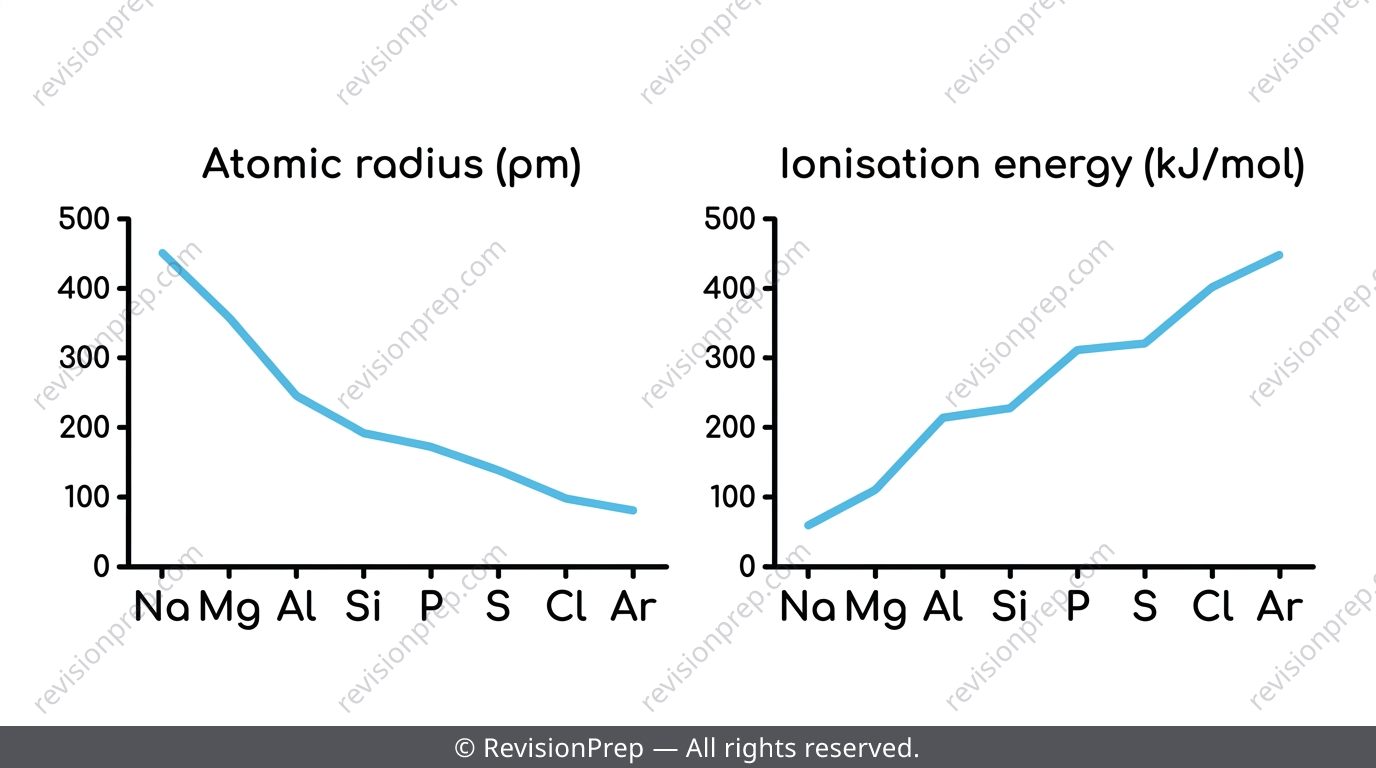
Across a period, electrons keep being added to the same outer shell while the number of protons increases — this single fact explains both trends. More protons pull the electron shell in tighter, so atomic radius shrinks across a period. That same stronger pull makes it harder to remove an outer electron, so ionisation energy rises across a period. A frequent structure error is claiming a new shell forms across a period — it doesn't; only nuclear pull changes.
Exam tip
Always finish an 'explain the trend' answer with the causal chain: more protons → stronger nuclear pull → [effect on radius or ionisation energy]. Stopping at 'atomic number increases' only repeats the data and caps you at partial marks.
Common mistake
Saying atomic radius decreases 'because there's another shell' — the number of shells stays constant across a period, only nuclear charge increases.
Mini summary
Same shell, more protons, stronger pull: atomic radius falls and ionisation energy rises across a period.
Separation Techniques for Mixtures
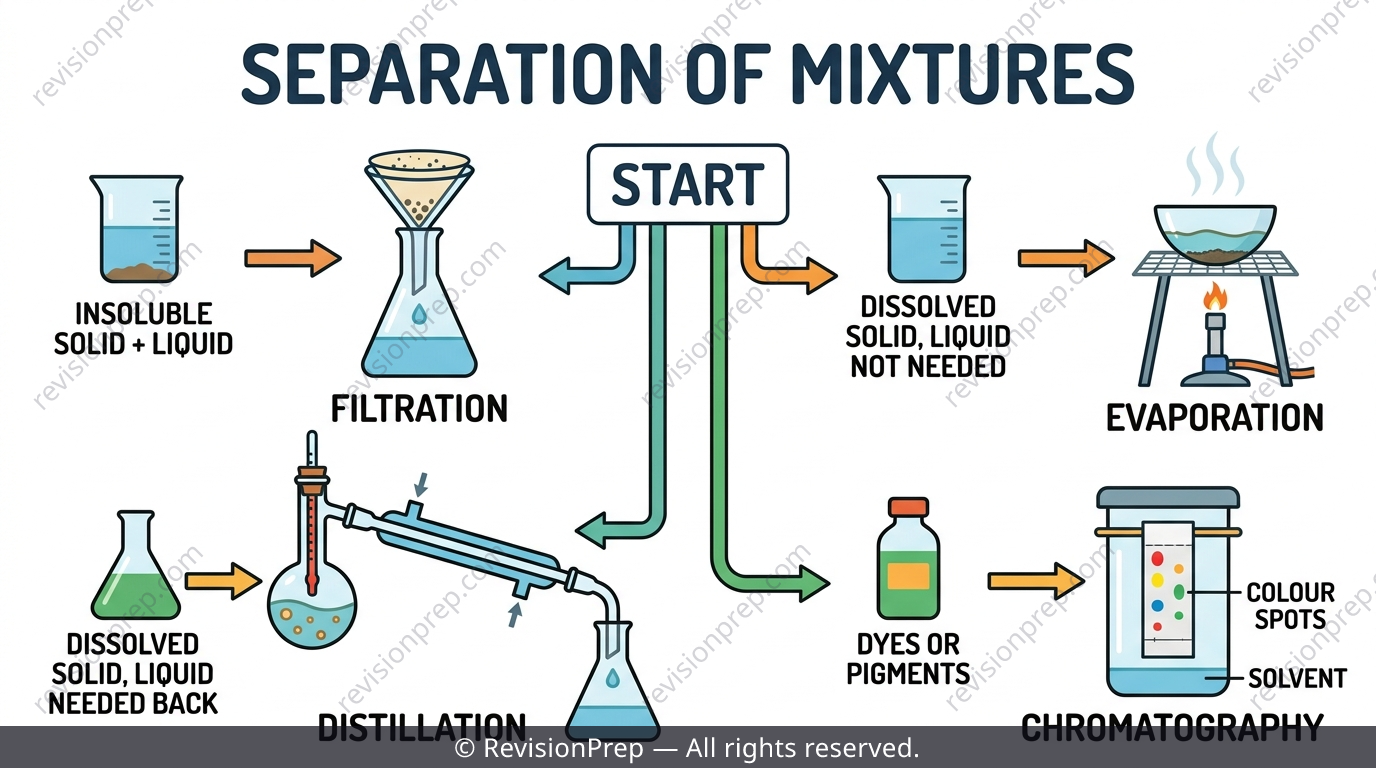
Because mixtures aren't chemically bonded, they can always be separated using a physical property difference such as particle size, solubility, density, or boiling point. An insoluble solid in a liquid is separated by filtration, using particle size. A dissolved solid where you don't need the liquid back is separated by evaporation, while a dissolved solid or liquid mixture where you DO need the liquid back requires distillation. Dyes or pigments are separated using chromatography, which exploits differences in solubility.
Exam tip
Before naming a technique, identify the exact physical property being exploited (size, solubility, or boiling point) — this reasoning is usually worth its own mark.
Common mistake
Choosing evaporation when the liquid solvent is actually needed back — evaporation destroys the solvent, so distillation is required instead.
Mini summary
Filtration = particle size; evaporation = lose the solvent; distillation = keep the solvent; chromatography = solubility differences.
Quick formula sheet
Practice questions
- Classify each as an element, compound, or mixture: oxygen gas, salt water, carbon dioxide.
- Write the chemical symbol for iron, gold, and lead.
- State whether atomic number or mass number is always the smaller value.
- Explain why sodium chloride behaves completely differently from sodium metal and chlorine gas.
- An atom has 17 protons and 18 neutrons. State its atomic number, mass number, and number of neutrons.
- Name the separation technique you would use to recover pure water from salt water, and explain why.
- Explain, using atomic structure, why atomic radius decreases from sodium to chlorine across Period 3.
- Explain, using atomic structure, why first ionisation energy increases across a period, referencing both nuclear charge and shell distance.
- Two isotopes of the same element have different mass numbers. Explain why they have identical chemical behaviour despite this difference.
Frequently asked questions
What's the easiest way to tell an element from a compound?+
Look at the particles: if every particle is the same type of atom, it's an element; if different atoms are chemically bonded in a fixed ratio, it's a compound.
Why isn't the symbol for gold just 'G'?+
Many chemical symbols come from Latin element names rather than English — gold's symbol Au comes from 'aurum', so it can't be guessed from the English spelling.
How do I find the number of neutrons in an atom?+
Subtract the atomic number from the mass number (neutrons = mass number − atomic number).
Why does atomic radius shrink across a period instead of grow?+
Electrons keep filling the same outer shell while protons increase, so the stronger nuclear pull draws the shell in tighter rather than adding a new one.
How do I know whether to use evaporation or distillation?+
Use evaporation if you only need the dissolved solid back; use distillation if you also need to recover the liquid solvent.
Does RevisionPrep provide official IB MYP exam papers for this topic?+
No — RevisionPrep provides original revision notes and practice questions modelled on the MYP curriculum, not official exam-board material.
Master Matter and Its Properties with the Full MYP 3 Revision Note
Related articles