
Forces and Motion: MYP 3 Sciences Revision
Master friction, motion graphs, and net force — the reasoning behind every 'explain the motion' question.
Quick facts
Forces don't have to be big or dramatic to matter — even a book sitting still on a table has forces acting on it, just balanced ones. IB MYP 3 Sciences forces and motion builds one core skill: identify every force acting on an object, work out the net force, and use that to explain or predict its motion. Distance-time graphs and the vocabulary of speed, velocity and acceleration let you describe motion precisely, while friction, force diagrams, and balanced versus unbalanced forces let you explain why it happens. Exam questions love to hide friction inside real contexts — carpets, brake pads, sliding boxes — and test whether you can link a smaller friction force directly to a bigger net force and faster motion. This teaser covers the five ideas examiners return to again and again. For full worked examples, definitions, and the complete formula set, head to the full RevisionPrep notes.
What you’ll be able to do
Friction, Air Resistance and Drag
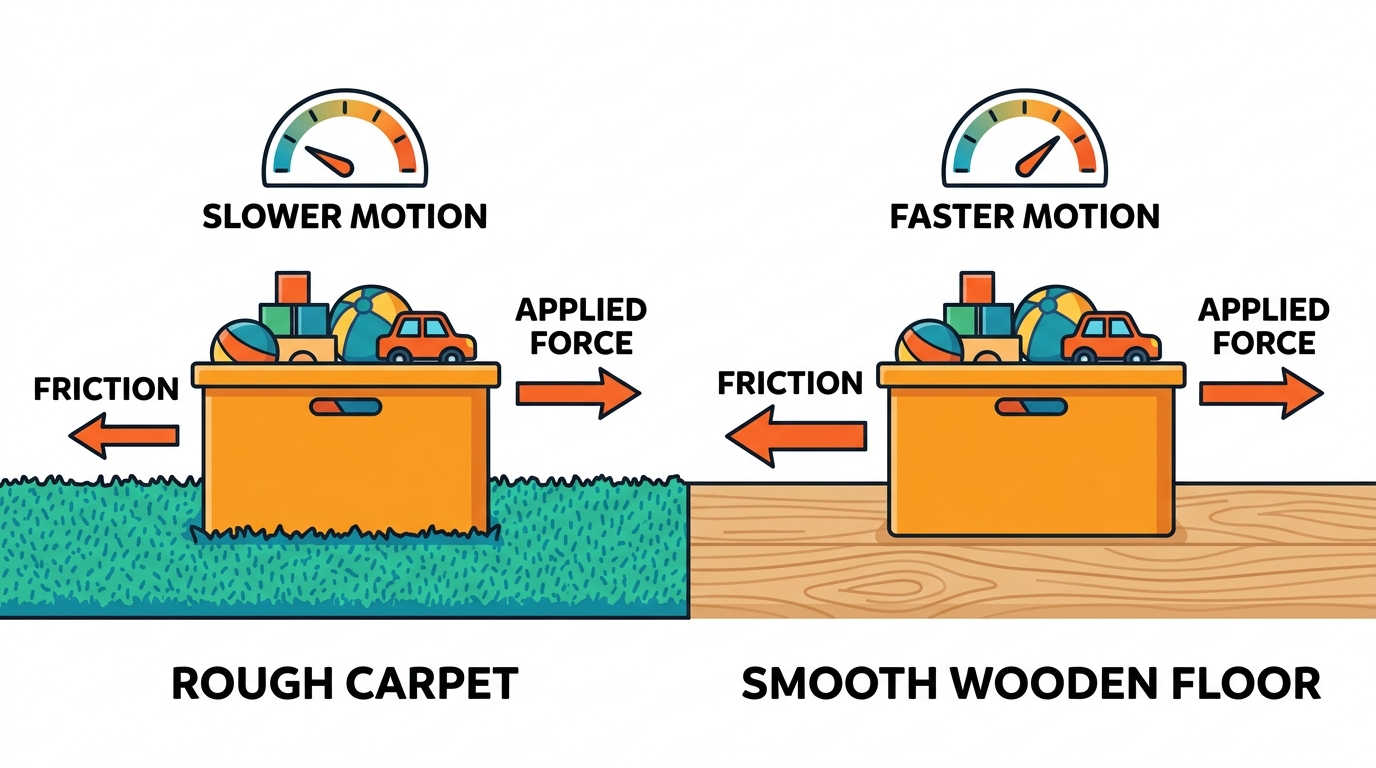
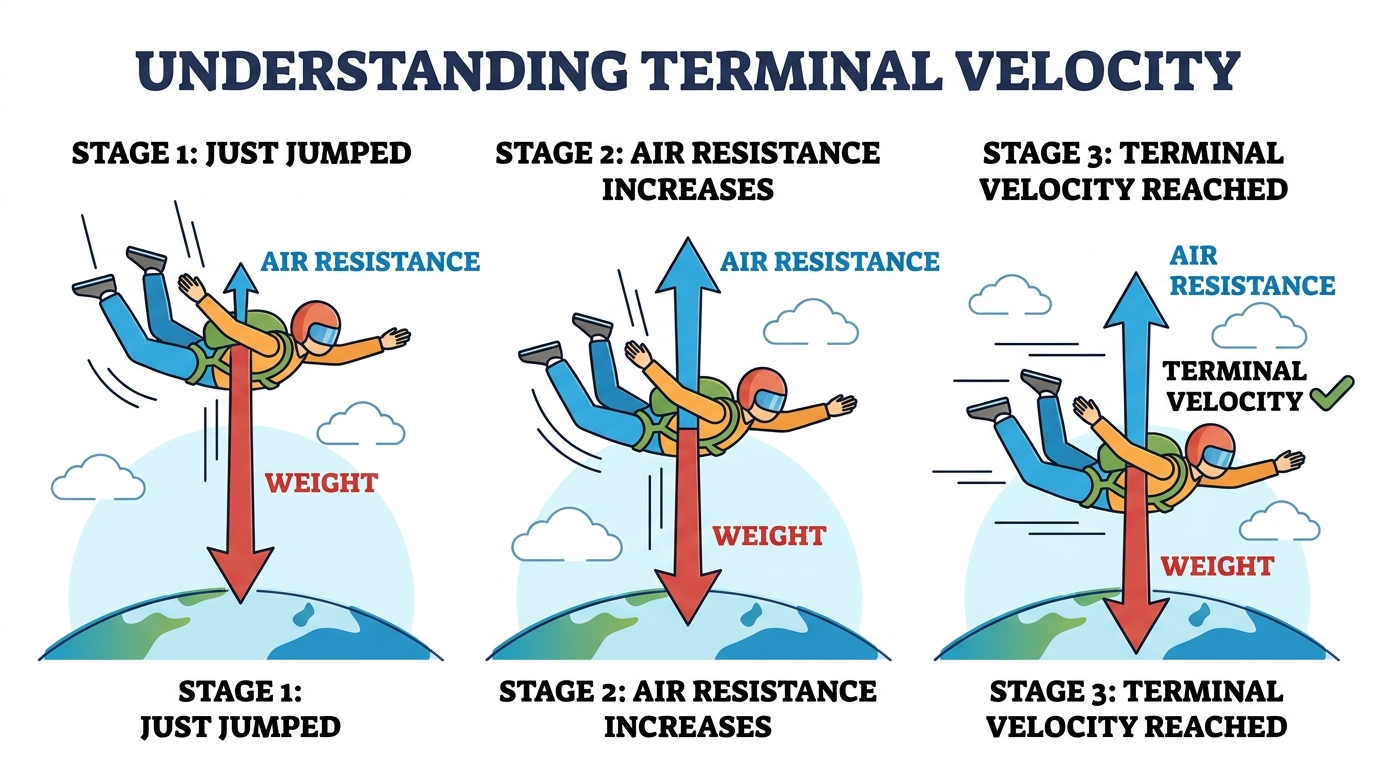
Friction is a contact force that opposes relative sliding between two touching surfaces — it never acts in the direction you're pushing. Its size depends on surface roughness and how hard the surfaces are pressed together (normal force), not on how much area is in contact. Rolling friction is much smaller than sliding friction, which is why wheels and ball bearings reduce resistance. Air resistance and drag work the same way but come from a fluid, increasing with speed and cross-sectional area, and a falling object reaches terminal velocity once drag exactly balances weight.
| Surface (rough → smooth) | Typical friction size | Effect on stopping distance/time |
|---|---|---|
| Sandpaper | High | Short stopping distance, quick stop |
| Carpet | Medium | Moderate stopping distance |
| Tile/wood | Low | Longer stopping distance |
| Polished glass | Very low | Longest stopping distance |
Exam tip
One-mark 'explain' questions on friction only score if you state the full chain: smaller friction → larger net force → faster motion. Saying 'the floor is smoother' alone usually earns 0/1.
Common mistake
Believing friction depends on how much surface area is touching. It actually depends on surface texture and normal force — a bigger box does not automatically mean more friction.
Mini summary
Friction opposes sliding motion, depends on roughness and normal force (not area); drag balances weight at terminal velocity.
Reading Distance–Time Graphs
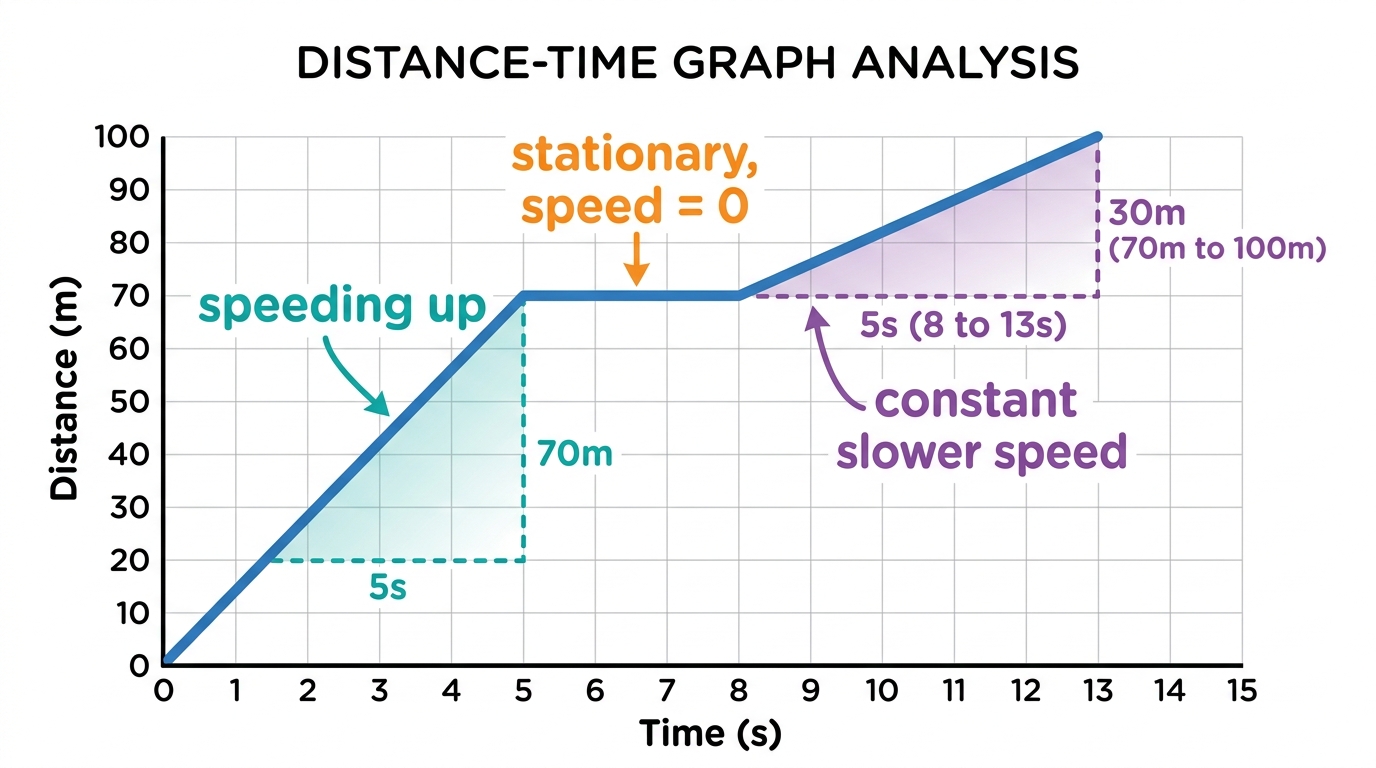
A distance-time graph plots how far an object is from its start point against time, and the gradient of the line at any point is the speed — steeper is faster, flatter is slower, horizontal is completely stationary. A straight line means constant speed, while a curve means the speed is changing: getting steeper means accelerating, flattening means decelerating. Calculate gradient using change in distance over change in time for the specific section you're asked about.
Exam tip
When asked to describe a graph, name each section in sequence ('speeds up, then stays still, then speeds up again more slowly') — marks are given per correctly identified section, not for one overall comment.
Common mistake
Reading a horizontal section as 'moving slowly' instead of completely stopped. If the line is perfectly flat, gradient = 0, so speed = 0.
Mini summary
Gradient = speed; straight line = constant speed; curve = changing speed; flat = at rest.
Speed, Velocity and Acceleration
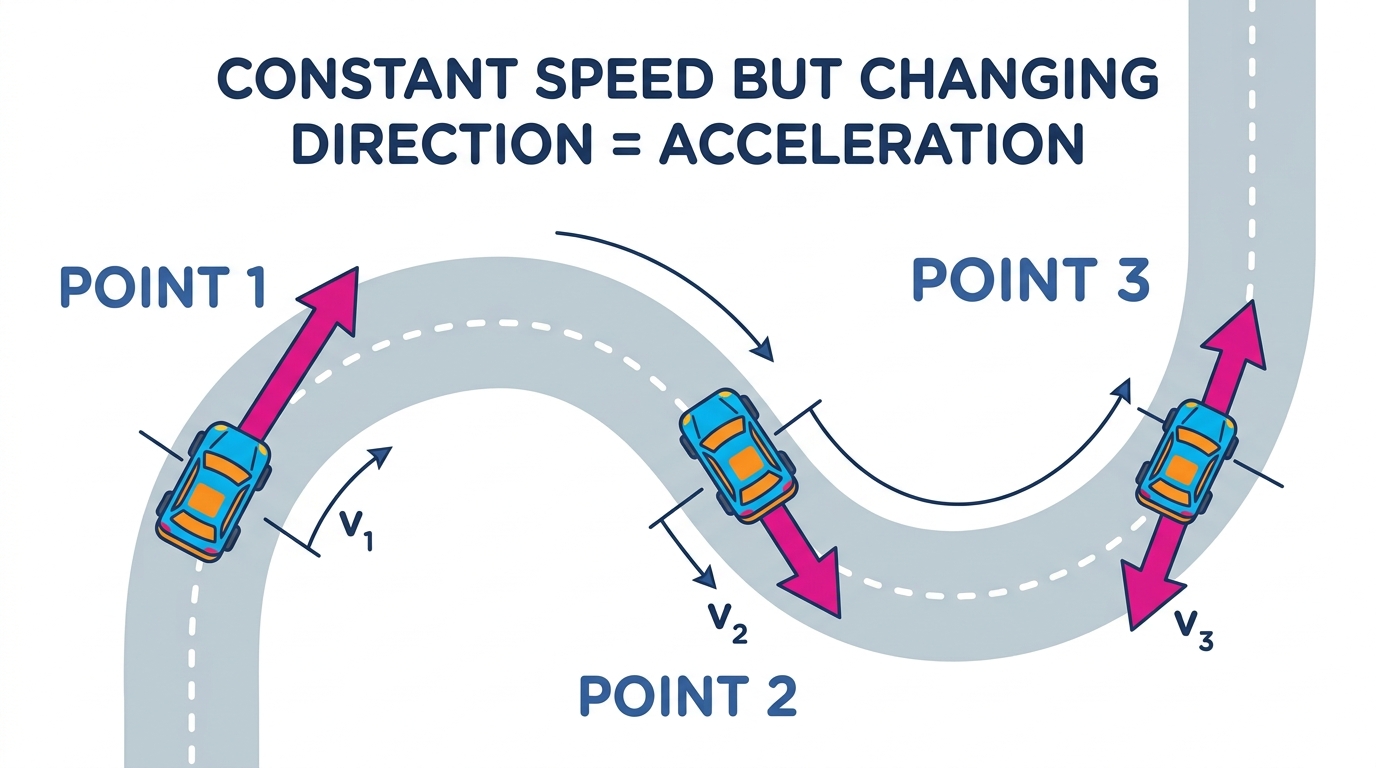
Speed is a scalar — just how much distance is covered per unit time. Velocity is speed with a direction attached, making it a vector. Acceleration measures how quickly velocity is changing, so it exists whenever an object speeds up, slows down, or even changes direction at constant speed, like a car going round a bend.
Exam tip
Don't assume negative acceleration always means 'slowing down' — it just means velocity is decreasing in the chosen positive direction, which can mean speeding up in the opposite direction.
Common mistake
Mixing up speed and velocity is the single most common vocabulary error in this unit — always check whether a direction is implied or required by the question.
Mini summary
Speed = scalar (size only); velocity = vector (size + direction); acceleration = rate of change of velocity, including direction changes.
Contact vs Non-Contact Forces
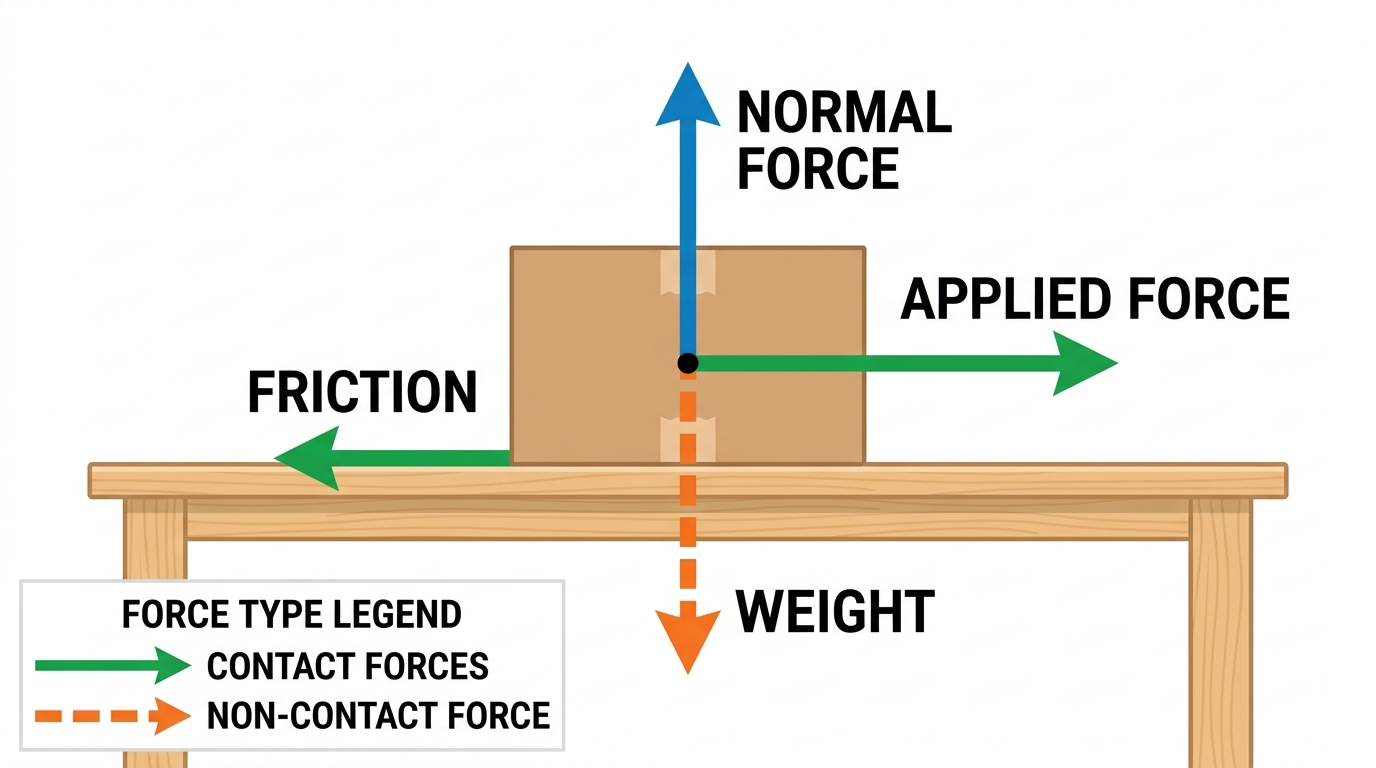
Before you can draw a force diagram, you need to correctly identify which forces are even acting on an object. Contact forces, like friction, the normal force, and applied push/pull forces, only act when surfaces are touching. Non-contact forces, like gravity, act on an object without any physical touching required, which is why weight still acts on objects in mid-air.
Exam tip
In force-diagram questions, list every force you can identify before drawing arrows — missing a force is the most common way to get the net force wrong.
Mini summary
Contact forces need touching surfaces (friction, normal force, applied force); non-contact forces act at a distance (gravity).
Balanced and Unbalanced Forces
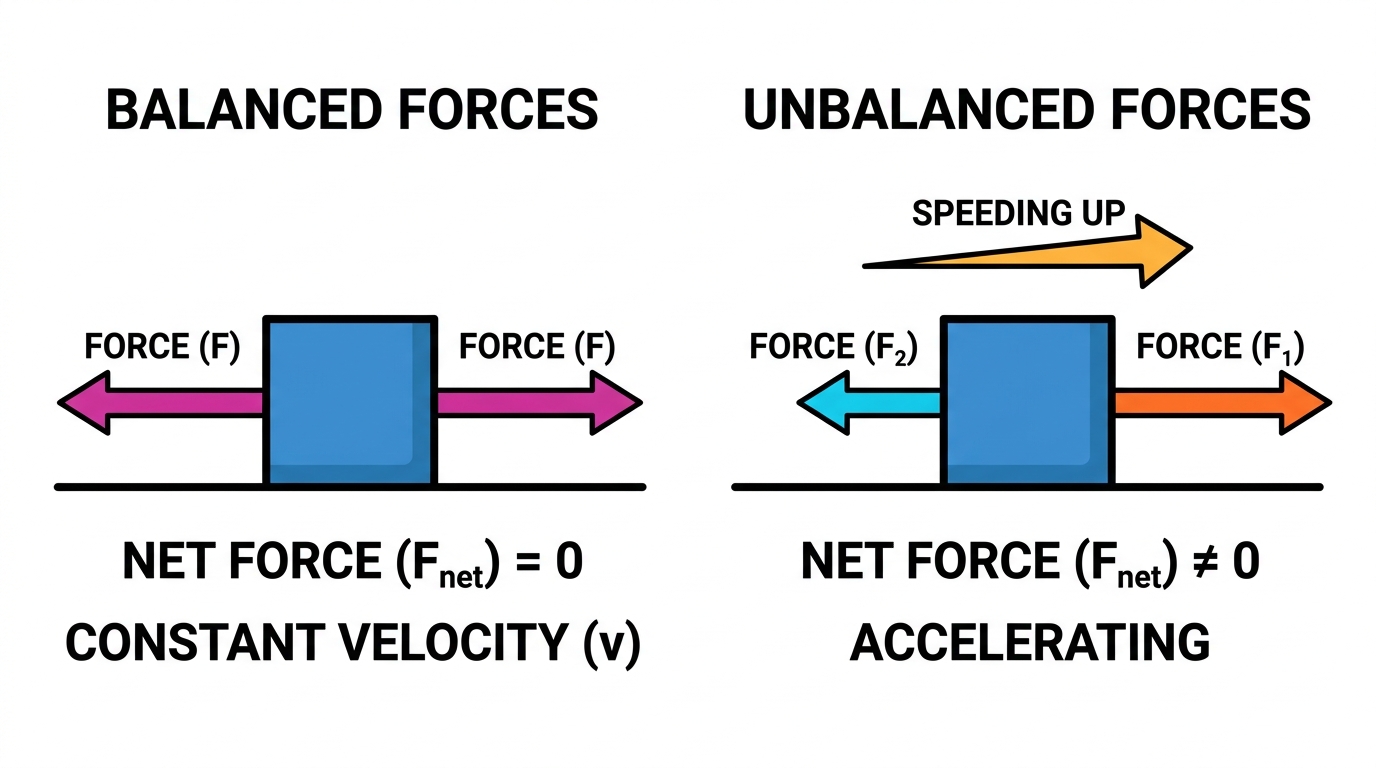
This is the payoff idea of the whole unit: when all the forces on an object combine to a net force of zero, the object stays at rest or keeps moving at constant velocity. When the forces don't cancel out, there's a net (unbalanced) force, and the object accelerates in the direction of that net force. Use the friction formula to connect a change in one force directly to a change in speed or acceleration — that causal link is what earns explain marks.
Exam tip
Consistency-analysis questions require you to state the direction of the trend and show a new data point fits it — a bare 'yes' or 'no' answer only earns partial credit.
Mini summary
Balanced forces (net force = 0) → constant velocity or rest; unbalanced forces (net force ≠ 0) → acceleration in the direction of the net force.
Quick formula sheet
Practice questions
- State whether friction is a contact or non-contact force and explain why.
- What does a perfectly horizontal section of a distance-time graph tell you about an object's speed?
- Give one example each of a contact force and a non-contact force acting on a book resting on a table.
- A box is pushed with the same force across carpet and then across tile. Explain why it moves faster on the tile.
- Describe what is happening to an object's speed during a distance-time graph section that curves and gets steeper.
- A car goes around a bend at a constant speed. Explain why it is still accelerating.
- A skydiver's air resistance increases as speed increases during a fall. Explain, using net force, why the skydiver eventually stops accelerating.
- A toy car travels 15 cm on sandpaper, 32 cm on carpet, and 68 cm on tile before stopping. A new surface gives 91 cm. Analyse whether this result is consistent with the pattern shown by the other three surfaces.
- Rollers are placed under a box that was previously sliding on carpet. Describe and explain the change in friction, and predict the effect on the box's motion if the pushing force stays the same.
Frequently asked questions
What is the difference between speed and velocity?+
Speed is a scalar — it only tells you how much distance is covered per unit time. Velocity is speed with a direction attached, making it a vector, so two objects can have the same speed but different velocities.
Does friction depend on how much surface area is touching?+
No. Friction depends mainly on how rough the two surfaces are and how hard they're pressed together (the normal force), not on the contact area.
What does a flat line on a distance-time graph mean?+
A perfectly horizontal line has a gradient of zero, which means the object's speed is zero — it is completely stationary, not just moving slowly.
What is terminal velocity?+
Terminal velocity is the constant maximum speed reached when air resistance or drag becomes exactly equal in size to the driving force (like weight), making the net force zero so speed stops increasing.
What happens when forces on an object are balanced versus unbalanced?+
Balanced forces produce a net force of zero, so the object stays at rest or moves at constant velocity. Unbalanced forces produce a non-zero net force, causing the object to accelerate in that force's direction.
Why is rolling friction smaller than sliding friction?+
Rolling friction is much smaller than sliding friction for the same two surfaces, which is exactly why wheels, rollers and ball bearings are used to reduce resistance to motion.
Get the full MYP 3 Forces and Motion revision notes
Related articles