
Maths: Same Number, Three Different Forms
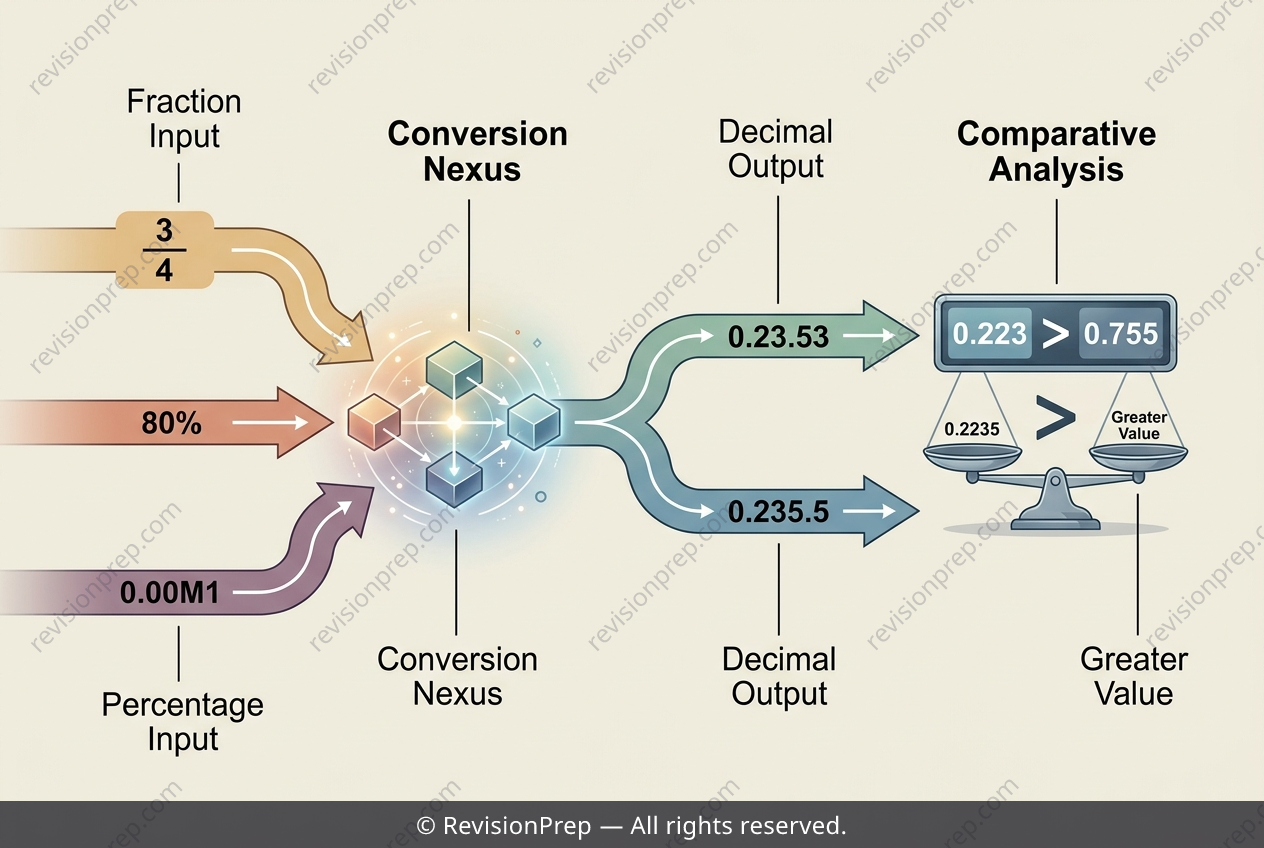
Percentages, fractions, and decimals are three different languages for the same underlying idea: parts of a whole. When you see 25%, you are looking at a ratio out of 100, which can be rewritten as the fraction 25/100 and simplified to 1/4, or expressed as the decimal 0.25. This equivalence is not just a mechanical trick—it is the foundation for comparing values that appear in different forms, a skill you will use constantly in financial contexts, data interpretation, and even everyday shopping decisions. The real power of this concept emerges when you need to compare two offers that are not expressed in the same way. Imagine one discount written as a percentage and another as a fraction—say, a percentage versus 1/3. Without a common form, your brain struggles to judge which is larger. By converting both to decimals (or both to percentages), you create a direct numerical comparison: one becomes 0.25, the other approximately 0.333. Because 0.333 is greater, the fractional discount wins. This conversion process—moving fluidly between fraction, decimal, and percentage—turns an ambiguous verbal comparison into a clear, unambiguous decision. Mastering this interconversion is not about memorising steps; it is about recognising that every rational number is simply a different lens on the same proportional truth.
Start practising IB questions today
150,000+ IB-styled questions, criteria-mapped and instantly accessible.