
Ratio, Proportion & Percentages
Master the constant multiplier that links every proportion and percentage question in MYP 3
Quick facts
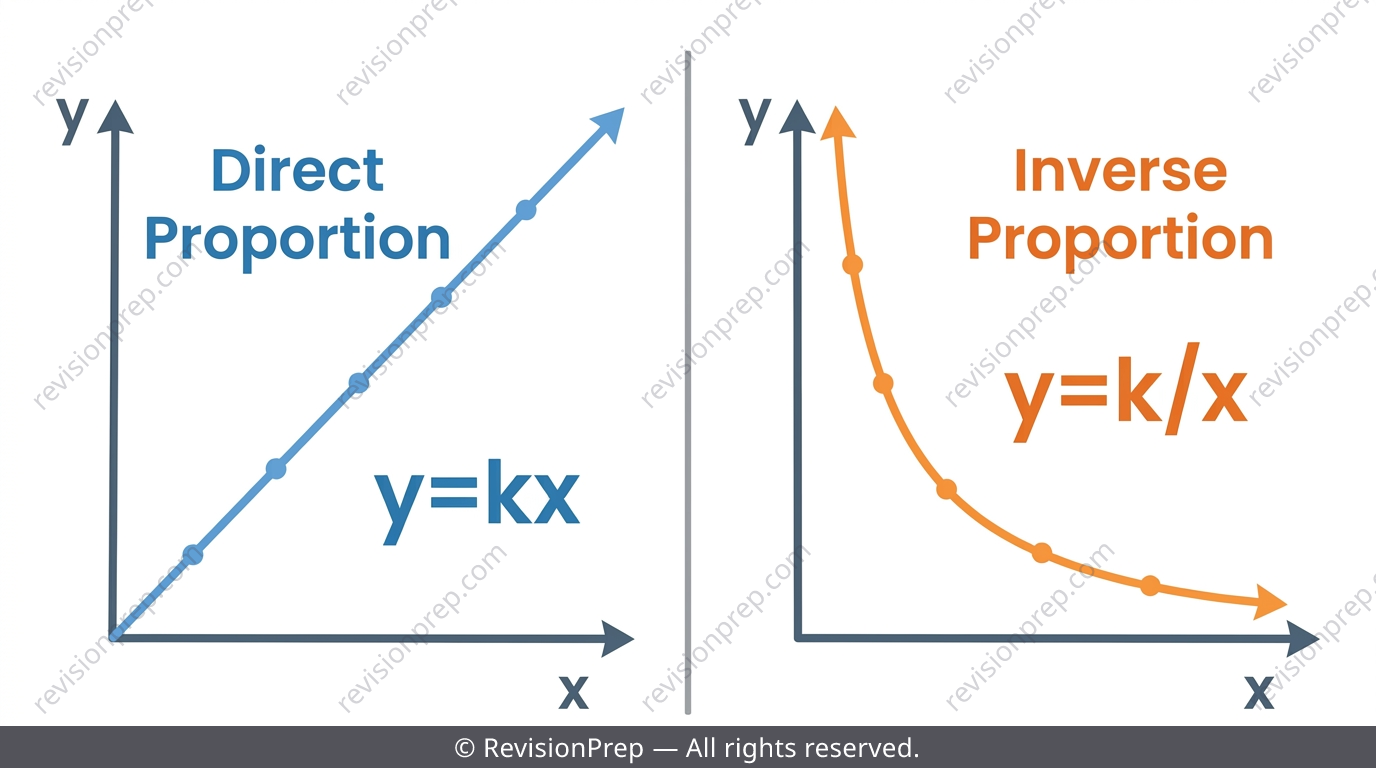
Ratio, proportion and percentages all describe how two quantities scale together, and MYP 3 tests this constantly — in unit tests, on-screen eAssessments, and real-life Criterion D investigations. The examiners' favourite move is hiding a fixed fee, bulk discount or base charge inside a question that looks proportional, and asking you to explain or justify whether the model actually holds. Getting the number right isn't enough — MYP wants reasoning. This teaser walks through the five ideas that show up again and again: spotting direct versus inverse proportion, finding and correctly using the constant multiplier , telling simple interest apart from compound interest, and applying the fast multiplier method for percentage increase and decrease. Once these click, most Number-strand questions become pattern recognition rather than guesswork. Read on for the core rules, then head to the full revision notes for worked examples, all formulas and the complete common-mistakes list.
What you’ll be able to do
Direct Proportion: y = kx
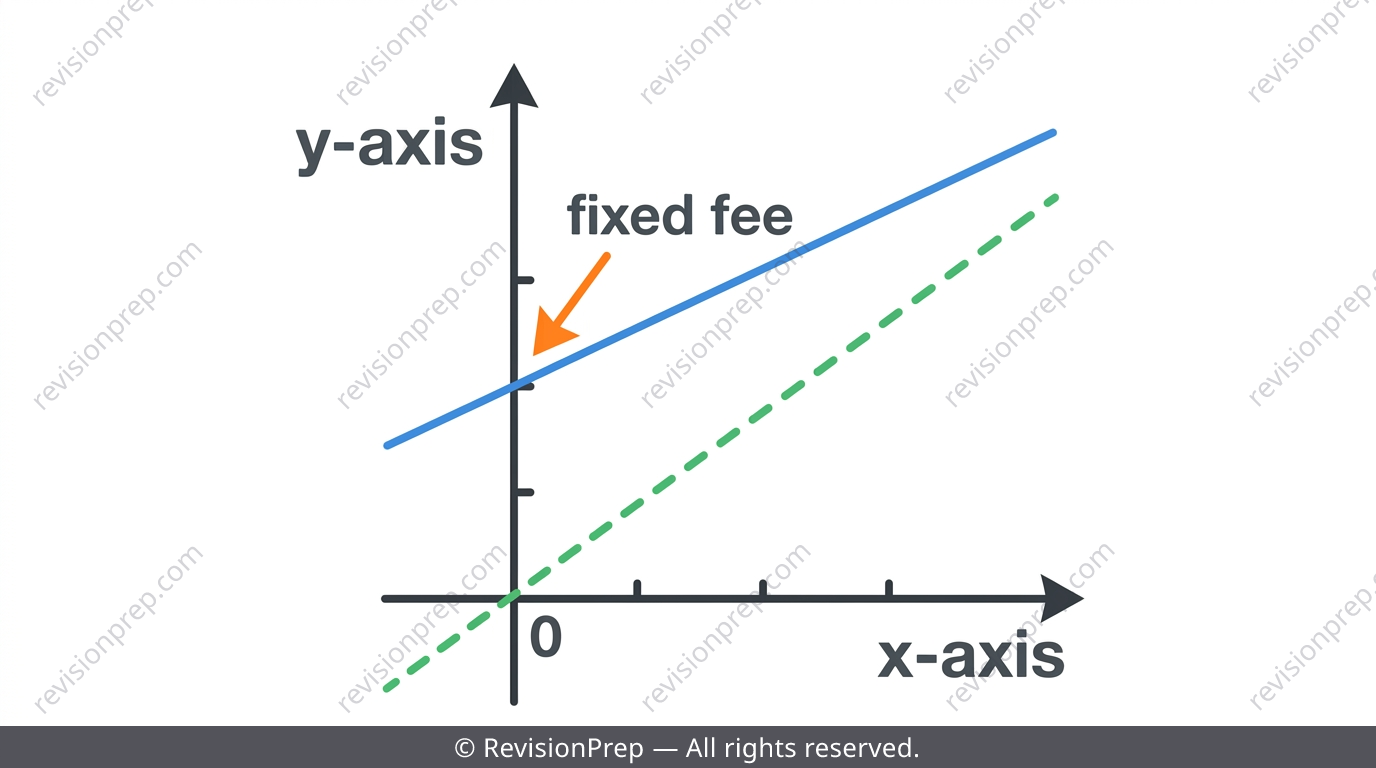
Two quantities are directly proportional if their ratio stays constant — as one increases, the other increases by the same factor, and the graph always passes through the origin. Test it from a table by checking that gives the same value for every pair. If the graph doesn't pass through — often because of a fixed fee — the relationship is linear but NOT proportional.
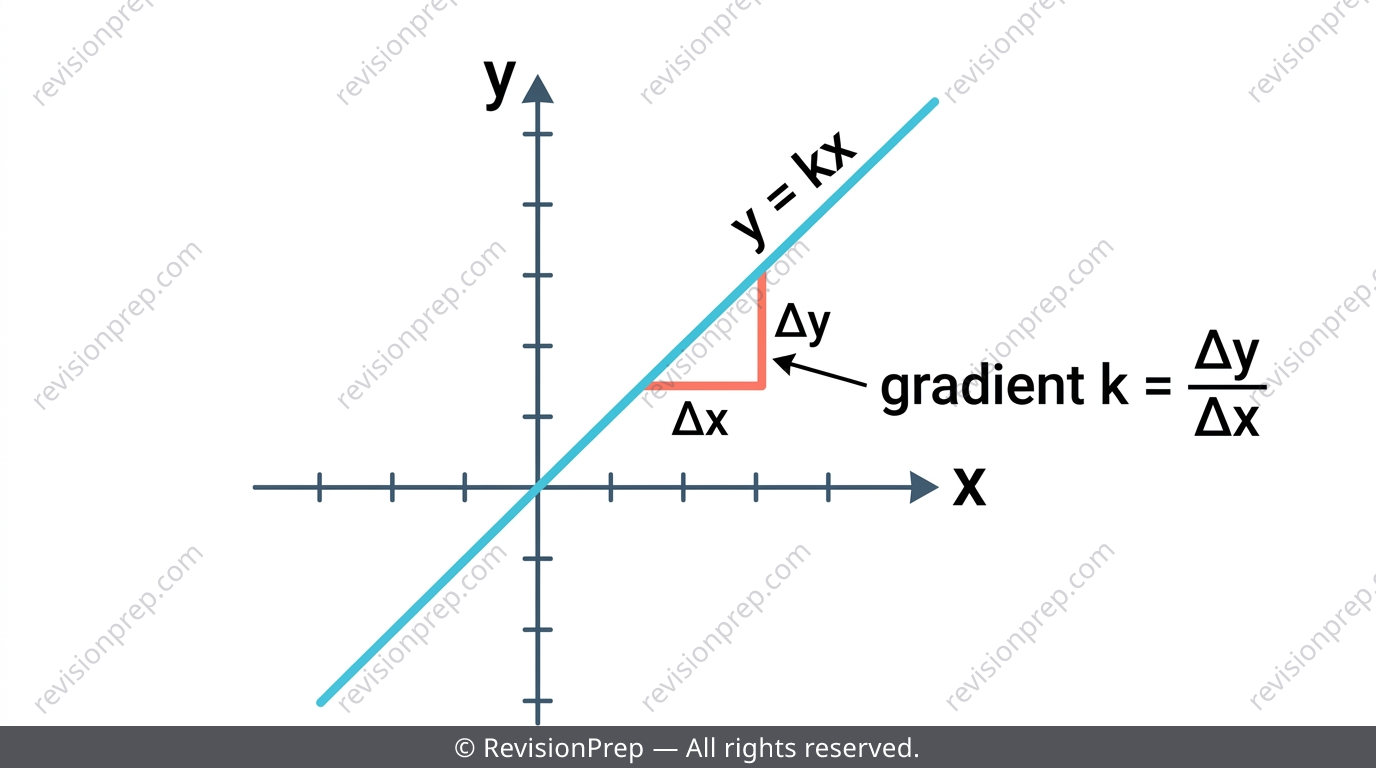
| Feature | Direct Proportion |
|---|---|
| Formula | y = kx |
| Test from table | y ÷ x is constant |
| Graph shape | Straight line through origin |
Exam tip
When asked to 'state k, including units', a bare number like 'k = 62.5' often drops a mark — write '62.5 g/serving' or similar.
Common mistake
Assuming any straight-line relationship is proportional, even when it has a fixed starting fee that stops it passing through the origin.
Mini summary
Direct proportion = constant ratio, straight line through (0,0), always check for a hidden fixed fee.
Inverse Proportion: y = k/x
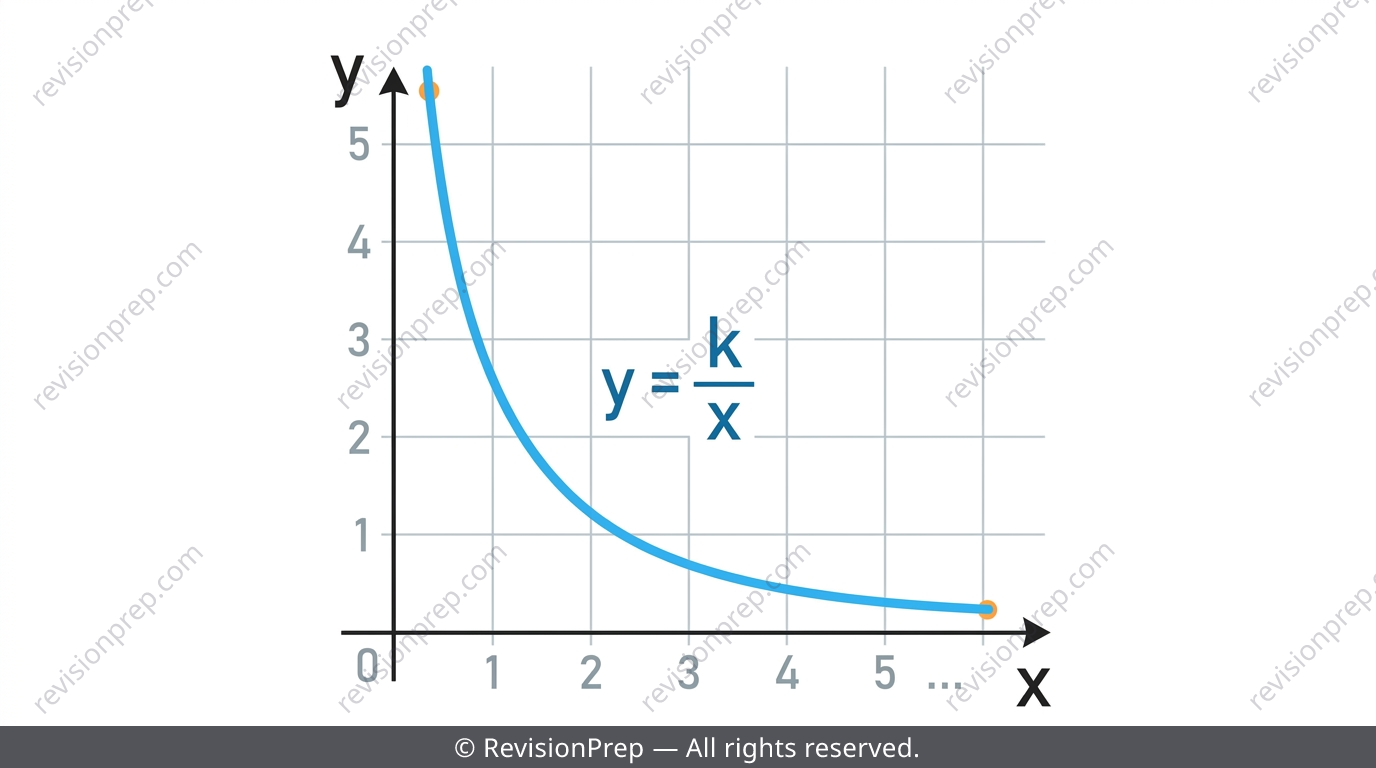
Two quantities are inversely proportional if their product stays constant — as one goes up, the other goes down proportionally. Test it by checking that gives the same value for every pair in the table. Classic examples are worker-days problems: more workers means fewer days needed to finish the same job, which signals inverse, not direct, proportion.
Exam tip
Before choosing a formula, ask: does more of one quantity mean MORE or LESS of the other? Less means inverse, not direct — check this first.
Common mistake
Reaching for the direct formula d = kw out of habit in worker-days problems, when the situation is actually inverse (d = k/w).
Mini summary
Inverse proportion = constant product, decreasing curve (hyperbola), never touches the axes.
Simple vs Compound Interest
Simple interest applies the rate to the original principal every single time, so growth is a straight line. Compound interest applies the rate to the new, grown amount each period, so growth accelerates because you earn 'interest on interest'. The gap between the two is tiny after one year but grows enormous over 10–20 years, which is why almost all real bank accounts and investments use compound interest.
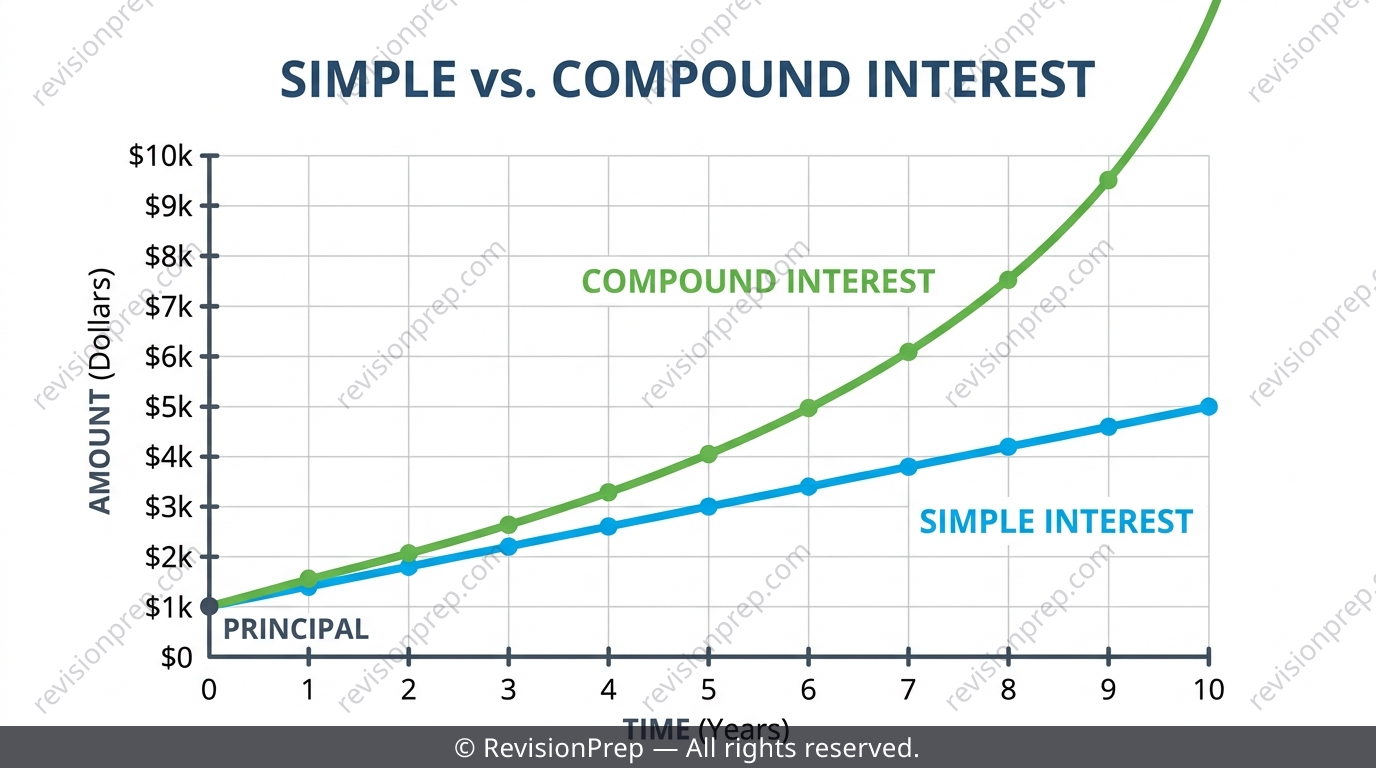
| Feature | Simple | Compound |
|---|---|---|
| Base for interest | Original principal only | Principal + previous interest |
| Growth pattern | Straight line | Accelerating curve |
| Formula | I = Prt/100 | A = P(1+r/100)^n |
Exam tip
If a question asks for 'interest earned', not 'total amount', subtract P from A: interest = A − P.
Common mistake
Calculating A = P(1+r/100)^n correctly, then reporting this total amount as the interest earned instead of subtracting P.
Mini summary
Simple interest = flat rate on principal; compound interest = rate on the growing total — always check what the question is really asking for.
Percentage Increase & Decrease: The Multiplier Method
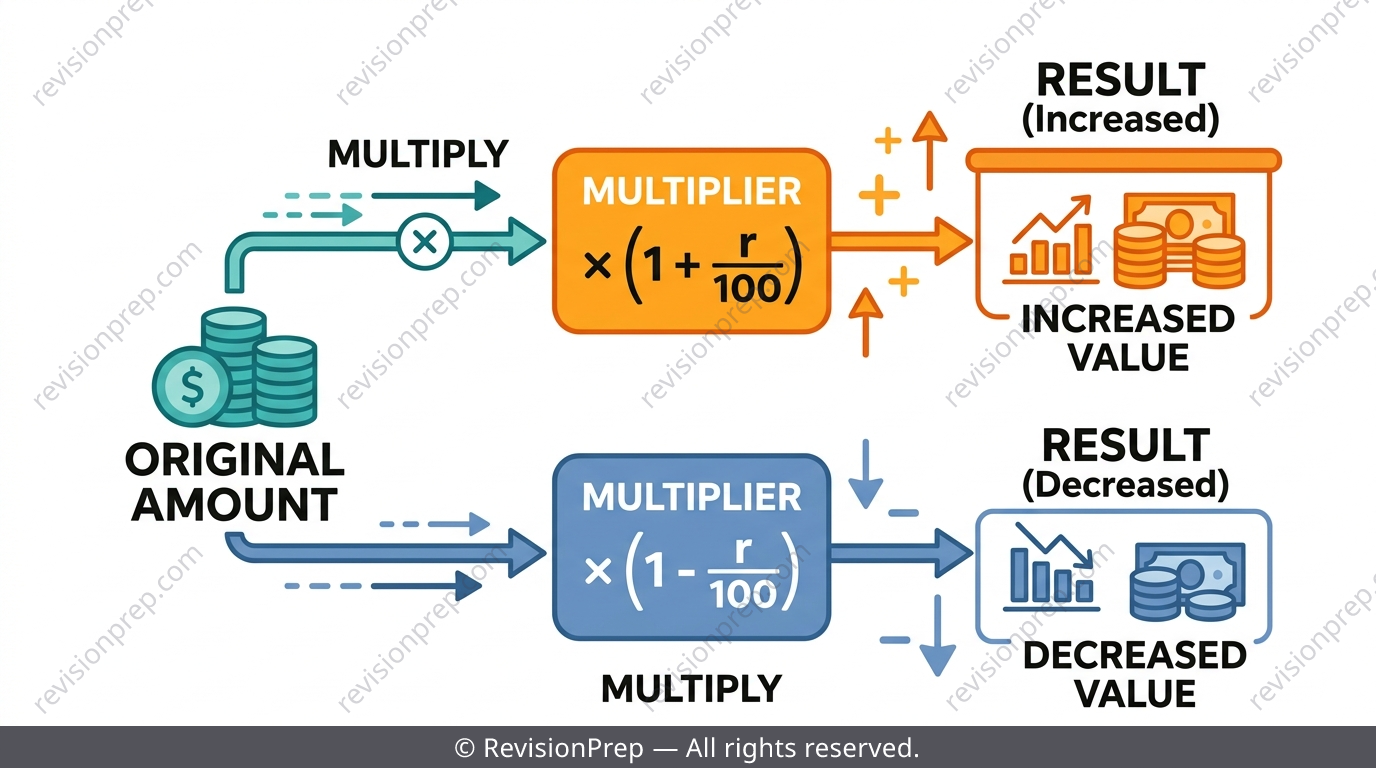
To increase an amount by , multiply by ; to decrease by , multiply by . This single-step method is faster and less error-prone than finding the percentage first and then adding or subtracting it. To find the percentage change itself given before and after values, use .
Exam tip
Use the multiplier method wherever possible — it avoids the sign and rounding errors that creep into the two-step add/subtract approach.
Common mistake
Treating successive percentage changes as if they cancel out (e.g. assuming a 10% increase followed by a 10% decrease returns the original value) — they don't, because each percentage applies to a different base.
Mini summary
Multiply by (1 ± r/100) for fast, accurate percentage change — and remember successive percentage changes never simply cancel.
Spotting the Proportionality Trap
MYP examiners love hiding a fixed fee, base charge or bulk discount inside a question that looks proportional. A currency conversion formula like looks proportional, but if a fixed transaction fee is deducted first, the graph no longer passes through the origin — so it's linear, not proportional. Always test at least two data pairs before trusting a model, and back up any 'explain' or 'justify' answer with actual numbers, not just a verdict.
Exam tip
For 'justify' questions, always show the numeric comparison (e.g. 20 vs 15) explicitly — a bare 'no, it's not consistent' with no numbers typically scores zero.
Common mistake
Ticking 'direct proportion' just because a formula looks like y = kx, without checking whether a fixed fee has shifted the graph away from the origin.
Mini summary
A relationship can look linear yet fail to be proportional — a fixed fee or bulk discount is the classic giveaway, and every claim needs numbers to back it up.
Quick formula sheet
Practice questions
- A recipe for 4 servings needs 250 g of flour, directly proportional to servings. Find k, including units.
- $2000 is invested for 2 years at 4% simple interest per year. Calculate the interest earned.
- Increase $80 by 15% using the multiplier method.
- Hours worked: 1, 2, 3, 4. Pay ($): 8, 16, 24, 32. State the constant multiplier k and calculate pay for 7 hours.
- A job takes 6 workers 4 days. Find the total worker-days, then calculate how many days 5 workers would take.
- $2000 is invested for 3 years at 5% compound interest per year. Calculate the total interest earned.
- A bank converts EUR to USD using y = 1.08x, but deducts a fixed EUR 3 fee before conversion. Explain whether euros converted and USD received are still directly proportional.
- Weight (kg): 2, 4, 6; Cost ($): 6, 12, 18. A customer claims 5 kg will cost $16 — justify whether this is correct using the constant ratio.
- A price rises by 20% then falls by 20%. Explain, with numbers, why the final price is not equal to the original.
Frequently asked questions
What's the easiest way to tell direct proportion from inverse proportion?+
Check whether increasing one quantity increases the other (direct) or decreases it (inverse). Numerically, divide each pair (y÷x constant = direct) or multiply each pair (xy constant = inverse).
Why doesn't a straight-line graph always mean direct proportion?+
Direct proportion requires the line to pass through the origin (0,0). A fixed fee or base charge shifts the y-intercept away from zero, making the relationship linear but not proportional.
What's the real difference between simple and compound interest?+
Simple interest is calculated only on the original principal every period, giving straight-line growth. Compound interest is calculated on the principal plus all previously added interest, so growth accelerates over time.
Do I need to include units when stating the constant of proportionality k?+
Yes — MYP mark schemes often require k with context, like 'g/serving' or 'km/min', not just a bare number.
Why don't a 10% increase and a 10% decrease cancel each other out?+
Because each percentage change applies to a different base value — the decrease is calculated on the already-increased amount, not the original, so the final value ends up lower than the start.
How is this topic actually assessed in MYP 3?+
It appears throughout the Number strand — in unit tests, on-screen eAssessment tasks, and real-life investigations under Criterion A (Knowing & Understanding) and Criterion D (Applying Mathematics in Real-Life Contexts).
Get the Full MYP 3 Ratio, Proportion & Percentages Notes
Related articles