
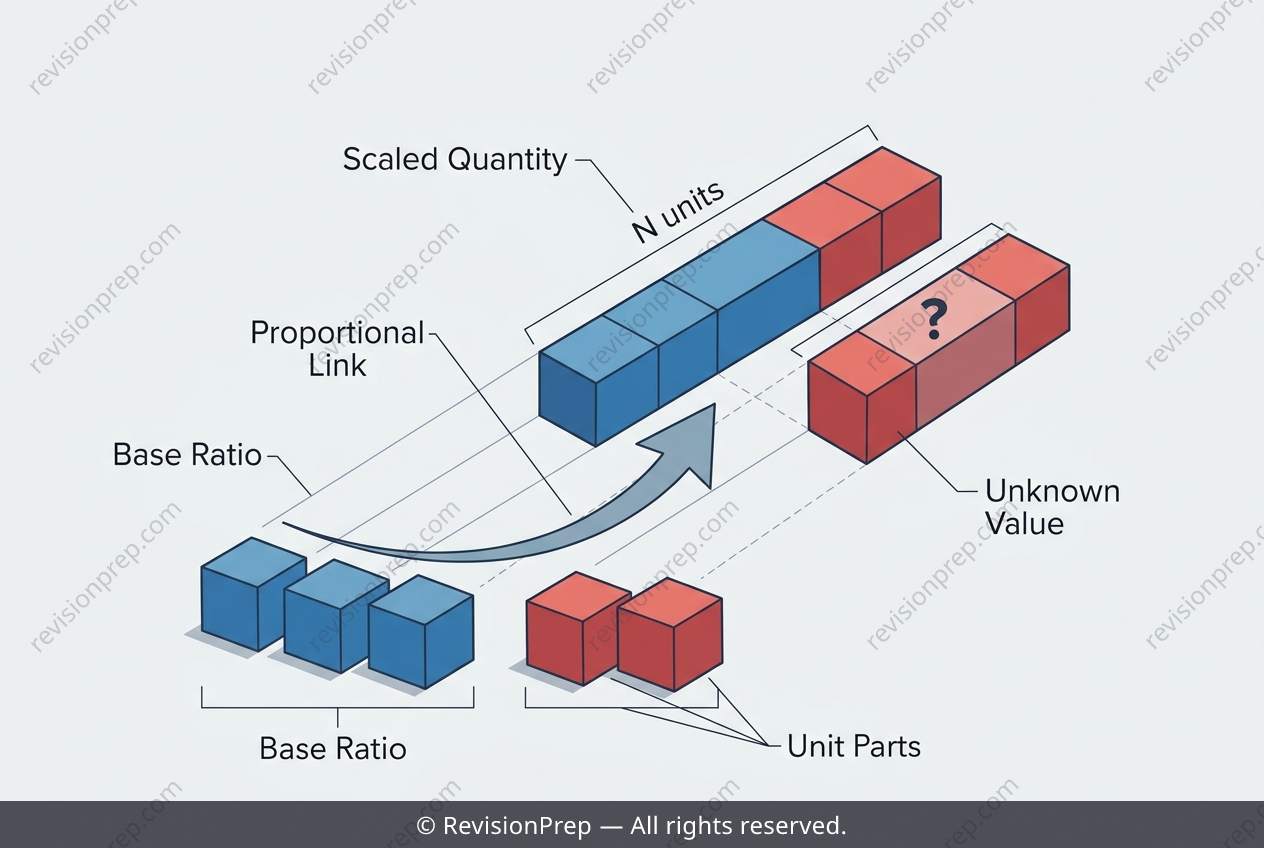
Maths: Two Methods, One Constant Ratio
Proportional reasoning is the quiet engine behind countless mathematical relationships, and ratio equivalence is its most direct expression. When two quantities are linked by a fixed multiplier, such as the sides of a rectangle maintaining a 3:2 ratio, you are not just comparing numbers—you are describing an invariant structure that scales up or down without losing its shape. This idea shows up everywhere, from map scales to recipe adjustments, making it a foundational skill for solving real-world problems efficiently. At the heart of this concept lies the equivalence of fractions: if one side is known, the unknown side can be found by setting up a proportion like 3/2 = 6/x, where the cross-products reveal the missing value. Alternatively, you can think in terms of a scale factor—if the longer side equals 3k, then solving 3k = 6 gives the multiplier k, which you then apply to the shorter side (2k). Both methods rely on the same principle: the ratio between parts remains constant, so any change in one dimension forces a proportional change in the other. Understanding this connection turns a simple geometry question into a flexible tool for interpreting any situation where relationships stay balanced.
Start practising IB questions today
150,000+ IB-styled questions, criteria-mapped and instantly accessible.