
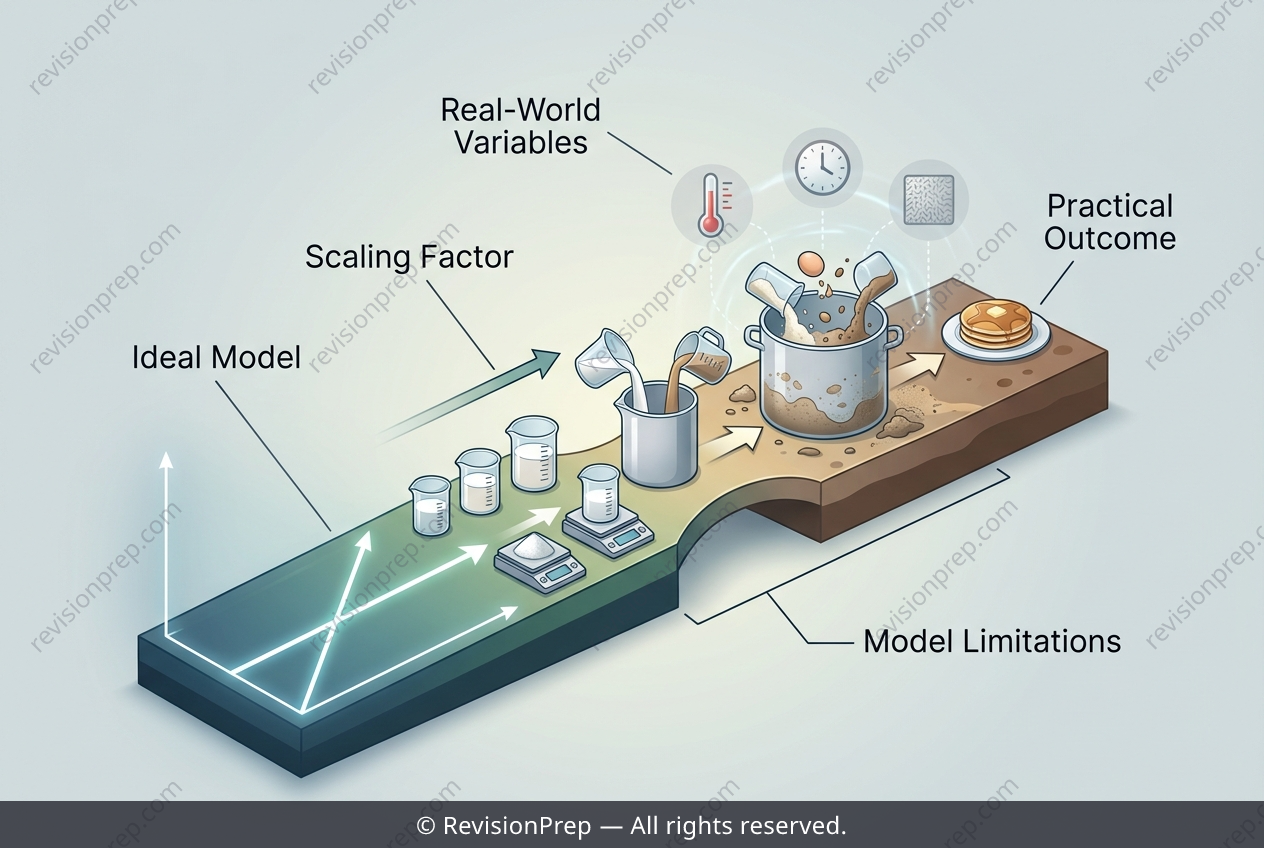
Maths: When a Ratio Meets Real Ingredients
Ratios are one of the most direct ways mathematics describes the world: they compare two quantities in a fixed relationship, letting us scale a recipe, mix a solution, or read a map. At its heart, proportional reasoning asks whether two ratios are equivalent — meaning that when you multiply or divide both parts by the same number, the relationship stays intact. In this pancake example, the flour-to-milk ratio is expressed as a pair of whole numbers, and simplifying it involves finding the greatest common factor (GCF) to reduce the terms to their smallest integer form. That simplified ratio becomes the engine for scaling: if you know the original serves 10 people, you can find a scaling factor by dividing the new number of servings by the original, then multiply both parts of the ratio by that factor to get the new quantities. But a ratio is a mathematical model — a clean abstraction that assumes perfect measurement and uniform behaviour. Real ingredients don’t always obey neat numbers. Flour compacts, cups vary, and heat behaves differently in larger batches. Understanding when a model works, and where it breaks down, is part of true proportional reasoning. The simplified ratio gives a reliable starting point, but the model’s accuracy depends on factors outside the numbers themselves, such as measurement variability and physical changes during cooking. Recognising these limits turns a simple calculation into a thoughtful application of mathematics.
Start practising IB questions today
150,000+ IB-styled questions, criteria-mapped and instantly accessible.