
Maths: When Scaling Up Breaks the Ratio
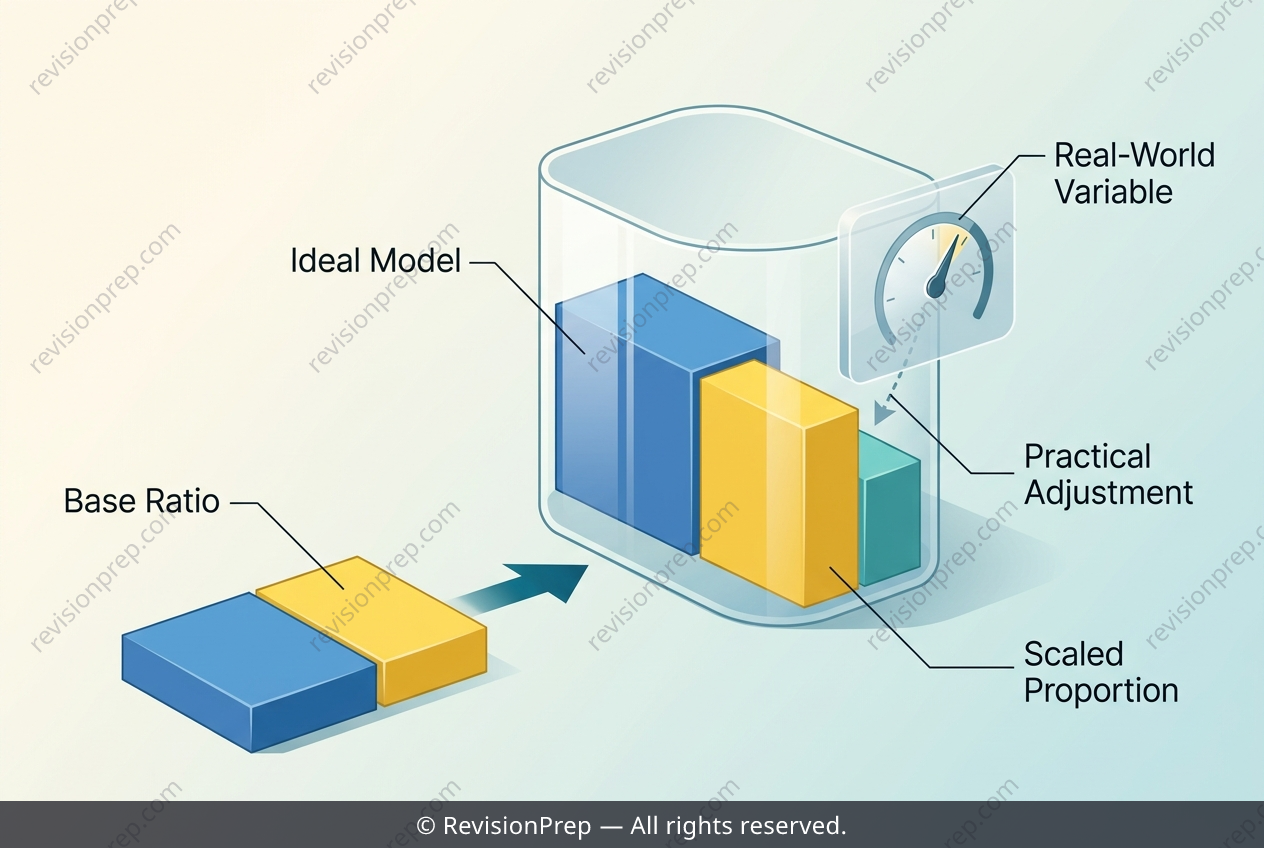
Proportional reasoning is the mathematical engine behind scaling—taking a simple relationship, like a 3:2 mix of water to lemon juice, and projecting it across any number of servings. At its core, it asks: if one part changes, how do all other parts change to keep the whole consistent? This idea appears everywhere, from recipes to maps to currency conversion, making it a foundational skill in both IB Mathematics and everyday decision-making. The power of a ratio lies in its multiplicative structure: to scale from one serving to many, you multiply each component by the same factor. But here’s the subtlety—proportionality assumes the world behaves linearly. In practice, large quantities introduce variables that a fixed ratio ignores. Evaporation during bulk mixing, for instance, removes water but not lemon juice, silently shifting the concentration. Taste perception also changes with volume, and uneven stirring can create pockets of imbalance. So while the math is clean—each part scales identically—the real-world context demands you question whether the relationship itself remains valid at a new scale. That tension between elegant arithmetic and messy reality is exactly what makes proportional reasoning both useful and limited.
Start practising IB questions today
150,000+ IB-styled questions, criteria-mapped and instantly accessible.