
Maths: Why a Perfect Model Still Gets It Wrong
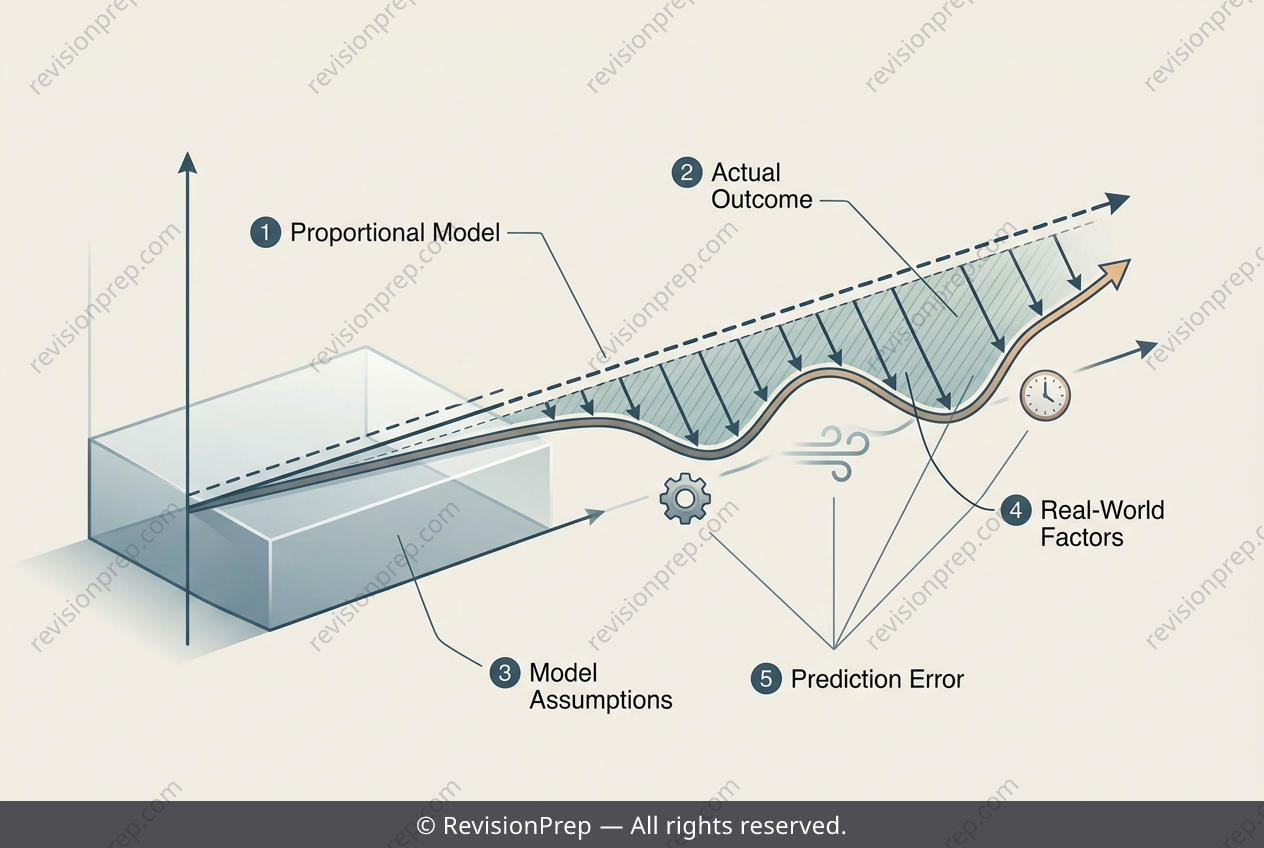
Proportionality is one of the cleanest ideas in mathematics: when two quantities scale together at a fixed rate, you can predict one from the other using a simple multiplier. In this case, a car’s fuel consumption is modelled as directly proportional to distance travelled, with a constant rate of 8 litres per 100 km. That means for any distance, predicted fuel = (8/100) × distance. This linear relationship is powerful because it lets you extend a known rate to any trip length instantly. But the real world rarely obeys such tidy rules. The core concept here is the validity and limitations of mathematical models: a proportional model assumes that the rate stays constant under all conditions. That assumption breaks down when the trip mixes highway and city driving. City driving involves stops, idling, and acceleration, which burn more fuel per kilometre than steady highway cruising. So while the model gives a neat prediction, the actual consumption deviates—sometimes higher, sometimes lower—depending on context. Understanding why a model fails is just as important as using it. It teaches you to ask: what hidden assumptions am I making, and when do they stop holding?
Start practising IB questions today
150,000+ IB-styled questions, criteria-mapped and instantly accessible.