
Maths: Why Rounding Breaks a Perfect Ratio
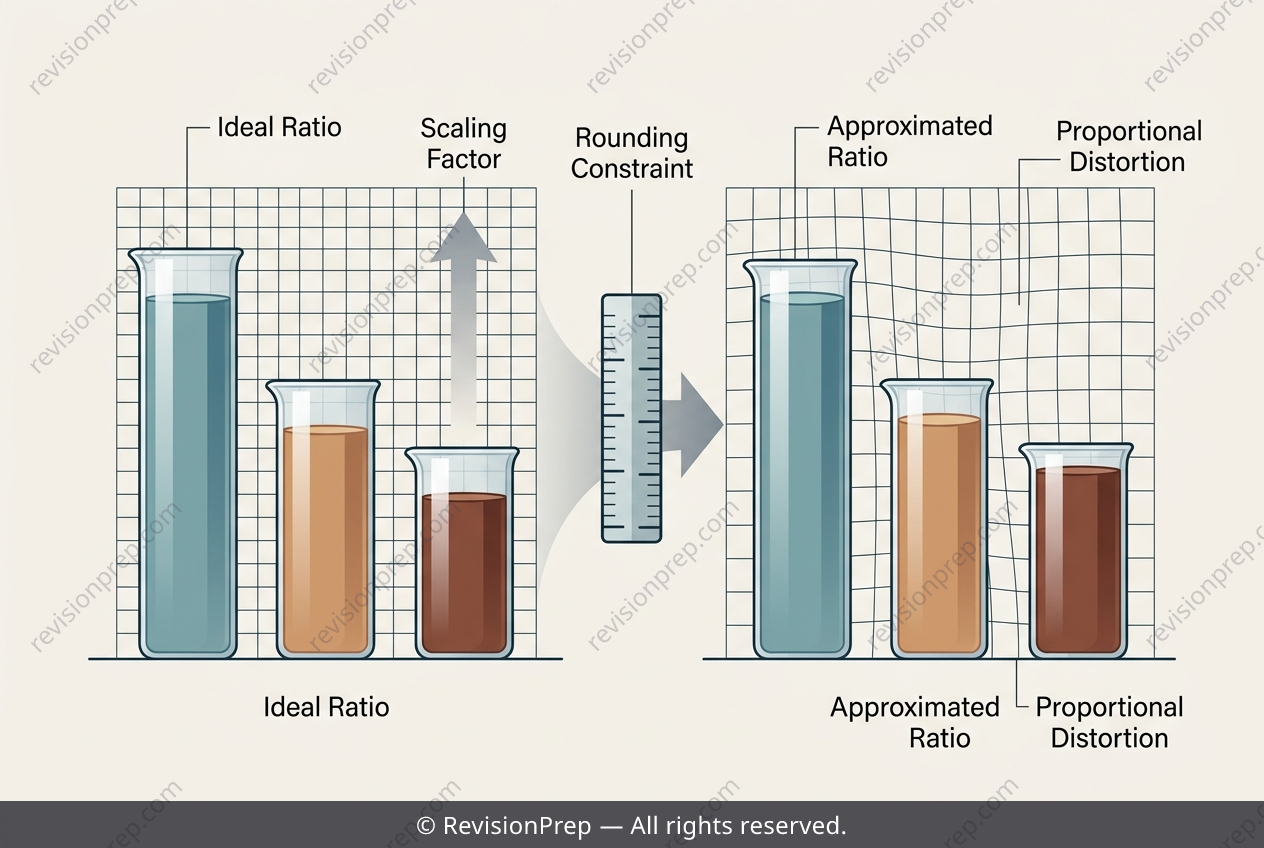
Ratio problems are everywhere—from adjusting recipes to scaling up production—and they hinge on one central idea: preserving the proportional relationship between quantities while changing their total size. In this case, a bakery’s cookie recipe uses flour, sugar, and butter in the mass ratio 5:3:2, and the challenge is to scale that mix from 20 cookies to 75. The core concept here is precision versus approximation: when you multiply each ingredient by a scaling factor (here, 75 ÷ 20 = 3.75), you often get awkward numbers like 937.5 g or 562.5 g, which then must be rounded to the nearest 5 g because that’s the limit of the measuring equipment. This rounding step is where the real mathematical tension appears. The original ratio is exact, but once you round each mass individually, the new ratio—say 940:560:375—no longer matches 5:3:2 perfectly. Dividing by 5 gives 188:112:75, while the ideal scaled ratio would be 187.5:112.5:75. So one ingredient becomes slightly over-represented, another slightly under-represented. Understanding this mechanism matters because it shows how real-world constraints (measurement limits) interact with pure mathematical scaling, and why the model’s assumption of perfect proportionality breaks down at the edges—even if the practical impact on taste is negligible.
Start practising IB questions today
150,000+ IB-styled questions, criteria-mapped and instantly accessible.