
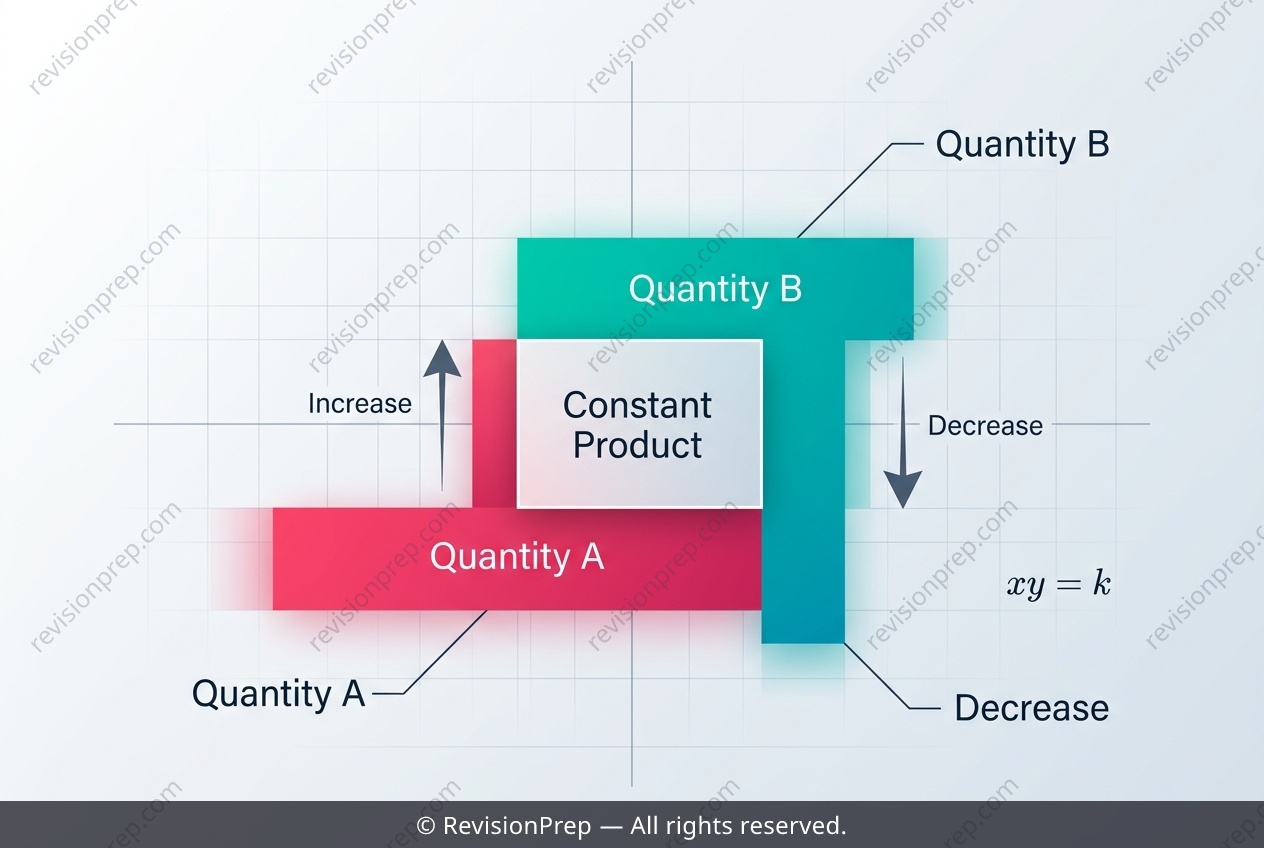
Maths: xy = k — The Logic of Inverse Proportion
Inverse proportionality describes a relationship where one quantity increases exactly as another decreases, and vice versa—so long as everything else stays fixed. If two variables are inversely proportional, their product remains constant, which is often written as xy = k, where k is that fixed value. This is distinct from direct proportion, where both quantities rise or fall together. This concept is everywhere in real-world decision-making. Consider the relationship between the number of workers on a project and the time required to finish it, assuming the total workload is unchanged. Double the workforce, and the job takes half as long; halve the workforce, and the time doubles. Understanding this inverse link is not just a mathematical curiosity—it is a practical planning tool. A manager can use it to calculate how many people are needed to hit a deadline, or to estimate how long a task will take with the staff available. The same logic applies to speed and travel time over a fixed distance, or the number of taps filling a tank of fixed volume. Recognising the constant product allows you to predict one quantity when the other changes, turning a simple formula into a powerful guide for resource allocation and scheduling.
Start practising IB questions today
150,000+ IB-styled questions, criteria-mapped and instantly accessible.