
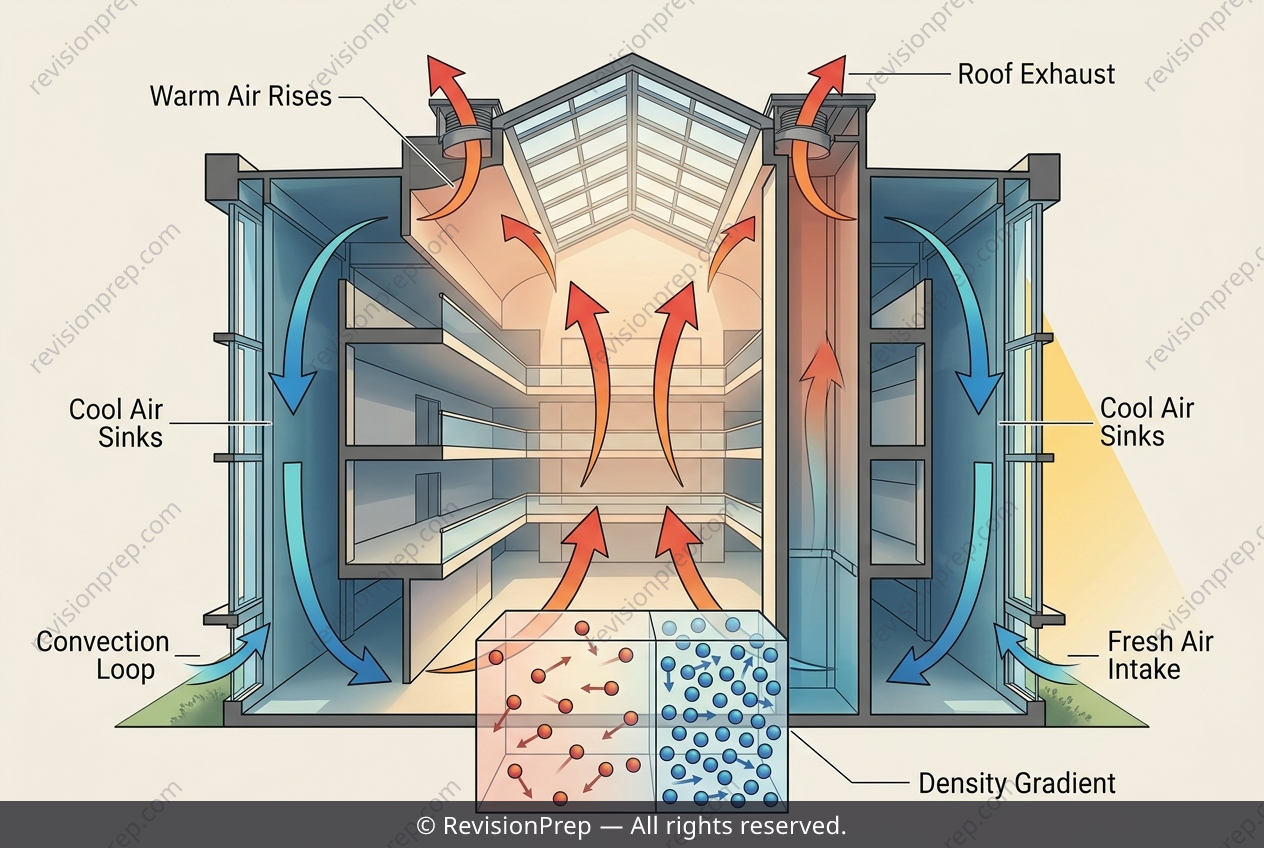
Physics: Convection — Nature's Own HVAC System
When you heat a room, the air near the ceiling feels warmer than the air at your feet—that’s natural convection in action. This core concept explains how fluids (liquids and gases) transfer heat through density differences: warm air expands, becomes less dense, and rises, while cooler, denser air sinks to replace it. In a building designed with an open atrium, this simple physical principle becomes a powerful, passive climate-control system. Warm air generated by sunlight or internal heat rises up through the atrium and escapes through roof vents, drawing cooler, fresher air in through low-level openings. This continuous, self-sustaining circulation removes excess warmth and redistributes heat without a single fan or compressor. Why does this matter? Because passive thermal regulation replaces energy-hungry mechanical systems. A conventional HVAC unit uses electrically powered fans, compressors, and heaters to force air movement and temperature change, consuming significant electricity. In contrast, a convection-driven building relies solely on temperature gradients—no external energy input is needed for the air to move. The result is a dramatic drop in operational energy use, which translates directly into lower fossil fuel consumption and reduced greenhouse gas emissions. The relationship is straightforward: the greater the temperature difference between the warm rising air and the cool incoming air, the stronger the natural driving force, and the less mechanical backup is required. Over a building’s lifetime, this passive mechanism not only cuts costs but also shrinks its environmental footprint.
Start practising IB questions today
150,000+ IB-styled questions, criteria-mapped and instantly accessible.