
Physics: The Weak Point in Every Thermos Flask
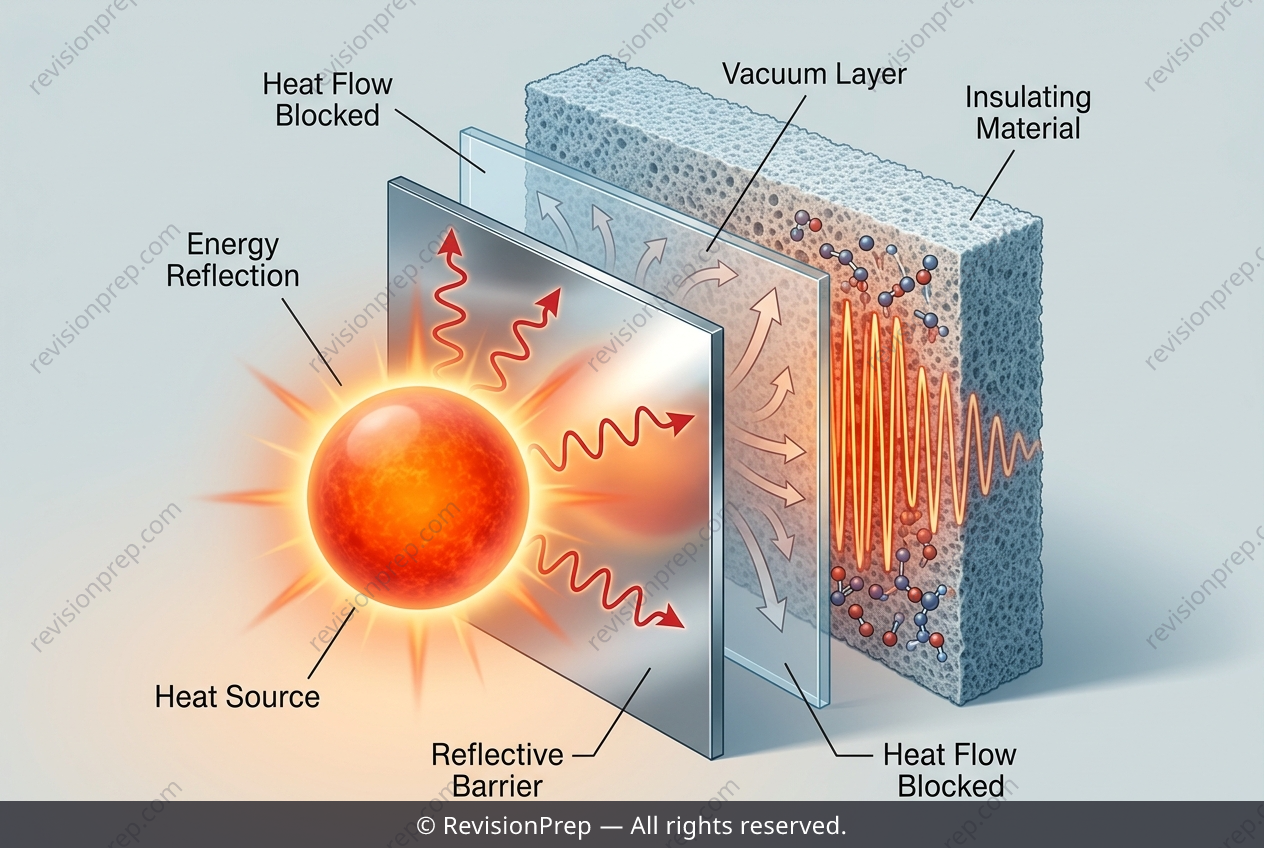
Heat transfer is the movement of thermal energy from hotter to cooler regions, and it occurs through three distinct mechanisms: conduction, convection, and radiation. In conduction, energy travels through direct particle collisions within a solid or stationary fluid; convection relies on the bulk movement of heated fluid particles carrying energy away; and radiation transfers heat via electromagnetic waves—specifically infrared—which can travel through a vacuum. Understanding these pathways is essential because real-world insulation, from a thermos flask to a building’s walls, works by systematically blocking each one. The thermos flask is a perfect case study in thermal insulation principles. Its double glass walls create a vacuum, which removes virtually all air particles—this simultaneously eliminates conduction (no particles to collide) and convection (no fluid to circulate). Meanwhile, the shiny reflective coating on the inner surfaces acts as a mirror for infrared radiation, bouncing radiant heat back toward the hot soup instead of letting it escape. However, no insulator is perfect: the solid stopper or lid provides a direct conduction path from the hot interior to the cooler exterior, and even the narrow glass neck connecting the walls allows slow heat leakage. Together, these mechanisms explain why the flask keeps soup hot for hours—but not indefinitely, as each design choice has a trade-off between effectiveness and practicality.
Start practising IB questions today
150,000+ IB-styled questions, criteria-mapped and instantly accessible.