
Chemistry: Henry’s Law, Pressure and Gas Solubility
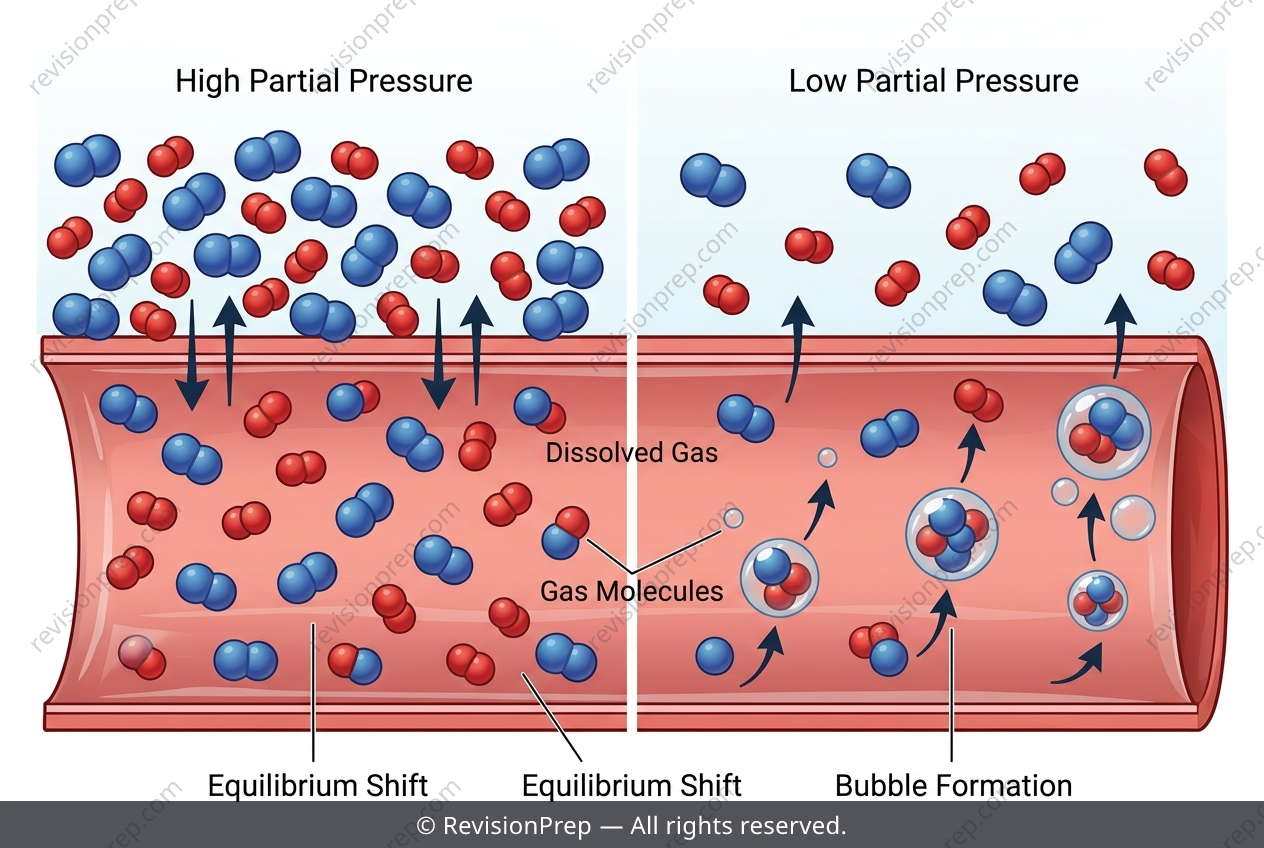
Henry's Law describes how the solubility of a gas in a liquid is directly proportional to the partial pressure of that gas above the liquid. For a gas mixture, the partial pressure of each component is found from its mole fraction multiplied by the total pressure, so P(gas) = mole fraction × total pressure. This relationship explains why the amount of gas that dissolves changes whenever the pressure above a liquid changes. This matters in situations where pressure varies dramatically, such as deep-sea diving. As a diver descends, total pressure rises, so the partial pressures of nitrogen and oxygen increase, and more gas dissolves in the blood. If the diver ascends too rapidly, external pressure falls quickly, solubility drops, and the blood becomes supersaturated. The excess gas cannot leave through the lungs fast enough, so bubbles form in tissues and bloodstream, causing decompression sickness. Henry's Law therefore connects pressure, solubility, and the practical consequences of changing depth.
Start practising IB questions today
150,000+ IB-styled questions, criteria-mapped and instantly accessible.