
Chemistry: How Intermolecular Forces Set Boiling Points
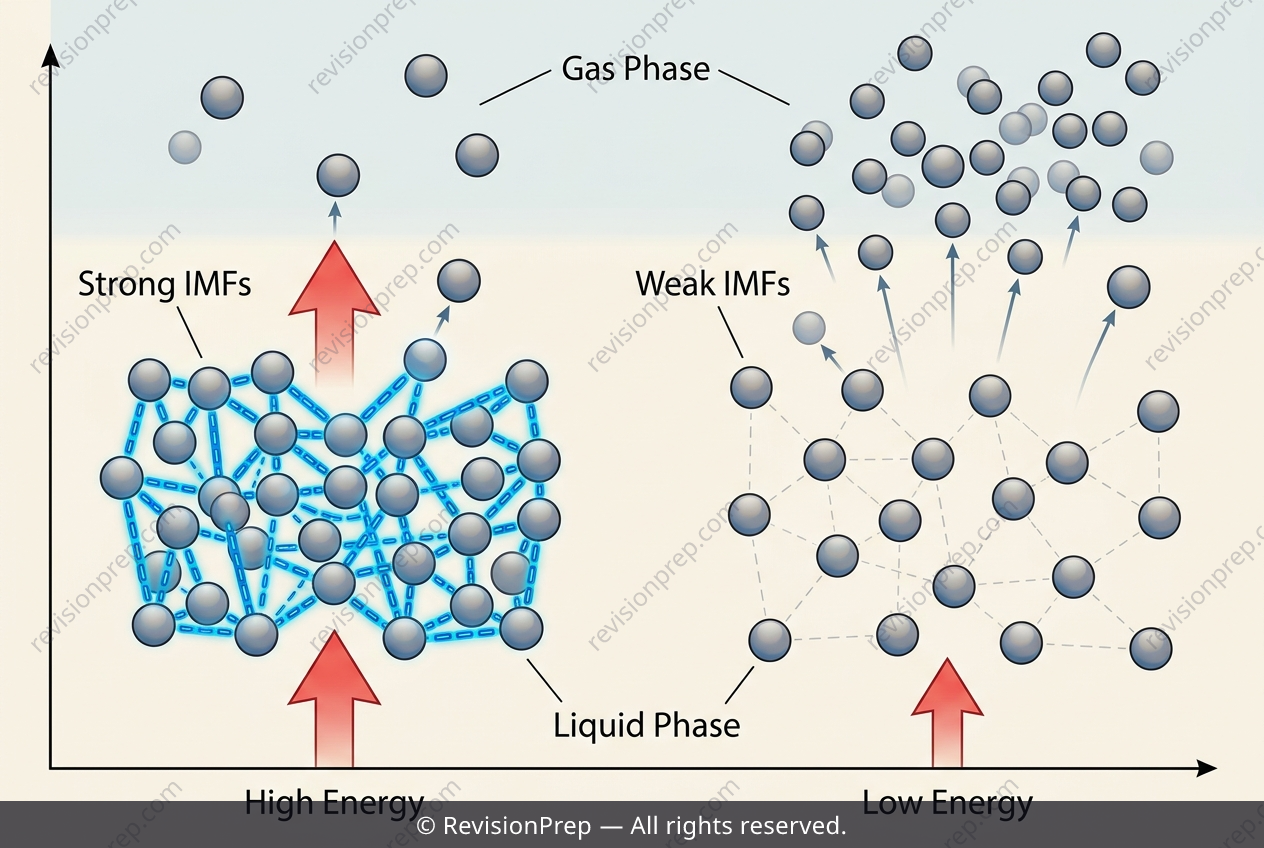
Why does water boil at 100°C while methane boils at −161°C, despite both being small molecules? The answer lies in intermolecular forces — the attractions between molecules, not the covalent bonds within them. Water molecules form hydrogen bonds, since oxygen's high electronegativity leaves it partially negative and each hydrogen partially positive. Methane, with its near-symmetric, non-polar structure, relies only on much weaker London dispersion forces. This distinction matters because boiling is simply the point at which molecules gain enough energy to overcome these attractions and escape as gas. Stronger forces demand more energy, so boiling point rises. At 25°C, methane's weak London forces are already largely overcome, letting many molecules escape, while water's hydrogen bonds keep most molecules liquid. Comparing the two reveals a clear relationship: intermolecular force strength directly governs boiling point.
Start practising IB questions today
150,000+ IB-styled questions, criteria-mapped and instantly accessible.