
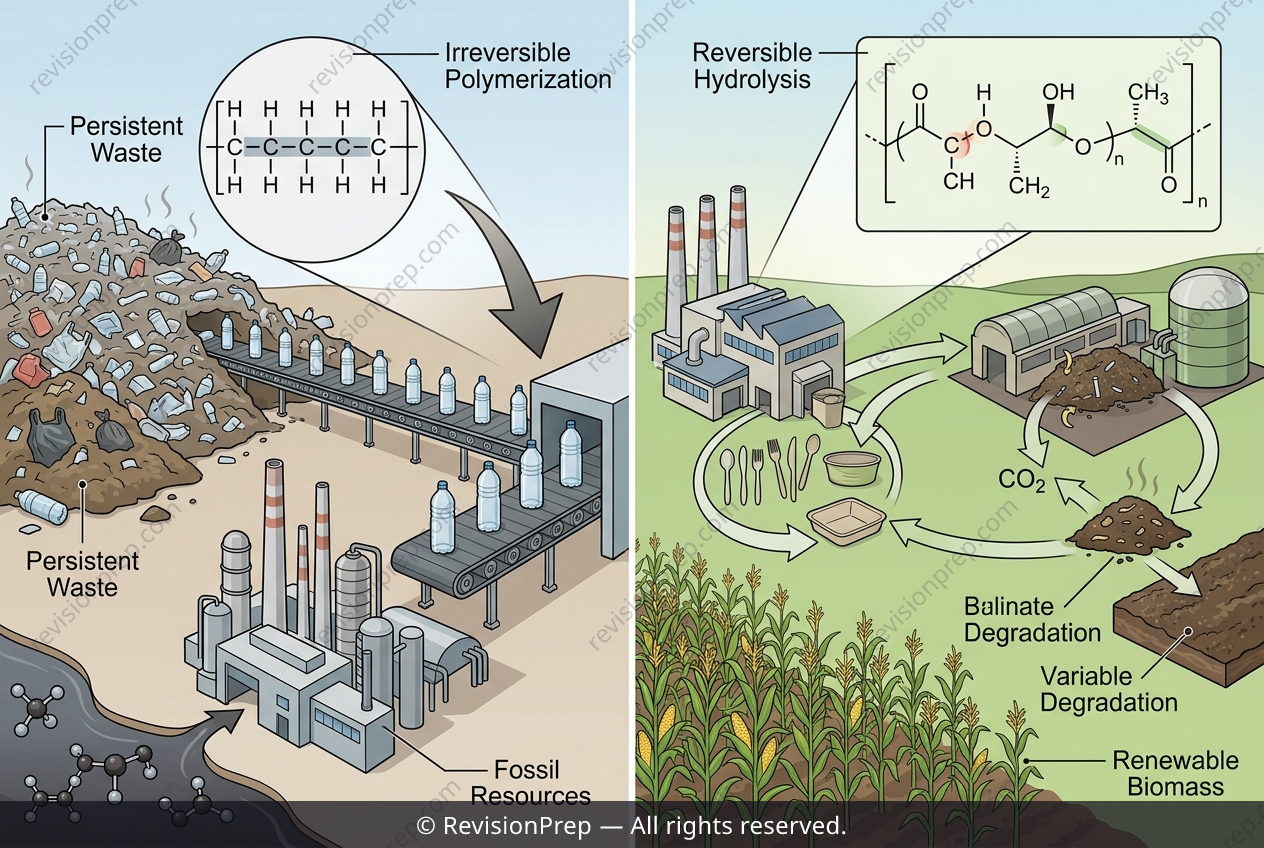
Chemistry: Why Plastics Differ in Degradability
Why do some plastics linger in the environment for centuries while others break down in weeks? The answer lies in the bonds holding their polymer chains together. Irreversible polymerisation links monomers through strong covalent bonds that cannot be broken under normal environmental conditions, so conventional plastics accumulate in landfills almost indefinitely. Reversible hydrolysis, by contrast, cleaves bonds in a bioplastic through reaction with water, assisted by heat and microbial activity, regenerating smaller molecules or monomers — but only under the controlled temperature and moisture of industrial composting. This distinction matters because switching to biodegradable bioplastics is often presented as a simple fix for plastic waste, when the reality is a trade-off. Corn-starch production competes with food crops for agricultural land, water, and fertiliser, while processing consumes energy that may come from fossil fuels. Degradation is also conditional: in home composting or landfill, breakdown is often incomplete, and anaerobic conditions can generate methane. Evaluating such a switch therefore requires a full life cycle assessment, weighing reduced persistence and microplastic pollution against land, water, and energy costs.
Start practising IB questions today
150,000+ IB-styled questions, criteria-mapped and instantly accessible.