
Chemistry: How Water Hydrates Ions in Solution
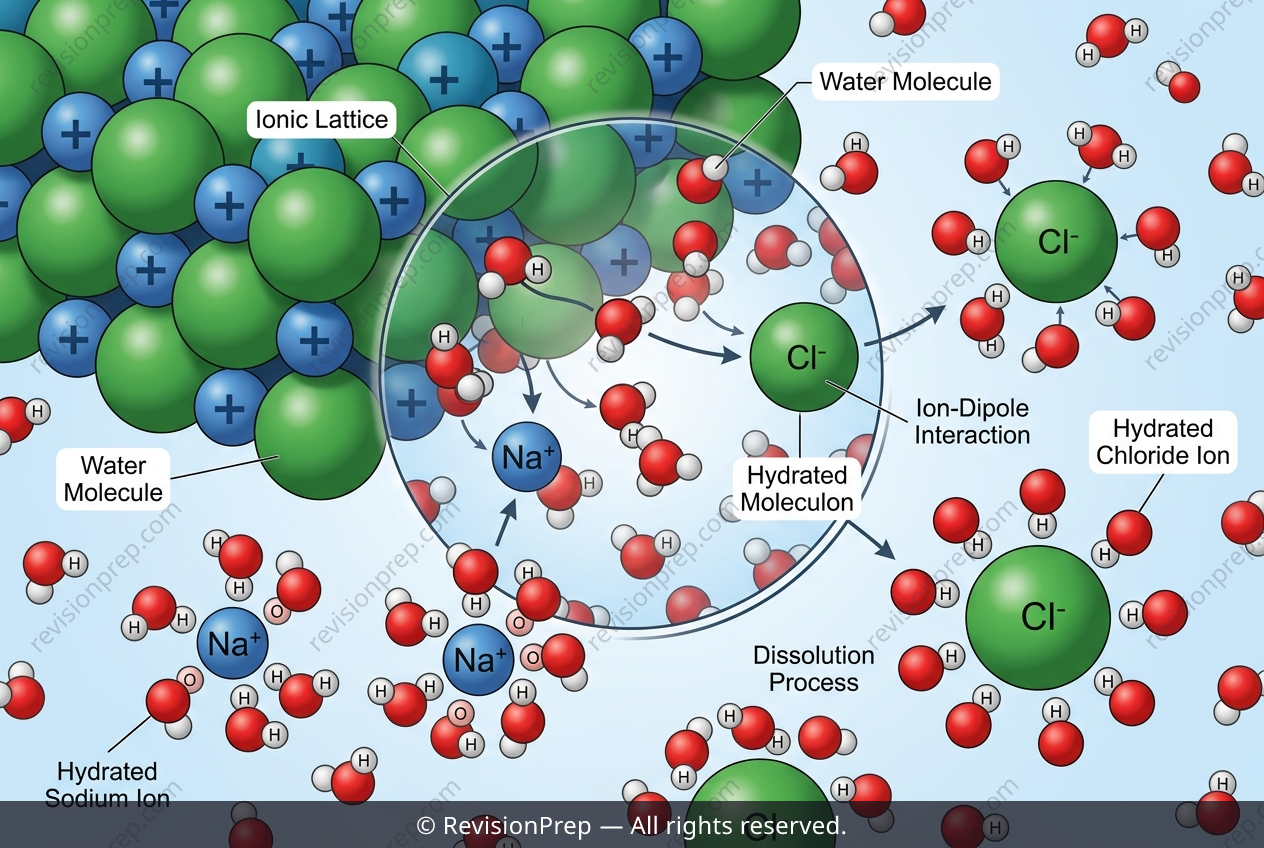
When an ionic crystal such as sodium chloride is placed in water, its orderly lattice breaks apart and the ions disperse throughout the liquid, forming a homogeneous solution. Here, sodium chloride acts as the solute and water as the solvent, and the process can be summarised by the equation NaCl(s) → Na⁺(aq) + Cl⁻(aq), in which the solid lattice separates into freely moving, hydrated ions. This concept matters because it explains why ionic solids dissolve at all, and why the resulting solution conducts electricity. The key lies in water's polarity: the partially negative oxygen atom is attracted to Na⁺ ions, while the partially positive hydrogen atoms are attracted to Cl⁻ ions. Each ion becomes surrounded by a shell of water molecules — a process called hydration. The ion–dipole attractions formed release energy that compensates for the energy needed to break the ionic lattice, so the separated ions stay dispersed rather than re-forming a crystal.
Start practising IB questions today
150,000+ IB-styled questions, criteria-mapped and instantly accessible.