
Maths: Error Bounds & Uncertainty Analysis
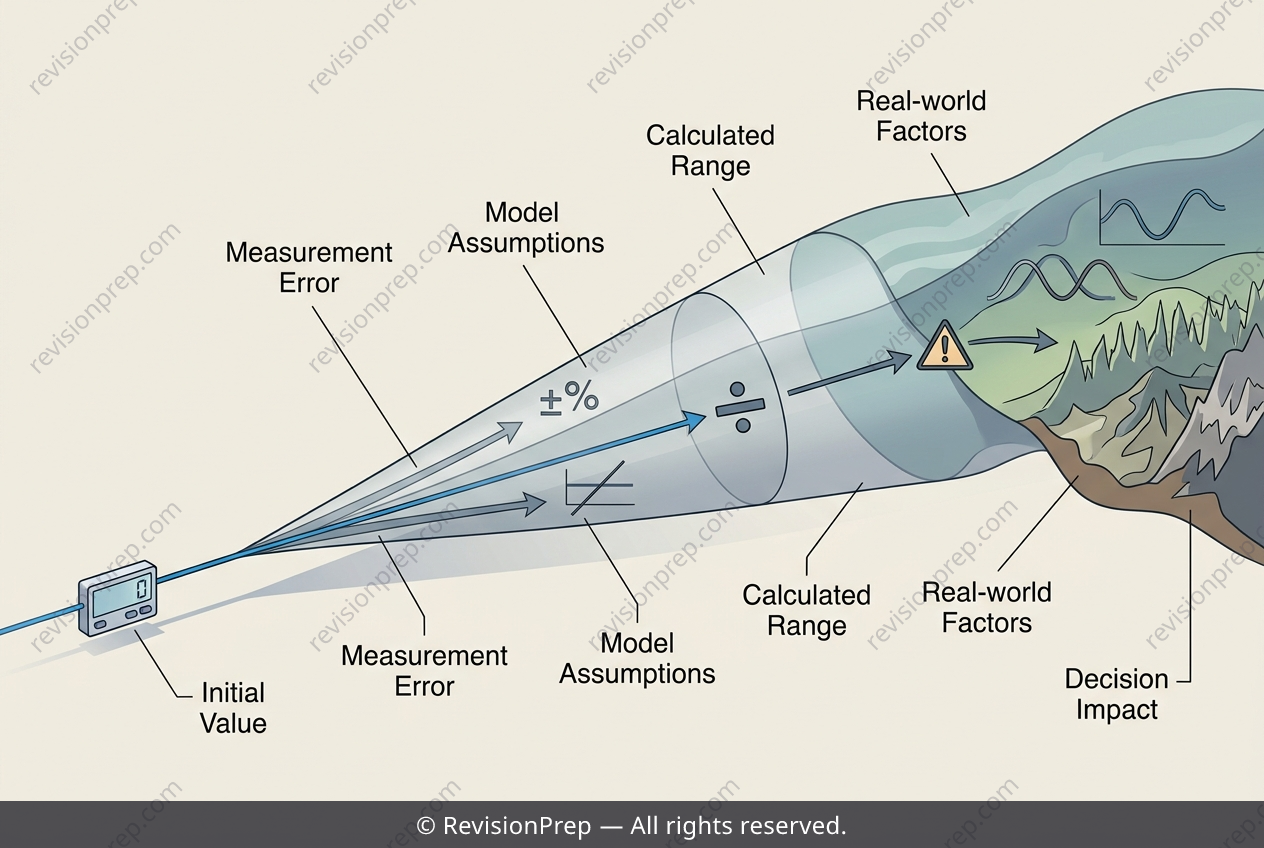
Error bounds and uncertainty analysis explore how small inaccuracies in measurement ripple through calculations to affect final results. When a quantity is measured with a percentage error, the absolute error is found by multiplying that percentage by the measured value, giving a range of possible true values rather than a single figure. This range then propagates into any derived quantity — such as dividing distance by speed to estimate journey time — producing best-case and worst-case outcomes instead of one fixed answer. Understanding this matters because real-world decisions, from navigation to engineering, depend on knowing how reliable an estimate truly is. The key relationship is that error in an input directly widens the spread of possible outputs: a distance range of d ± Δd, combined with a constant speed v, yields times bounded by (d − Δd)/v and (d + Δd)/v. Recognising these limits reveals when a model is precise enough to trust and when additional factors must be considered.
Start practising IB questions today
150,000+ IB-styled questions, criteria-mapped and instantly accessible.