
Chemistry: Particle Size and the Tyndall Effect
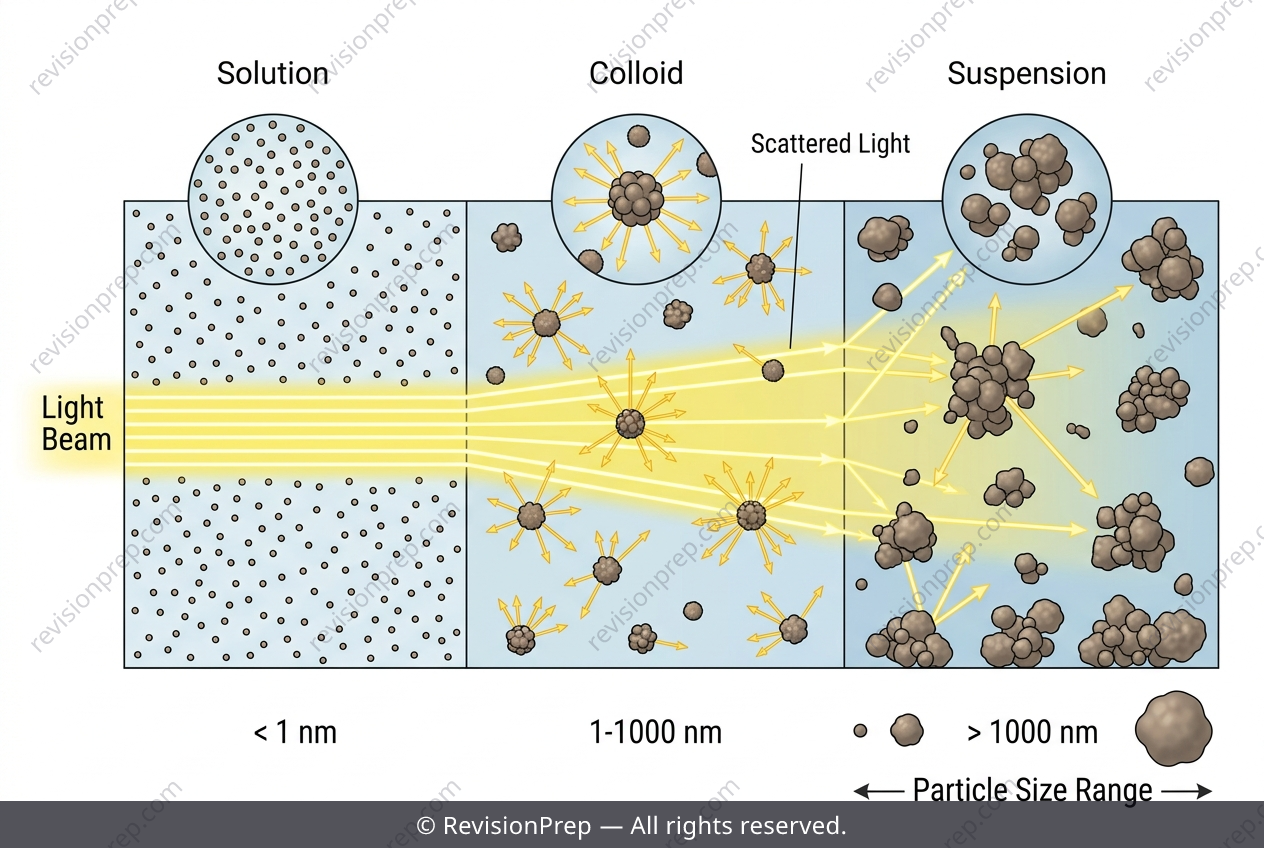
The Tyndall effect is the scattering of a light beam by dispersed particles in a mixture, revealing the beam's path through the sample. Whether this scattering is strong or faint depends on how particle size compares with the wavelength of visible light, roughly 400–700 nm. Particles in the colloidal range, about 1–1000 nm, are close enough in scale to visible wavelengths to scatter light efficiently, while much larger suspension particles scatter poorly and settle out over time. This size relationship explains why milk, fog and muddy water behave so differently. Milk, a colloid, scatters strongly because its particles match visible wavelengths well. Fog is also colloidal, yet its lower droplet concentration means fewer scattering centres per unit path length, so the beam appears weaker. Muddy water, a suspension, has particles too large for efficient scattering. Understanding these distinctions connects particle size, mixture type and light behaviour into one coherent picture.
Start practising IB questions today
150,000+ IB-styled questions, criteria-mapped and instantly accessible.